
Golden lion tamarin
Small, vividly colored New World monkey from Brazil's Atlantic Forest. Diurnal, arboreal, and highly social; threatened by habitat loss but the focus of successful conservation and reintroduction programs.
Overview
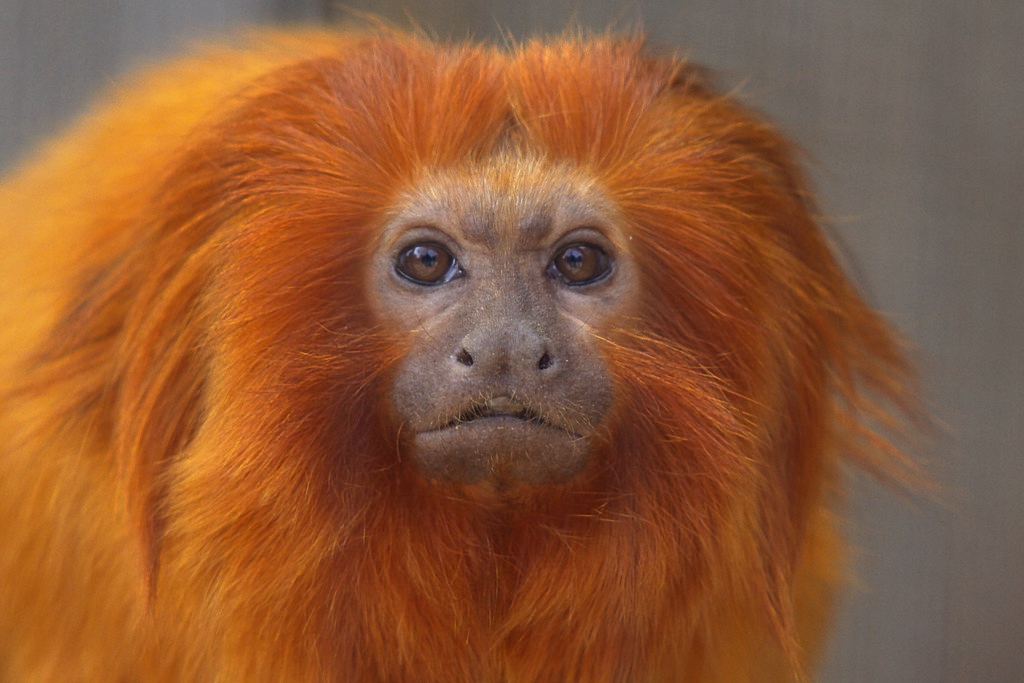
The golden lion tamarin (Leontopithecus rosalia) is a small New World primate notable for its bright golden-orange fur and a mane that frames the face, giving it a lion-like appearance. Roughly the size of a squirrel, these tamarins are active during daylight hours and spend most of their lives in the forest canopy. They are social animals that typically form small family groups centered on a breeding pair and their offspring. In both wild and captive settings individuals commonly live to around 15 years.
Image gallery
7 Images




Physical characteristics and behavior
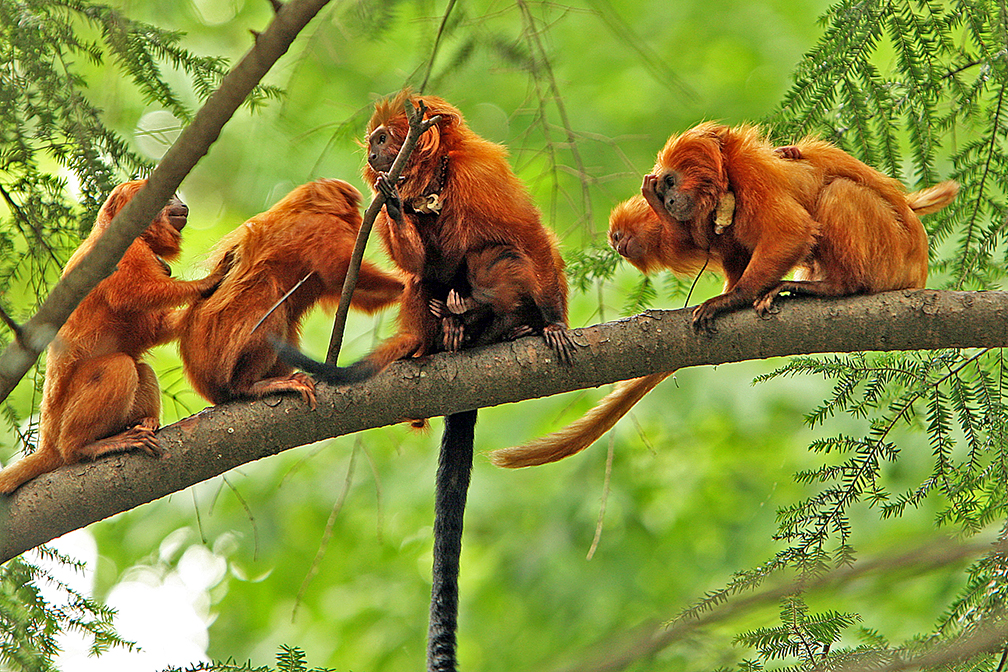
Golden lion tamarins have long hair, slender limbs and a long tail that aids balance when leaping between branches. Their hands have long fingers adapted for grasping and manipulating food and bark, and they move with quick, agile climbing and jumping. Group members communicate with a mix of high-pitched calls, scent marks and visual displays. They sleep at night in tree cavities or dense tangles of vegetation to avoid predators and the elements.
Diet and ecology
These tamarins are omnivores with a varied diet that includes fruits, flowers, nectar, insects and small vertebrates. They often forage by probing bark crevices and leaf litter for insects and other invertebrates, and they may visit fruiting trees to feed and disperse seeds. Their role as seed dispersers and insect predators makes them a functional part of the Atlantic Forest ecosystem in which they live.
Range and habitat
The species is native to coastal Atlantic Forest remnants in eastern Brazil. Historically the Atlantic Forest stretched along much of Brazil's Atlantic coast, but extensive clearing and fragmentation have left only scattered patches suitable for tamarins. The golden lion tamarin depends on complex, multi-layered forest with abundant fruiting trees, tree cavities for sleeping and continuous canopy for safe movement.
Conservation history and current efforts
Loss and fragmentation of habitat have long threatened golden lion tamarins, and they have also suffered from capture for the pet trade in past decades. Conservation responses have combined in-situ measures—such as protecting forest fragments, creating corridors between isolated patches and engaging local communities—with ex-situ measures like captive breeding and carefully planned reintroductions. International zoos, research institutions and Brazilian conservation organizations have cooperated on breeding, monitoring and habitat restoration. These efforts demonstrate that coordinated action can stabilize and increase the number of wild groups, though the species remains vulnerable without continued habitat protection.
Importance, distinctions and further reading
The golden lion tamarin is an emblematic species for Atlantic Forest conservation and is often cited in studies of reintroduction biology, landscape connectivity and community-based protection programs. It belongs to the small genus of lion tamarins, whose species vary in coloration and geographic range within Brazil. For more information on field projects, captive-breeding programs and how habitat corridors are created, see resources from conservation organizations and zoo programs: field conservation summary, captive-breeding and reintroduction notes and habitat restoration case studies.
- Typical lifespan: about 15 years.
- Activity: diurnal and arboreal.
- Main threats: habitat loss, fragmentation and historical capture for pets.
- Conservation focus: protected areas, corridors, captive breeding and community engagement.
Related articles
Author
AlegsaOnline.com Golden lion tamarin Leandro Alegsa
URL: https://en.alegsaonline.com/art/39500