
Eurasian golden oriole (Oriolus oriolus)
A bright yellow migratory songbird of the oriole family that breeds across Europe and western Asia and winters in sub‑Saharan Africa; noted for its flute‑like song and striking male plumage.
The Eurasian golden oriole (Oriolus oriolus) is a conspicuous, medium‑sized passerine notable for the male's vivid yellow plumage and the species' clear, flute‑like song. It belongs to the oriole family and is the only oriole regularly breeding in temperate parts of the Northern Hemisphere. Although often secretive among canopy leaves, the species is frequently detected by voice during the breeding season.
Image gallery
7 Images


Appearance and identification
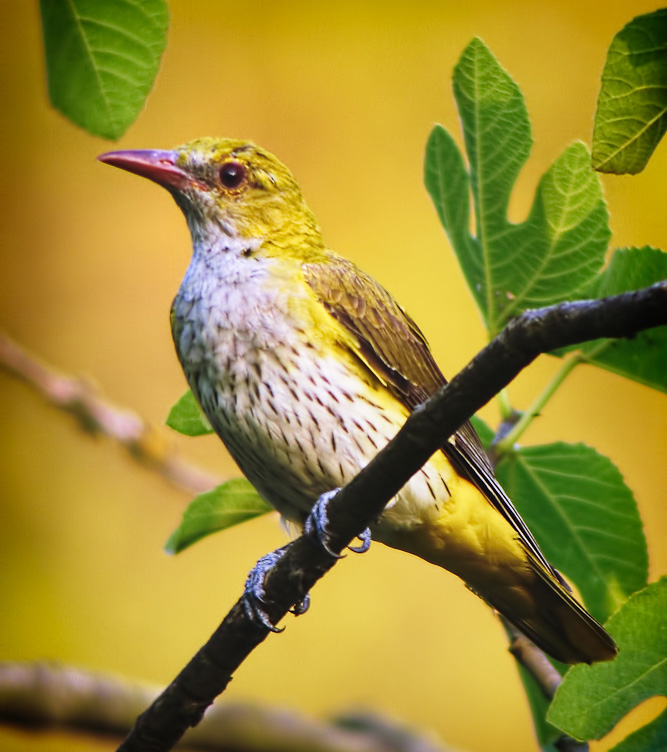
Adult males are bright yellow with contrasting black wings, tail markings and a black eye stripe; females and juvenile birds are generally greener and more streaked, providing camouflage in foliage. Both sexes have a slender body and a pointed bill adapted to an omnivorous diet. Observers rely on a combination of plumage, behaviour and the characteristic song to separate the golden oriole from less similar species.
Vocalisations
The song is a clear, whistling series of notes often described as fluting and melodious. Calls are varied and include sharp contact notes; males sing from high perches, especially during the breeding season, which makes song an important identification clue when the bird itself is hidden.
Distribution, migration and habitat
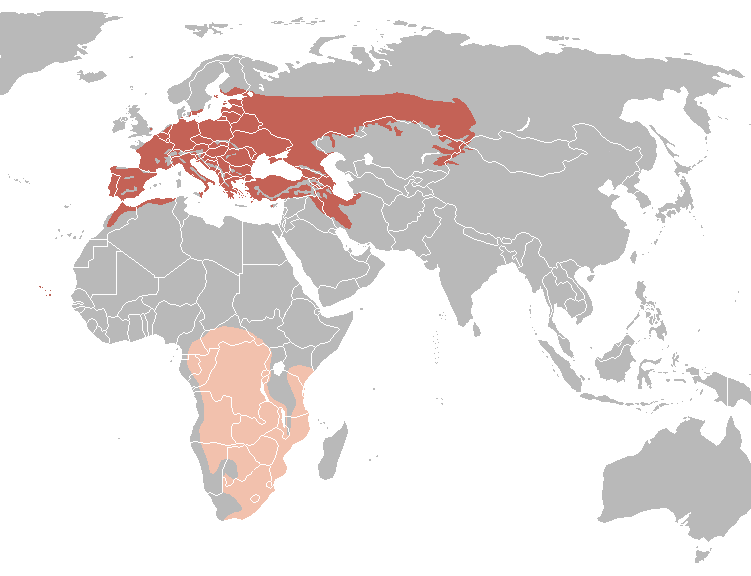
This species is a long‑distance migrant. It is a summer migrant across much of Europe and parts of western Asia, favoring open mature woodland, riparian trees, parkland and large gardens for breeding. In autumn birds depart for the wintering grounds in central and southern Africa, returning north in spring along established flyways. Migration timing varies with latitude and weather.
Diet and behaviour
Golden orioles are largely arboreal and feed on a mix of insects, caterpillars, and soft fruit and berries. They typically forage in foliage, gleaning or plucking prey and fruit from branches. Individuals are most often seen singly or in pairs rather than large flocks. They are territorial on their breeding grounds.
Breeding
Nests are shallow cups woven from plant fibres, lined with soft material and suspended from a fork in a tree. Clutch sizes are small, commonly three to four eggs, and both parents participate in feeding the young. The species usually raises one brood per season in temperate areas, although timing and success depend on local conditions.
Conservation and human interactions
The Eurasian golden oriole has a very large range and, overall, stable populations; it is often assessed as of low conservation concern. Local declines can occur where mature trees are removed or habitats are fragmented. The bird's attractive colours and song have led to a presence in folklore, literature and birdwatching interest across its range.
Taxonomy and related topics
Members of the genus Oriolus show some geographic variation and related populations in southern Asia have sometimes been treated separately. For broader context see pages on passerine biology and general bird migration patterns. For regional identification, migration timing and conservation updates consult specialist guides and monitoring programmes linked via the oriole family page above (oriole family).
Questions and answers
Q: What is the Eurasian golden oriole?
A: The Eurasian golden oriole (Oriolus oriolus) or simply golden oriole, is a bird species that belongs to the oriole family of passerine birds and is the only oriole breeding in northern hemisphere temperate regions.
Q: Where does the Eurasian golden oriole migrate?
A: The Eurasian golden oriole is a summer migrant in Europe and western Asia and spends the winter season in central and southern Africa.
Q: Are golden orioles' populations stable?
A: Yes, golden orioles have an extremely large range with large populations that are apparently stable.
Q: What type of bird is the Eurasian golden oriole?
A: The Eurasian golden oriole is a passerine bird.
Q: Is the Eurasian golden oriole the only oriole to breed in northern hemisphere temperate regions?
A: Yes, the Eurasian golden oriole is the only oriole breeding in northern hemisphere temperate regions.
Q: Where does the Eurasian golden oriole spend its winter season?
A: The Eurasian golden oriole spends its winter season in central and southern Africa.
Q: What is the range of the golden oriole?
A: The golden oriole has an extremely large range with large populations.
Related articles
Author
AlegsaOnline.com Eurasian golden oriole (Oriolus oriolus) Leandro Alegsa
URL: https://en.alegsaonline.com/art/39504
Sources
- nrm.se : "Phylogeny and biogeography of Oriolidae (Aves: Passeriformes)"
- doi.org : 10.1111/j.1600-0587.2010.06167.x