
Goethals Bridge
A major vehicular crossing linking Elizabeth, New Jersey and Staten Island, New York; opened in 1928 and replaced by twin cable-stayed spans in 2018.
Overview
The Goethals Bridge is a long-established vehicular crossing between Elizabeth, New Jersey and Staten Island, New York. The original span, a steel cantilever structure, was opened on June 29, 1928 and was built and operated by the regional port authority. It was named for Major General George W. Goethals, a prominent engineer and the first consulting engineer of the authority that oversaw the bridge's construction. The crossing served as an important inter-state link for commuters, freight and regional traffic for many decades.
Image gallery
5 Images


Design and engineering
The first Goethals Bridge was a cantilever truss design, a form that allowed long central spans without the need for piers in deep or busy shipping channels; this type of structure is sometimes summarized as a cantilever bridge. Its design work was led by John Alexander Low Waddell, who also contributed to the nearby Outerbridge Crossing. The original bridge carried multiple lanes of motor vehicle traffic but provided little in the way of sidewalks or bike facilities, reflecting the transportation priorities of the era in which it was built.
Regional role and comparisons
The Goethals Bridge is one of three principal road links between Staten Island and New Jersey, along with the Outerbridge Crossing and the Bayonne Bridge. While all three crossings serve similar regional functions, they differ in design and scale. The Goethals tied into major approach highways on both sides and functioned as a key freight route to and from New Jersey industrial areas, including nearby communities such as Bayonne, New Jersey.
Replacement and legacy
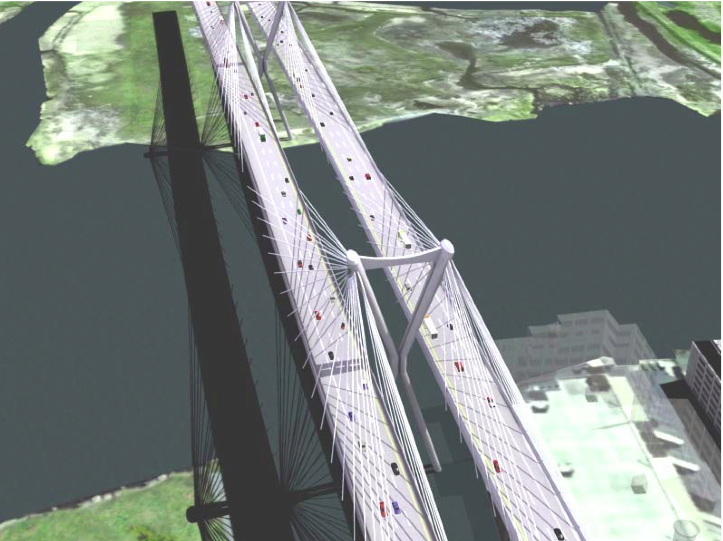
By the early twenty-first century the original structure was outmatched by contemporary traffic volumes and modern design standards. To improve capacity, safety and resilience, the original cantilever span was replaced by a pair of modern cable-stayed bridges that opened in 2018. After the new spans became operational, the old bridge was taken down and demolished, a process that included careful planning for river navigation, environmental protection and material recycling.
The new crossings include features that the original lacked: dedicated lanes and shoulders, modern long-term structural systems, and pedestrian and bicycle accommodations. In particular, the replacement project added formal pedestrian routes and bicycle facilities, expanding non-motorized access across the Arthur Kill for the first time in this location.
Notable facts and impact
- The bridge was constructed and managed by the regional port authority, reflecting inter-state coordination for major infrastructure projects.
- Its namesake, George W. Goethals, is widely known for major engineering work in the early 20th century.
- Replacement was driven by aging materials, changing traffic patterns and the desire to provide multimodal access.
- Project planning balanced transportation needs with environmental mitigation and local community concerns.
Today the Goethals crossing continues to be an essential link in the New York–New Jersey transportation network, albeit in a substantially modernized form that reflects current engineering practice and a broader view of mobility than the original 1928 structure offered.
Related articles
Author
AlegsaOnline.com Goethals Bridge Leandro Alegsa
URL: https://en.alegsaonline.com/art/39416
Sources
- panynj.gov : "Facts & Info - Goethals Bridge"
- nyc.gov : "New York City Bridge Traffic Volumes"
- select.nytimes.com : "Two Bridges Open Over Arthur Kill. Traffic Between Staten Island and New Jersey Begins at 5 A.M. Without Ceremony. New Bus Service Starts. Borough President Lynch Will Ask Legal Action to Bar It as Bad for Business"
- silive.com : "Happy Bridge Birthday"
- app.com : "Port Authority planning its first new bridge since 1930s"
- nj.gov : "Bridges and Tunnels"
- commons.wikimedia.org : Goethals Bridge