
Frill-necked Lizard (Chlamydosaurus kingii)
A reptile native to northern Australia and New Guinea, notable for its expandable neck frill, bipedal sprinting and defensive displays. Overview of appearance, behavior, habitat, diet and human significance.
Overview
The frill-necked lizard (Chlamydosaurus kingii) is a distinctive reptile native to northern Australia and parts of New Guinea. It is best known for the large, thin frill of skin around its head that can be suddenly expanded into a dramatic display. The species is the sole living representative of its genus and is a familiar subject in natural-history accounts of Australian wildlife.
Image gallery
10 Images



Physical characteristics
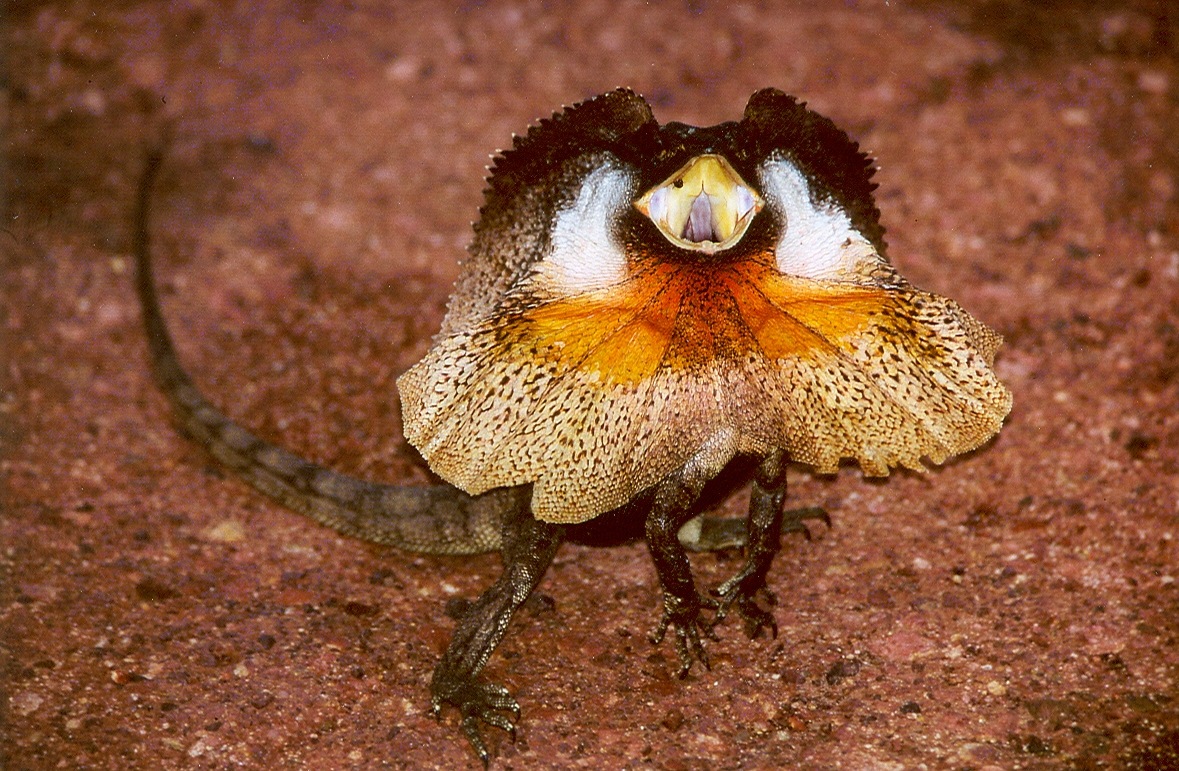
When relaxed, the frill lies folded against the neck. If the animal feels threatened it opens the frill to form a wide, circular collar and usually gapes its mouth, sometimes standing on its hind legs to enhance the illusion of size. The body is long and slender with a long tail, and its coloration ranges through mottled browns and yellows that provide camouflage in woodland and savanna habitats. Males and females are similar in appearance, though males may be larger or more brightly patterned in some populations.
Behavior and diet
Frill-necked lizards are diurnal and primarily insectivorous, feeding on a variety of insects and other small invertebrates; larger individuals may take small vertebrate prey. Their most famous defensive behaviour is the frill display, intended to intimidate predators and rivals. If display fails, they will often flee in a rapid bipedal sprint, using the strong hind legs and tail for balance—an action that earned them the nickname "bicycle lizard." They are also capable climbers and frequently move among low trees and shrubs.
Habitat and reproduction
This species occupies open forest, woodland and savanna, where it uses both ground cover and vegetation. During the breeding season females lay clutches of eggs in shallow nests or burrows, which are then left to incubate. Juveniles resemble small adults and develop the frill early, though the display is less pronounced in young animals.
Human context and notable facts
- Often featured in wildlife guides and popular media as an emblematic Australian reptile.
- Its frill is functionally similar to throat fans or dewlaps in other lizard groups, but structurally unique in appearance and use.
- Despite its dramatic display, it prefers to avoid confrontation and will choose flight when threatened.
Further information
For more on behaviour, distribution and conservation status, consult specialist field guides or online resources. A general overview is available here, and more detailed species accounts can be found here.
Related articles
Author
AlegsaOnline.com Frill-necked Lizard (Chlamydosaurus kingii) Leandro Alegsa
URL: https://en.alegsaonline.com/art/36753