
Amoeba — single-celled organisms with pseudopodia
Amoebae are single-celled eukaryotes that move and feed using pseudopodia. This article summarizes their structure, movement, diversity, ecology, medical relevance and use in research.
An amoeba (plural: amoebae) is a general term for certain single-celled eukaryotes that move and feed by extending temporary projections called pseudopodia. The name is applied to species in the genus Amoeba and, more broadly, to many unrelated organisms that show similar amoeboid behaviour. In a broad sense the term describes a type of unicellular organism often placed among diverse groups of protists, rather than a single taxonomic unit.
Image gallery
4 Images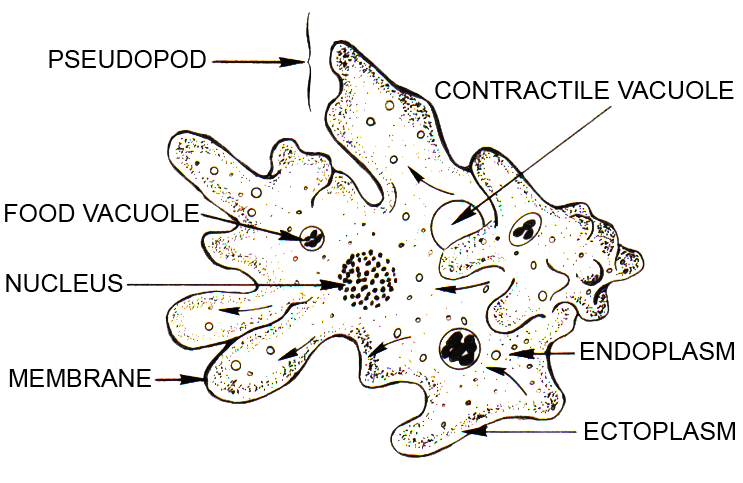

Structure and visible features
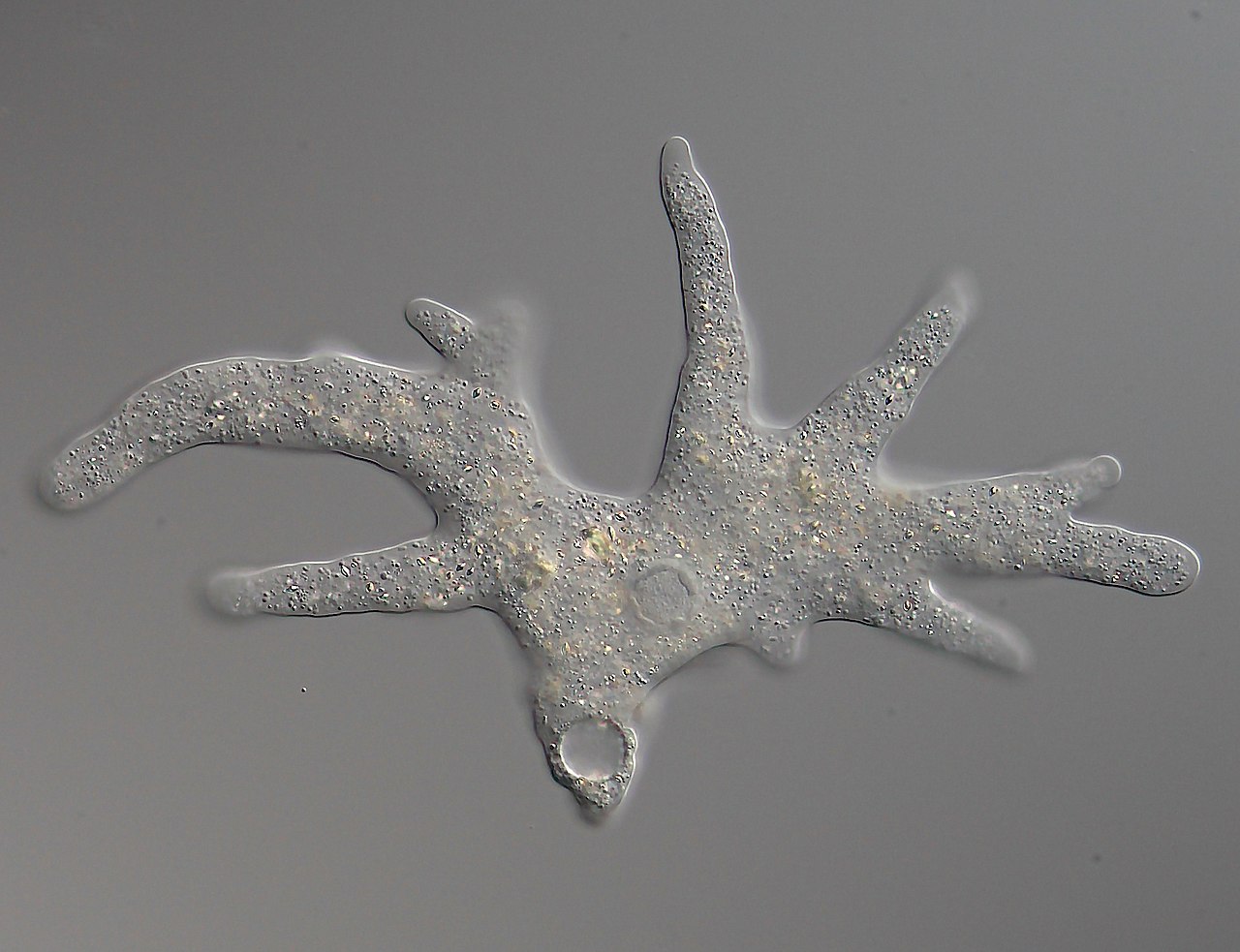
Amoebae typically have a flexible outer membrane and a cytoplasm that can be described as a clearer ectoplasm at the periphery and a more granular endoplasm within. They contain the usual eukaryotic organelles: a nucleus, mitochondria (or mitochondrion-related organelles in some lineages), food vacuoles for digestion and sometimes a contractile vacuole to regulate water balance. Well-known freshwater species such as Amoeba proteus are large enough to be seen under a light microscope and are commonly used in teaching.
Movement and feeding
The defining behaviour of amoebae is the formation of pseudopodia. These temporary extensions of cytoplasm are used both to pull the cell forward and to capture prey. Different groups produce different forms of pseudopodia — broad lobose projections, thin filose extensions, or radiating axopods — but all rely on reorganisation of the actin cytoskeleton and associated proteins to change cell shape. Feeding is usually by phagocytosis: the amoeba surrounds particles or other microorganisms, internalises them into food vacuoles and digests them with enzymes.
Reproduction and life cycle
Most amoebae reproduce asexually by simple division (binary fission), producing genetically similar daughter cells. Many species can form resistant cysts when conditions are unfavourable; these cysts help them survive drying, cold or scarcity of food. In some lineages processes that resemble sexual exchange of genetic material have been described, but the details and frequency of such events vary and are an active area of study.
Ecology and diversity
Amoebae are widespread in freshwater, marine and terrestrial habitats where they often graze on bacteria, algae and other small protists, playing an important role in microbial food webs and nutrient cycling. The appearance of amoeboid cells has evolved independently in several major branches of eukaryotes; one well-known clade that contains many amphizoic and free-living amoebae is the Amoebozoa. Because the functional form has evolved multiple times, the term “amoeba” groups organisms by behaviour and shape rather than strict evolutionary relationship.
Medical and practical significance
While many amoebae are harmless or beneficial in ecosystems, a few genera include species that can infect humans or animals. For example, members of the genus Entamoeba include species associated with intestinal infection, and free-living genera such as Naegleria and Acanthamoeba are known to cause rare but serious illnesses in specific circumstances. Public health efforts focus on water safety, sanitation and clinical diagnosis where these organisms are a concern.
Use in research and education
Certain amoebae are established model organisms in cell and developmental biology. Their visible movement, relatively large cell size (in some species) and tractable growth in the laboratory make them useful for studying cell motility, signal transduction, cytoskeleton dynamics and the mechanisms of phagocytosis. In classrooms, observation of live amoebae under light microscopes remains a common introduction to protist diversity and behaviour.
History and taxonomy
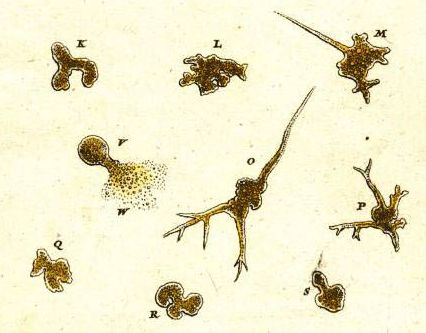
Descriptions of amoeboid organisms date to early naturalists of the 18th century, and the concept has been refined as microscopy and molecular methods improved. Modern taxonomy emphasises that amoeboid form is polyphyletic: similar shapes appear in unrelated groups. For accurate identification and classification it is therefore important to use genus and species names and to consult up-to-date taxonomic resources.
Practical notes for observation
- Light microscopy with simple stains will often reveal the nucleus, contractile vacuole and moving pseudopodia; live observation shows characteristic cytoplasmic flow.
- Size varies widely between species; some are microscopic and others, like classroom strains, are large enough to follow without high magnification.
- For laboratory work and clinical settings follow standard protocols for culture, staining and molecular identification; consult an authoritative guide or database.
For general background and identification keys, see Further resources. Taxonomy, ecology and medical information are actively studied and updated, so specialists consult current literature and curated databases when precise details are required.
Related articles
Author
AlegsaOnline.com Amoeba — single-celled organisms with pseudopodia Leandro Alegsa
URL: https://en.alegsaonline.com/art/3609
Sources
- links.jstor.org : "Amoeba proteus"
- doi.org : 10.1086/272082