
Fenrir (moon) — an irregular outer satellite of Saturn
Fenrir (Saturn XL(I), S/2004 S 16) is a small, retrograde irregular moon of Saturn discovered in 2004–2005; named after the Norse wolf, it orbits far from Saturn with a multi-year period.
Fenrir is a small natural satellite of Saturn known by its provisional designation S/2004 S 16 and by the official name Fenrir. It belongs to the population of irregular, distant moons that orbit Saturn on elongated, inclined, and typically retrograde paths. The moon is named after the wolf Fenrisulfr from Norse mythology; readers can follow the name links for more on the mythic figure and the team that discovered the object: Fenrir, Norse mythology, Scott S. Sheppard, David C. Jewitt.
Image gallery
3 Images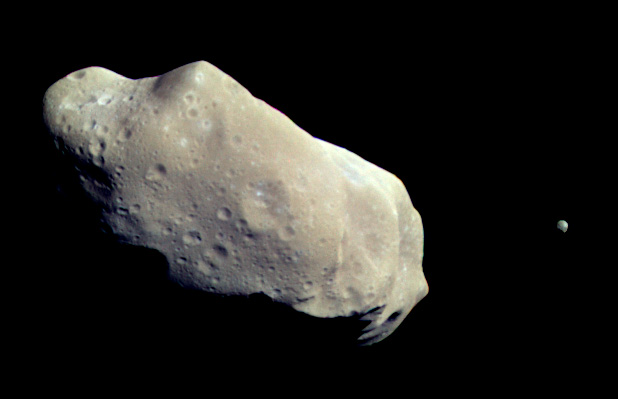


Overview
Fenrir is one of Saturn's many small outer moons. It measures only a few kilometres across and orbits far from the planet. Because of its size and distance it is a faint target for telescopes and is studied mostly by teams conducting deep surveys of the outer regions of the Saturnian system. Its discovery and naming follow the convention of assigning Norse names to Saturn's retrograde irregular satellites.
Physical characteristics
Observed brightness and assumed reflectivity imply a diameter on the order of several kilometres; published estimates put Fenrir at about 4 kilometres in diameter. With such a small size, Fenrir lacks the gravity needed to pull itself into a spherical shape, so it is expected to have an irregular, fractured form similar to other small outer moons and large asteroids.
Orbit and dynamics
Fenrir follows a distant, inclined, and eccentric orbit around Saturn. Published orbital elements indicate an average orbital distance of roughly 22.6 million kilometres from Saturn and an orbital period of about 1,269 days (more than three Earth years). Its orbital inclination is steep relative to the ecliptic (about 163°), which makes the motion retrograde (opposite the direction of Saturn's rotation), and its eccentricity is moderate (about 0.13). These properties are typical of an irregular satellite and suggest a dynamical history distinct from Saturn's inner, regular moons.
Discovery and name
The discovery announcement was made in May 2005, based on observations taken between December 2004 and March 2005 by a team that included Scott S. Sheppard, David C. Jewitt, Jan Kleyna, and Brian G. Marsden. The moon received the provisional designation S/2004 S 16 upon detection and was later given the name Fenrir in April 2007, following the International Astronomical Union's naming conventions for Saturn's irregular satellites. Additional background on the discoverers and the naming decision can be found here: orbit data, eccentricity reference, Loki (mythology), Ragnarök.
Context and significance
- Fenrir is part of the group of retrograde, irregular moons often referred to collectively as the "Norse group" because their official names are drawn from Norse myth. These satellites are of interest for studies of solar system capture processes, collisional fragmentation, and the dynamical evolution of planetary satellite systems.
- Because Fenrir is small and distant, it does not affect Saturn's rings or inner moons, but its orbit contributes to the broader understanding of how giant planets accumulate or capture small bodies.
Observational follow-up is challenging: precise orbit refinement requires repeated imaging over years, and physical characterization (composition, shape, rotation) typically depends on very large telescopes or serendipitous spacecraft encounters. For current orbital elements, size estimates, and discovery details consult major planetary satellite catalogues and survey publications that monitor Saturn's outer system: Fenrir, discoverer list.
Related articles
Author
AlegsaOnline.com Fenrir (moon) — an irregular outer satellite of Saturn Leandro Alegsa
URL: https://en.alegsaonline.com/art/33988