
Federico Menabrea: Italian general, statesman and early computing author
Luigi Federico Menabrea (1809–1896) was an Italian engineer, mathematician, general and statesman, known for an influential 1842 essay on Babbage's Analytical Engine and for senior military and ministerial roles in unified Italy.
Luigi Federico Menabrea (4 September 1809 – 24 May 1896) was an Italian military officer, engineer, mathematician, diplomat and political leader who played a notable role in the mid‑19th century processes that produced a unified Italy. Born in Chambéry, then within the borders of the Kingdom of Sardinia, he combined technical training with public service and was later ennobled as Count Menabrea and held the title Marquis of Valdora.
Image gallery
1 Image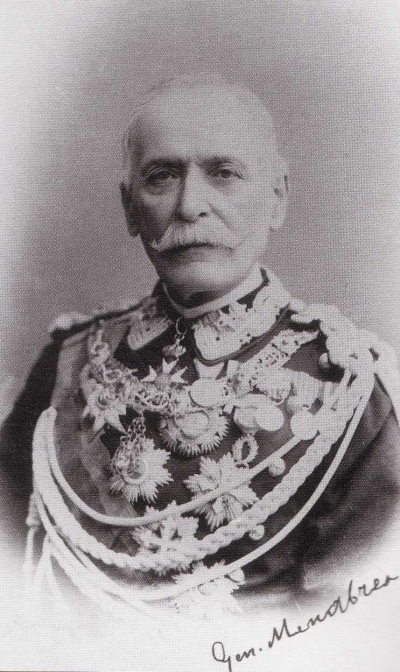
Education and scientific contribution
Menabrea trained as an engineer and received advanced mathematical training at the University of Turin, which informed both his military engineering practice and his writing. In 1842 he published a concise report entitled Sketch of the Analytical Engine Invented by Charles Babbage, Esq. that summarized Babbage's design and operational ideas for an automatic calculating machine. This account circulated in European technical circles and, through a later English translation with extensive notes by Ada Lovelace, contributed to the early historical record of programmable machinery. The 1842 paper is often cited by historians of computing as an important contemporary description of the Analytical Engine and of concepts that anticipated aspects of modern computing (1842).
Military career and early politics
Menabrea entered public life during the revolutionary year of 1848, when he was elected as a deputy to the Piedmontese parliament. He combined military service with governmental duties, holding portfolios such as Minister of War and Minister of Foreign Affairs in the pre‑unification administrations. As a professional officer and engineer he rose to the rank of lieutenant‑general and took part in the military campaigns associated with the downfall of the Bourbon Kingdom of the Two Sicilies. His wartime leadership included participation in the operations that culminated in the siege of Gaeta, and for his services he was appointed to the senate and granted noble status.
Ministerial roles in the Kingdom of Italy
After the proclamation of the Kingdom of Italy, Menabrea belonged to the conservative parliamentary group known as the "Historical Right." He served in several ministerial positions in the early national government, including Minister of the Navy and Minister of Public Works, before being chosen as Prime Minister. His administration ran from October 1867 until December 1869 and faced a mixture of domestic and foreign policy challenges.
Key issues and controversies (1867–1869)
- One major flashpoint involved the nationalist leader Giuseppe Garibaldi, who sought to capture Rome from papal control. Garibaldi's plans created a difficult diplomatic situation between the Italian government, the city of Rome, the Papacy, and foreign powers, particularly France, which maintained troops in Rome to protect the Pope.
- Menabrea's government also enacted fiscal measures intended to address state finances after unification. Critics argued that some tax reforms, including assessments tied to land, disproportionately affected small landholders and the poor, generating social discontent.
- Contemporaries debated proposals for migration and settlement overseas. Menabrea's cabinet considered arrangements with Argentina to facilitate Italian emigration and the remote colonization of parts of southern Patagonia as a potential solution to crime and brigandage in Italy; these plans were controversial and never produced a significant state‑led colonization project.
During this period the government responded firmly to unrest, at times authorizing military suppression under commanders such as General Raffaele Cadorna. Internal disagreements within the cabinet and the withdrawal of ministerial support led to the fall of Menabrea's administration in late 1869.
Diplomacy, later life and legacy
After leaving the premiership Menabrea continued to serve the Italian state in a diplomatic capacity, holding ambassadorial posts in major European capitals including London and Paris, where his technical background and experience in international affairs were considered assets. He retired from public life in his later years and died at Saint‑Cassin in 1896.
Historians assess Menabrea as a figure who bridged technical expertise and conservative statecraft during a formative era. His short but important 1842 essay on the Analytical Engine remains a recognized document in the history of computing, both for its clear description of Babbage's concepts and for its later amplification through Ada Lovelace's notes. Politically, his career illustrates the tensions of the unification period: balancing military necessities, financial consolidation and the nationalist aspirations that continued to shape Italian politics after 1861.
Related articles
Author
AlegsaOnline.com Federico Menabrea: Italian general, statesman and early computing author Leandro Alegsa
URL: https://en.alegsaonline.com/art/33876
Sources
- fourmilab.ch : Sketch of the Analytical Engine Invented by Charles Babbage, Esq.
- notes9.senato.it : Scheda senatore MENABREA
- treccani.it : MENABREA, Luigi Federico
- corrieredellemigrazioni.it : 25 maggio 1896
- risorgimento.comune.verbania.it : Il Risorgimento sul Lago Maggiore