
Interstellar extinction (astronomy): causes, reddening, measurement and effects
Interstellar extinction is the dimming and reddening of starlight by dust and gas. This article explains causes, wavelength dependence, measurement methods, corrections, and consequences for observations.
Interstellar extinction refers to the weakening and alteration of electromagnetic radiation from a distant source when it passes through intervening dust and gas. The effect combines absorption and scattering: photons are removed from the direct line of sight or redirected, so objects appear fainter and often redder than they would in empty space. When this occurs inside our own galaxy it is commonly called galactic extinction and is especially important for studies inside the Milky Way.
Image gallery
2 Images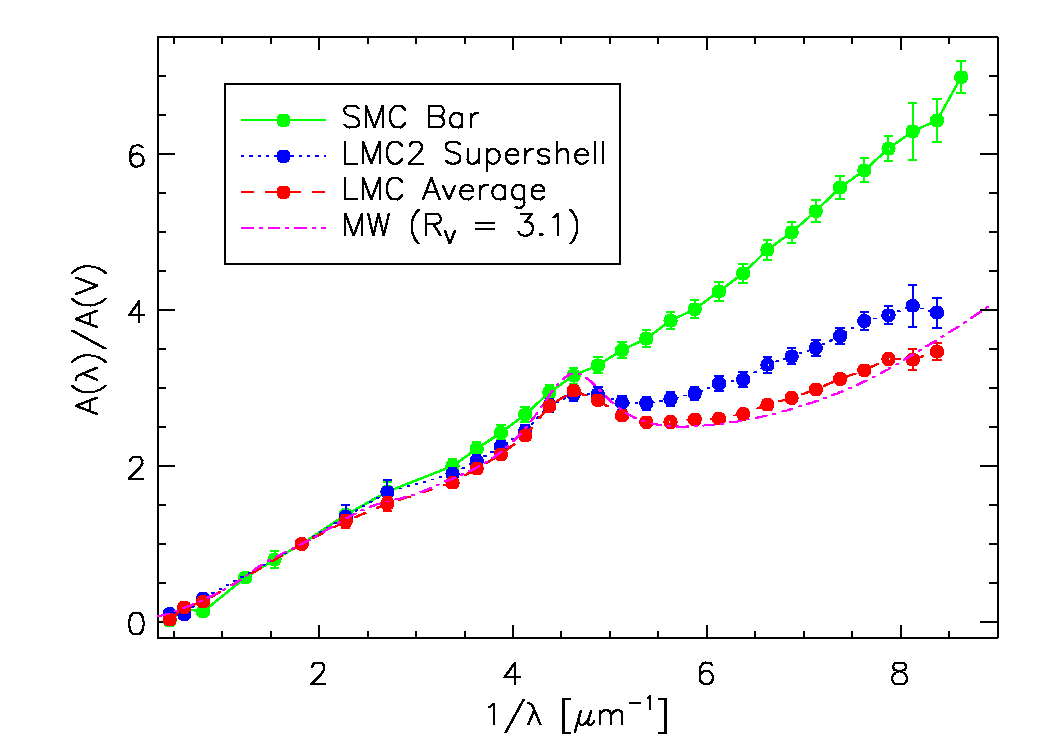

Physical causes and wavelength dependence
Extinction is produced by tiny solid particles (interstellar dust) and to a lesser extent by gas. Grain size, composition and geometry determine how strongly different wavelengths are affected: short wavelengths (ultraviolet and blue light) are scattered and absorbed more efficiently than red or infrared light. That selective removal of blue light is known as reddening.
Quantifying extinction
Observers measure extinction in magnitudes. The extinction at wavelength λ, A(λ), relates to optical depth τ(λ) roughly as A(λ) = 1.086 τ(λ). Color excess, E(B−V) = A_B − A_V, measures reddening between two bands; the ratio R_V = A_V/E(B−V) characterizes the curve shape (typical Milky Way value ≈ 3.1 but it varies).
Measurement and correction
- Star counts and color–magnitude diagrams reveal missing or reddened stars behind clouds.
- Spectroscopic indicators compare observed spectra to intrinsic templates to infer reddening.
- Infrared surveys and thermal dust emission maps trace column density where optical extinction is high.
Correcting for extinction is essential for accurate distances, luminosities and colors of astronomical objects. Maps and extinction laws are widely used, but local variations and different galaxies (e.g., the Large and Small Magellanic Clouds) show different extinction curves, including the strength of the 2175 Å bump.
History and distinctions
The need to account for interstellar dimming was established in the early 20th century when star counts and cluster studies showed systematic faintness with distance. Interstellar extinction differs from atmospheric extinction (caused by Earth’s air) and from intergalactic absorption by the diffuse intergalactic medium. Understanding extinction remains central to observational astronomy and cosmology.
For further reading on basic concepts and specific measurements, see general treatments of astronomical objects and the role of cosmic dust in shaping observed light.
Related articles
Author
AlegsaOnline.com Interstellar extinction (astronomy): causes, reddening, measurement and effects Leandro Alegsa
URL: https://en.alegsaonline.com/art/33016