
Eugène Ionesco: Romanian-born playwright and leading figure in modern absurdist theatre
Overview of Eugène Ionesco (1909–1994), his major works, themes, historical context, awards and legacy as a central figure of 20th-century avant-garde theatre.
Eugène Ionesco (born 26 November 1909 – died 28 March 1994) was a Romanian-born playwright who wrote primarily in French. He became internationally known for a body of stage works that challenged dramatic convention and helped bring the ideas associated with the avant-garde into postwar popular awareness. Born in Slatina, Romania, Ionesco settled in France and produced plays that remain frequently staged, studied and translated.
Image gallery
3 Images

Style and themes
Ionesco is often associated with the Theatre of the Absurd, a loose grouping of mid-20th-century dramatists who explored existential anxieties through fragmented language, circular plots and surreal situations. His plays repeatedly examine the breakdown of meaning in everyday speech, the ritualized emptiness of social roles, and the comic grotesque that sits between farce and bleak satire. He used repetition, non sequitur dialogue and exaggerated, often banal settings to expose how language can fail to convey human experience.
Major works
- La Cantatrice chauve (The Bald Soprano) — a short, episodic piece that helped inaugurate his reputation and is famous for parodying domestic chat and linguistic clichés. La Cantatrice chauve
- La Leçon (The Lesson) — a compact, tension-filled play about instruction, authority and violence. La Leçon
- Les Chaises (The Chairs) — an allegorical work built around an elderly couple preparing for guests who never arrive. Les Chaises
- Rhinocéros — a satirical drama in which townspeople transform into rhinoceroses, often read as a parable about conformity and ideology. Rhinocéros
- Amédée, ou Comment s'en débarrasser and other shorter plays — pieces that continue his explorations of obsessive repetition and the collapse of intelligible discourse. Amédée
These works vary in scale from brief parables to full-length allegories, but they share an interest in how ordinary situations reveal absurd or destructive patterns under pressure.
Life and recognition
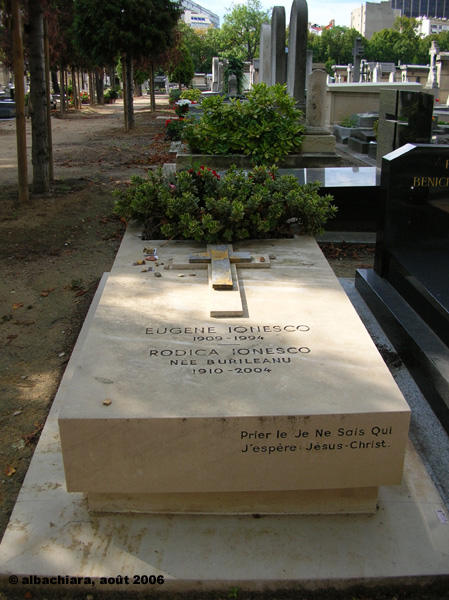
After coming to prominence in postwar Parisian circles, Ionesco became a central figure in contemporary theatre. Critics and audiences responded to his mix of comedy and menace, and directors around the world staged his plays in many languages. He received the Jerusalem Prize in 1973 and later academic honors; in the mid-1970s he was awarded honorary degrees, including recognition connected with the University of Warwick and institutions in Israel. He died in 1994 and is interred in the Cimetière du Montparnasse in Paris.
Although commonly linked with the Theatre of the Absurd, Ionesco resisted reductive labels and emphasized his interest in theatrical form and language. His influence persists in contemporary drama, performance art and critical writing: his works are still programmed by repertory companies, taught in university drama courses, and adapted for radio, television and film in various countries. For further information about performances, editions and studies of Ionesco's work, consult specialist theatre bibliographies and collections of twentieth-century drama. Biography, bibliography, and archival entries are available in many national libraries and performing-arts resources.
Notable facts: Ionesco wrote in a language that was not his mother tongue, helped shape modern reactions against naturalism on stage, and left a legacy of short, intense plays that continue to provoke questions about meaning, power and communication in public life.
Related articles
Author
AlegsaOnline.com Eugène Ionesco: Romanian-born playwright and leading figure in modern absurdist theatre Leandro Alegsa
URL: https://en.alegsaonline.com/art/32487