
Endymion (poem) — John Keats's Romantic narrative poem
Long narrative poem by John Keats, begun 1817 and published 1818. In four books of rhymed couplets, it pursues themes of beauty, imagination and the quest for an ideal love; famous for its opening line.
Endymion is a major long poem by the English Romantic poet John Keats. Conceived in 1817 and published in 1818, Keats subtitled the work "A Poetical Romance" and composed it in four narrative books written in rhymed couplets. Its first line — "A thing of beauty is a joy forever" — is among the most widely quoted openings in English verse and signals the poem's central preoccupation with the nature and permanence of beauty. The poem draws on the classical tale of Endymion from antiquity but recasts the material through the sensuous, imaginative concerns of the Romantic movement and the personal lyric voice of John Keats.
Image gallery
2 Images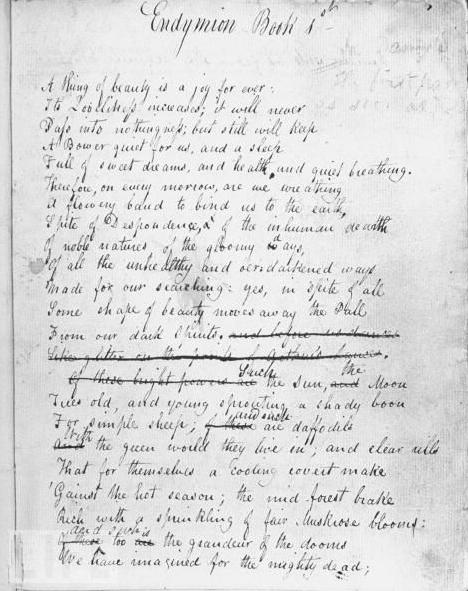

Form, length and style
Keats wrote Endymion in continuous narrative, using heroic rhymed couplets so that each pair of lines rhymes. The four books are lengthy, each running to roughly a thousand lines in many editions, making Endymion Keats's longest single poem. The diction ranges from plain narrative passages to luxuriant, sensory description; Keats's language often foregrounds tactile, visual, and auditory detail, and his imagery blends natural scenes with classical and mythic figures. That mixture of story and ornate lyricism contributes both to the poem's appeal and to the debates about its perceived unevenness.
Synopsis and central concerns
Rather than providing a tightly plotted epic, Endymion follows a series of episodes in which its hero pursues an idealized object of desire, represented by a moon goddess figure. The narrative moves through dreams, pastoral interludes, allegorical encounters and voyages that test the protagonist's endurance and imagination. Throughout, Keats frames the quest as an exploration of longing and the human need to apprehend beauty; the poem treats love, loss, transformation and consolation as interwoven experiences rather than as a single moral lesson.
Themes, imagery and literary importance
Endymion exemplifies several themes central to Romantic poetry: the elevation of imagination, the power of sensory perception, the reverence for natural beauty and a preoccupation with mortality and consolation. Keats uses classical motifs (the story of Endymion and elements of Greek mythology) to explore contemporary concerns about artistic creation and the relation between reality and ideal forms. While some readers have criticized its shifts in tone and digressive episodes, others celebrate its lyric passages and memorable lines for their emotional intensity.
Reception, history and legacy
On publication in 1818 Endymion attracted considerable hostile review attention, and contemporaries differed sharply over its merits. Some later accounts argued that the critical hostility contributed to Keats's physical and mental strain during the final years of his life; colleagues such as Shelley believed the reviews harmed him, and historical narratives sometimes link the period of Keats's intense critical exposure with the illness that claimed him in 1821 at age 25. Modern scholarship tends to treat such causal claims cautiously, while acknowledging that Endymion shaped Keats's reputation and remains central to study of his poetic development.
Notable facts and further reading
- Written in 1817 and printed in 1818; often cited in biographies and editions of Keats (composition year, publication year).
- Famous opening line: "A thing of beauty is a joy forever" (noted quotation).
- Keats labeled it a "Poetical Romance" and used rhymed couplets across four long books.
- Based on the classical figure Endymion but reworked for Romantic meditation on beauty and desire.
- Reception was mixed to hostile on first publication; later readers have reassessed its ambition and lyric power (biographical context).
For readers approaching Endymion today, the poem rewards attention to its expressive language and to the ways Keats's imagination transforms a mythic premise into a meditation on art, longing and consolation. Critics continue to debate its aesthetic successes and faults, but the poem remains a pivotal work for understanding Keats's growth as a poet and the broader aims of Romantic literature. For contemporary discussions and editions, see further commentary and textual notes (Romantic studies, Keats scholarship, composition histories).
Additional resources and contextual reading can provide detailed chapter summaries, variant readings of the text and commentary on its critical reception through the nineteenth and twentieth centuries; general introductions and annotated editions often help new readers navigate its length and episodic design (publication records, famous lines, mythic sources, classical background, contemporary responses, biographical notes).
Related articles
Author
AlegsaOnline.com Endymion (poem) — John Keats's Romantic narrative poem Leandro Alegsa
URL: https://en.alegsaonline.com/art/31405