
Einstein field equations
Fundamental equations of general relativity relating spacetime curvature to matter and energy, central to modern cosmology, black hole physics, gravitational waves, and numerical relativity.
Overview
The Einstein field equations are the core mathematical statement of general relativity. They relate the curvature of spacetime to the distribution of matter and energy. In compact symbolic form they are often written as G_{μν} + Λ g_{μν} = (8πG/c^4) T_{μν}, where G_{μν} is the Einstein tensor, g_{μν} the metric, Λ the cosmological constant and T_{μν} the stress–energy tensor. The equations replace Newton's law of gravitation for regimes where relativistic effects are important.
Image gallery
3 Images

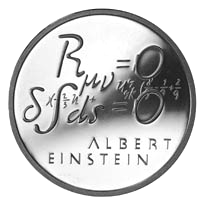
Mathematical character and structure
Mathematically the field equations are a set of coupled, nonlinear, second-order partial differential equations for the metric tensor of a four-dimensional manifold. Their nonlinearity means that superposition does not hold and solutions are sensitive to global geometry. The equations follow from the Einstein–Hilbert action by a variational principle and are tied to the differential identities known as the contracted Bianchi identities, which imply local conservation of energy and momentum (∇^μ T_{μν} = 0).
History and development
Derived by Albert Einstein in 1915 and closely related to work by David Hilbert, the equations united geometry and physics by making gravity a manifestation of spacetime curvature. Early successes included explaining Mercury's anomalous perihelion precession and predicting light deflection by the Sun. The idea of adding a cosmological constant, Λ, was introduced to allow static cosmological models and later reinterpreted in light of cosmic expansion.
Typical solutions and methods
Exact solutions are possible under strong symmetry assumptions; notable examples include:
- Schwarzschild solution (spherically symmetric, non-rotating mass)
- Kerr solution (rotating black hole)
- Friedmann–Lemaître–Robertson–Walker metrics (homogeneous isotropic cosmologies)
- Reissner–Nordström (charged spherically symmetric solutions)
Because general situations lack symmetry, physicists use approximation schemes such as linearization (useful for gravitational waves), post-Newtonian expansions for weak fields, and large-scale numerical methods (numerical relativity) for binary mergers and strong-field dynamics.
Physical consequences and applications
The field equations underpin predictions that have been experimentally confirmed: gravitational redshift, light bending, time dilation near massive bodies, and the existence of gravitational waves—ripples of spacetime whose direct detection validated predictions from linearized solutions. They are essential to black hole astrophysics, cosmology, and technologies that require relativistic corrections. Contemporary research explores exact solutions, stability, singularity theorems, and quantum gravity attempts to reconcile the equations with quantum principles.
Further reading
To explore derivations, solution techniques and modern applications, consult introductions to differential geometry and general relativity and review articles that cover both historical context and computational approaches. See a general survey on the geometric picture, technical treatments of curvature and tensors, biographies and origin stories about Einstein and about Hilbert, discussions of the cosmological constant and its role, mathematical analyses of PDE aspects and nonlinearity, and sources on approximation and numerical methods for practical solution techniques.
Related articles
Author
AlegsaOnline.com Einstein field equations Leandro Alegsa
URL: https://en.alegsaonline.com/art/30489