
Elastic collision
An elastic collision is a physical interaction where colliding bodies exchange momentum without net loss of kinetic energy. Covers definitions, conservation laws, formulas, examples, and limitations.
Overview
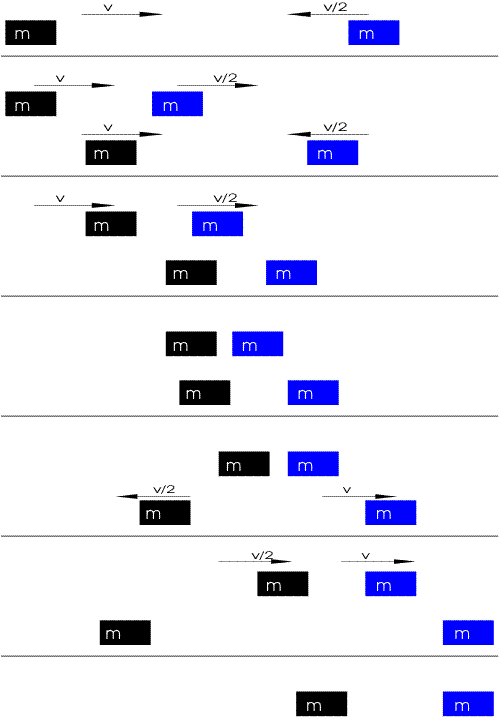
An elastic collision is an encounter between two or more bodies in which there is no net conversion of the system's kinetic energy into other forms such as heat, sound, or permanent deformation. In the idealized limit called a perfectly elastic collision the total kinetic energy of the isolated system before and after the encounter is exactly the same. Momentum is conserved in all collisions between isolated bodies, but kinetic energy is conserved only in elastic collisions. For background on collisions in general see collision (general) and for the energy quantity that remains constant in a perfectly elastic event see kinetic energy.
Image gallery
3 Images

Key characteristics
Several properties define an elastic collision:
- Conservation of linear momentum: the vector sum of momenta of the bodies remains constant if no external forces act.
- Conservation of kinetic energy: the total kinetic energy does not change during the interaction (perfect elasticity).
- Coefficient of restitution: a dimensionless number e, equal to 1 for a perfectly elastic collision and between 0 and 1 for partially elastic collisions; it quantifies the relative speed along the line of impact after versus before collision.
Simple formulas and frames
Exact algebraic expressions can be obtained for common situations, for example a one-dimensional two-body collision between masses m1 and m2 with initial velocities u1 and u2 and final velocities v1 and v2. For a perfectly elastic collision the results are
v1 = ((m1 - m2)/(m1 + m2)) * u1 + ((2 m2)/(m1 + m2)) * u2
v2 = ((2 m1)/(m1 + m2)) * u1 + ((m2 - m1)/(m1 + m2)) * u2
These expressions follow from solving conservation of momentum and conservation of kinetic energy simultaneously. In the center-of-mass frame the total momentum is zero and elastic collisions often simplify: in one dimension the particles exchange velocities when their masses are equal.
Examples and applications
Perfect elasticity is an idealization, but many systems are well approximated as elastic for certain time scales or collision speeds. Common examples include:
- Billiard balls and Newton's cradle, which approximate elastic collisions in short contacts.
- Molecules in an ideal gas model, where elastic collisions underpin the kinetic theory of gases and thermodynamic relations.
- Subatomic and nuclear scattering experiments, where elastic scattering refers to interactions that leave internal states unchanged.
- Engineering and materials testing, where elastic impact models inform safety and design calculations when deformation is reversible.
Limitations and distinctions
Real collisions often lose some kinetic energy to internal energy, plastic deformation, fragmentation, heat, or sound; these are called inelastic collisions. The coefficient of restitution provides a practical way to describe partial energy loss (0 < e < 1). A perfectly inelastic collision is the extreme case where colliding bodies stick together, maximizing kinetic energy loss subject to momentum conservation. Elastic scattering in particle physics is distinct from elastic macroscopic collisions but shares the same conservation principles applied to quantum states.
Historical and practical notes
The distinction between elastic and inelastic collisions has been central to classical mechanics and the development of statistical mechanics in the 19th century. Elastic-collision models remain a fundamental tool in physics and engineering because they provide tractable, predictive relationships that connect forces, motion, and energy exchanges under reversible deformation.
Questions and answers
Q: What is an elastic collision?
A: An elastic collision is when two objects collide and bounce back with little or no deformation.
Q: What is an example of an elastic collision?
A: Two rubber balls bouncing together would be an example of an elastic collision.
Q: What is an inelastic collision?
A: An inelastic collision is when two objects collide and crumple, and do not bounce back.
Q: What is an example of an inelastic collision?
A: Two cars hitting each other would be an example of an inelastic collision.
Q: What happens in a perfectly elastic collision?
A: In a perfectly elastic collision, no kinetic energy is lost, and so the kinetic energy of the two objects after the collision is equal to their total kinetic energy before the collision.
Q: How do elastic collisions occur?
A: Elastic collisions occur only if there is no net conversion of kinetic energy into other forms like heat or sound.
Q: What is conserved in an elastic collision?
A: In an elastic collision, momentum is conserved.
Related articles
Author
AlegsaOnline.com Elastic collision Leandro Alegsa
URL: https://en.alegsaonline.com/art/30602