
Dive bomber
A military aircraft that attacks by making steep dives to deliver bombs with high accuracy. Prominent in the 1930s–1940s, later replaced by multi-role attack aircraft and guided munitions.
Overview
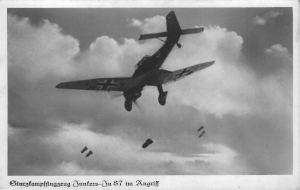
A dive bomber is a fixed-wing military aircraft designed to attack surface targets by flying a steep, controlled descent toward the objective and releasing bombs at close range. The tactic increases bombing accuracy by reducing horizontal drift and time of fall, and can in some cases limit exposure to hostile anti-aircraft fire defenses. Dive bombing was particularly effective against compact or moving targets such as naval vessels ships and fortified points like bridges bridges, because weapons were delivered from a much closer point of release.
Image gallery
7 Images


Design and equipment
Dive bombers were built to withstand the stresses of steep, high-speed dives and the abrupt pull-out that followed weapon release. Typical design features included strengthened airframes, reinforced landing gear and empennage, and aerodynamic devices such as dive brakes or airbrakes to control descent speed. Many carried specialized bomb racks and release mechanisms to ensure the ordnance separated cleanly during the steep dive. Aiming was aided by optical gunsights, simple mechanical bombsights, and later gyro-stabilized sights tuned for dive profiles. Some aircraft incorporated automatic pull-up systems to protect inexperienced pilots from excessive g-forces.
Tactics and operational use
In practice, a dive-bombing attack involved an aircraft approaching the target at altitude, entering a steep descent—often very steep, sometimes near-vertical in angle—stroking a steady aim, releasing the bomb at low altitude, and then executing a high-g recovery. This method concentrated the pilot's aim on a small area and reduced the effect of wind and target motion. The tactic was well-suited to striking the relatively thinly armored tops of warships or precise infrastructure points, allowing relatively small aircraft with limited bomb loads to inflict disproportionate damage.
History and development
Dive bombing emerged in the interwar years as air forces experimented with close air support and precision attacks. It became prominent during the early stages of World War II World War II, when several air arms adopted dedicated dive bombers to support ground offensives and naval operations. Famous examples of the genre were used in major battles and campaigns where accuracy was decisive. Over time, however, improvements in fighter interception, anti-aircraft weapons, and the development of combined-arms tactics exposed dive bombers to high risk.
Decline and legacy
After the mid-20th century, the role of the dive bomber largely disappeared. Advances in bombsights, radar-directed anti-aircraft systems, and the arrival of faster jet aircraft made low-altitude, predictable steep dives much more hazardous. The precision role once filled by dive bombers was progressively taken over by multi-role fighter-bombers and specialized attack aircraft attack aircraft, which combined greater speed, payload and self-defence, and by precision-guided munitions that permitted accurate strikes from safer distances. Nevertheless, dive-bombing influenced attack aircraft design and close air support doctrine for decades.
Notable characteristics and examples
- Strengths: high bombing accuracy against small or moving targets; ability to exploit thin deck armor on ships.
- Weaknesses: limited bomb load relative to level bombers, exposure to fighters and ground fire during the dive and recovery, and intense structural stress on the aircraft.
- Historical examples: Several well-known World War II-era types demonstrated the dive-bombing concept in combat and are often cited in histories and analyses.
Dive bombing represents a distinct stage in the evolution of air attack tactics: a technique born from the need for precision with limited technology, later supplanted by faster aircraft and precision weapons. For further technical or historical details see specialist aviation histories and operational studies on air defenses and naval-air engagements involving ships. Additional context on early employment and doctrine can be found in sources covering interwar experimentation and the early years of World War II. For comparisons with later approaches, consult materials on the transition to attack aircraft and the tactics of near-vertical or steep-angle delivery dives. You can also review case studies of strategic targets such as ports and bridges bridges to understand why dive accuracy mattered.
Note: many technical, operational and national variations existed; dive bombing as a named practice describes the tactic more than a single standardized aircraft type.
Related articles
Author
AlegsaOnline.com Dive bomber Leandro Alegsa
URL: https://en.alegsaonline.com/art/27793