
Fungi lacking known sexual stages: history, classification, and examples
Fungi lacking documented sexual stages — history of the Deuteromycota label, modern molecular reclassification, and notable examples with roles in medicine, food production, agriculture, and human disease
Fungi imperfecti, commonly called imperfect fungi and historically grouped as Deuteromycota, is a catch‑all designation for fungi in which a sexual reproductive stage has not been documented. This label is not a formal rank in biological taxonomy; instead it reflects an observational gap—members are linked by their lack of observed sexual reproduction rather than by agreed evolutionary relationships. Traditional classifications of fungi rely on visible, morphological characteristics or on definitions tied to the concept of a biological species, and fungi that lack a known sexual cycle often do not fit neatly into those systems.
Image gallery
1 Image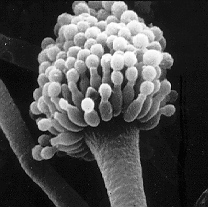
Historical context and biological basis
The name Deuteromycota (literally “second fungi”) was once used to designate a separate phylum for these organisms. That practice stemmed from grouping organisms by the presence or absence of sexual structures. The fungi placed in this assemblage reproduce only asexually or vegetatively in ways that produce conidia or other mitotic spores; a sexual stage has not been observed for them. With advances in microscopy, culturing, and molecular systematics, many species originally treated as “imperfect” have been reassigned to established fungal phyla when a sexual form or genetic evidence linked them to known groups.
Modern placement and diversity
Today, most fungi formerly placed among the imperfect fungi turn out to be asexual forms of members of the Ascomycota or the Basidiomycota, once their sexual life cycle is discovered or inferred. Roughly 25,000 species have at one time been included in the imperfect category, although ongoing research continues to change that number as species are studied and reclassified.
Practical importance and examples
- Medical: species that produce the antibiotic penicillin were historically treated as imperfect fungi.
- Human health: several agents responsible for conditions such as athlete’s foot and various yeast infections were described as imperfect because their sexual states were unknown.
- Food production: molds used in cheesemaking, for example those contributing to Roquefort and Camembert cheese, include species once called imperfect fungi.
- Pharmaceuticals: some fungi used to develop immunosuppressant drugs were classified among the imperfect fungi during early stages of study.
- Agriculture and pest control: certain species employed in biological control of insects and other pests have been described under this informal heading.
Alternative informal names for this assemblage include terms such as “Deuteromycetes,” anamorphic fungi, and mitosporic fungi. None of these terms denote a primary taxonomic rank today; they remain practical labels used when only the asexual, or anamorphic, stage of a fungus is known.
Related articles
Author
AlegsaOnline.com Fungi lacking known sexual stages: history, classification, and examples Leandro Alegsa
URL: https://en.alegsaonline.com/art/26938