
Darwin–Wedgwood family: science, industry and interwoven kinship
Prominent interconnected English families descended from Erasmus Darwin and Josiah Wedgwood. Their members shaped 18th–20th century science, industry, social reform and culture, including Charles Darwin and Francis Galton.
The Darwin–Wedgwood family refers to two closely related English family networks that merged by marriage and shared influence across science, industry and public life from the late 18th century onward. The two lineages trace to the physician and natural philosopher Erasmus Darwin and the entrepreneur Josiah Wedgwood. Over generations the families produced leading scientists, industrialists, artists and reformers and became notable for a pattern of intermarriage that kept wealth, connections and intellectual life concentrated within the extended kinship group; one well known example is the marriage of Charles Darwin to his cousin Emma Wedgwood (Charles Darwin).
Image gallery
8 Images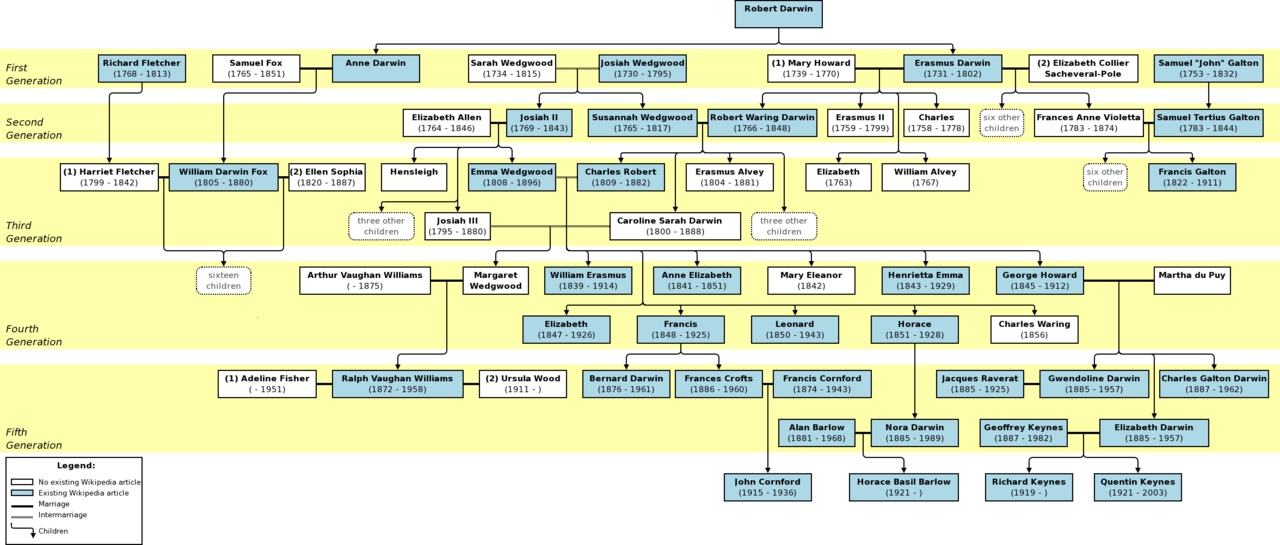


Origins and family networks
Josiah Wedgwood founded the pottery firm later known as Josiah Wedgwood and Sons, which played a central role in industrial development in the English West Midlands and helped establish the Wedgwoods as a prosperous mercantile family (West Midlands). Erasmus Darwin, a prominent physician, inventor and writer, was an influential intellectual whose ideas touched on natural history and human progress. Over time the two families became interwoven by multiple first- and second-cousin marriages (cousin marriages), a practice that reflected social norms of the period and reinforced familial alliances.
Notable members
- Charles Darwin — naturalist whose work on evolution by natural selection reached worldwide prominence; married Emma Wedgwood (Charles Darwin).
- Josiah Wedgwood — industrial innovator and entrepreneur who modernized pottery production and marketing (Josiah Wedgwood).
- Erasmus Darwin — physician and writer whose scientific and poetic work influenced later thinkers (Erasmus Darwin).
- Francis Galton — cousin within the network, noted for pioneering statistical methods and hereditary studies in the 19th century (Francis Galton).
- Artists and cultural figures — the extended family included painters, poets and musicians, among them links to figures such as the composer Ralph Vaughan Williams.
The family counted numerous Fellows of the Royal Society across successive generations, reflecting a concentration of scientific achievement and recognition. Members’ occupations ranged from industrialists and physicians to clergymen, lawyers and creative artists, which helped the network exercise influence in many spheres of public life.
Social and political commitments
Religious affiliation and political attitudes varied across branches. Several Wedgwoods were Quakers (Quakers) who were active in anti-slavery campaigns and wider social reform movements of the era (abolitionism). The families’ involvement in reform, philanthropy and public institutions contributed to their public profiles and to debates about industry, education and moral responsibility.
At the same time, the family’s dense kinship ties had complex consequences. Intermarriage helped preserve property and shared values but has also drawn modern attention because of its genetic and social effects. The presence of figures such as Francis Galton, who advanced statistical approaches to heredity, highlights how members of the network engaged with emerging ideas about evolution, heredity and social policy, sometimes in ways that later generations reassessed critically.
Legacy and distinctions
The Darwin–Wedgwood family left a multifaceted legacy: industrial innovation through Wedgwood potteries, scientific breakthroughs associated with members such as Charles Darwin, and contributions to arts, public institutions and reform movements. Their story illustrates how family networks could concentrate influence in Georgian and Victorian Britain, shaping scientific debate, commercial practice and cultural life in ways that continue to draw historical interest and study (Darwin–Wedgwood families).
Related articles
Author
AlegsaOnline.com Darwin–Wedgwood family: science, industry and interwoven kinship Leandro Alegsa
URL: https://en.alegsaonline.com/art/25590