
Danse Macabre (Dance of Death): a late-medieval allegory
Danse Macabre, or Dance of Death, is a medieval allegory depicting Death leading people of all ranks in a dance, used in art, literature and performance to express mortality and social equality in the face of death.
Overview
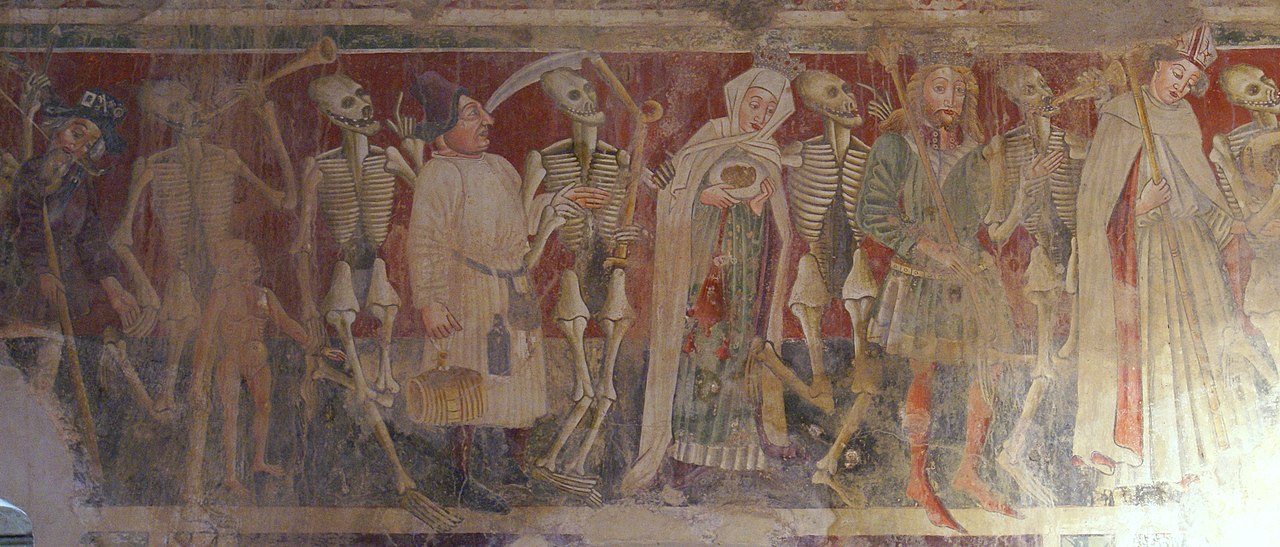
The Danse Macabre, often rendered in English as the "Dance of Death," is a visual and literary allegory that emerged in late medieval Europe to express the idea that death unites all people regardless of rank or wealth. The motif frequently shows a procession or dance in which a personified Death—commonly a skeleton or cadaver—confronts a variety of living figures from pope and king to merchant, child, and laborer.
Image gallery
10 Images




Characteristics and iconography
Typical scenes emphasize contrast and sequence: Death appears without discrimination and either beckons or reins in its living partners, sometimes with inscriptions or verses addressed to each figure. The imagery served both didactic and devotional purposes, reinforcing Christian themes of memento mori and exhorting viewers to spiritual readiness.
Origins and development
The theme became widespread after the upheavals of the 14th century, including the Black Death and recurring plagues, when reflections on mortality intensified across society. It appeared in murals, illuminated manuscripts, prints and dramatic pageants. Regional names reflect linguistic variety: Danse macabre (French), Danza macabra (Italian) and Totentanz (German), while scholars commonly place it within a broader medieval allegorical tradition.
Forms, uses and notable examples
Artists and authors adapted the theme across media: wall paintings and church frescoes made the message public and visible; woodcuts and broadsheets circulated it more widely; short dramas and street performances enacted it in communal settings. The motif also appears in later literature and music, and has been reinterpreted in modern art and popular culture. For introductions and collections, see general surveys and catalogues listed by specialists.
Legacy and distinctions
While closely related to memento mori and vanitas motifs, the Danse Macabre is distinctive for its processional, often dialogic format—an ordered sequence of encounters that dramatizes social equality before death. Its persistence reflects both medieval religious sensibilities and an enduring cultural fascination with mortality, echoed in later works such as the tone poem "Danse macabre" and many modern reinterpretations. For further context and resources, consult introductory treatments and image databases available to readers.
Related articles
Author
AlegsaOnline.com Danse Macabre (Dance of Death): a late-medieval allegory Leandro Alegsa
URL: https://en.alegsaonline.com/art/25452