
Cymothoa exigua — the tongue‑eating louse
Cymothoa exigua is a parasitic isopod crustacean that enters fish through the gills and can replace the host's tongue. This article summarizes its biology, life cycle, effects on hosts, and notable facts.
Overview
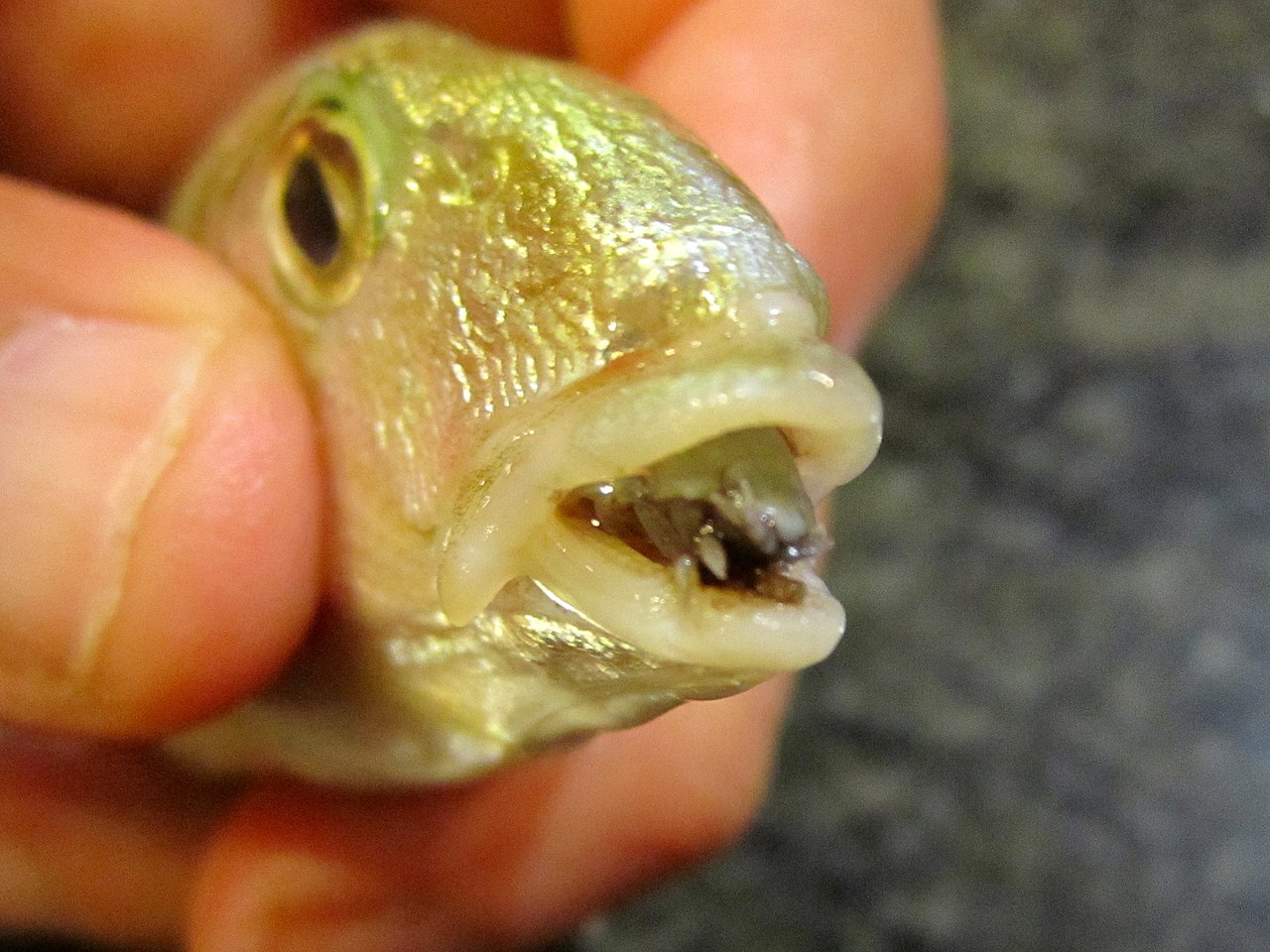
Cymothoa exigua is a marine crustacean in the family Cymothoidae commonly known as the tongue‑eating louse. It is a type of parasitic isopod found primarily in the eastern Pacific Ocean. The species attracts attention because of its unusual habit of entering a fish's mouth and attaching to the tongue, eventually replacing that organ and serving as a functional surrogate.
Image gallery
3 Images

Appearance and taxonomy
Like other isopods, C. exigua has a flattened, segmented body with multiple appendages and a hard exoskeleton. Individuals are typically reddish or brownish and measure on the order of a few centimetres. Taxonomically it belongs to the order Isopoda and the family Cymothoidae, a group composed of obligate ectoparasites of fishes.
Life cycle and behaviour
Juvenile isopods enter fish hosts through the gills and migrate within the mouth and branchial cavities. A typical sequence is:
- a young isopod lodges in the gill chamber and matures into a male;
- if a female is present or a vacancy exists, the male may change sex (protandric hermaphroditism) and become female;
- the female attaches to the tongue, severs or destroys most of the tongue tissue, then anchors to the remaining stub and functions in its place while feeding on blood and mucus;
- a male usually remains attached to the gill arches beneath or behind the female.
Effects on hosts and ecology
When established, the parasite often reduces the host's feeding efficiency and overall condition, which can lead to slower growth and lower reproductive output. In many cases the infested fish survives with the isopod acting as a replacement surface that the fish uses to manipulate food. The relationship is parasitic: the isopod derives nourishment and shelter at the host's expense.
Distribution, hosts and significance
C. exigua has been recorded mainly from the eastern Pacific, from the Gulf of California to Peru. It has been reported in several species of commercially and ecologically important fishes, especially snappers and related coastal species. While dramatic in appearance, infestations are not known to pose a direct health risk to humans, though affected fish are generally unmarketable if heavily parasitized.
Notable facts and distinctions
The tongue‑replacement behaviour of this isopod is often cited in popular accounts as one of the few documented instances in which a parasite appears to take over an anatomical function of its host. Researchers continue to study its life history, host specificity, and potential effects on fisheries. For further general information on related crustaceans and parasitic isopods see sources on marine parasitology and crustacean biology.
References and further reading are available through marine biology texts and review articles on fish parasites.
Questions and answers
Q: What is Cymothoa exigua?
A: Cymothoa exigua is a parasitic isopod, also known as the tongue-eating louse.
Q: How does Cymothoa exigua enter fish?
A: Cymothoa exigua enters fish through their gills.
Q: Where does the female Cymothoa exigua attach itself?
A: The female Cymothoa exigua attaches itself to the fish's tongue.
Q: Where does the male Cymothoa exigua attach itself?
A: The male Cymothoa exigua attaches itself on the gill arches beneath and behind the female.
Q: What does the female parasite do to the fish's tongue?
A: The female parasite destroys the fish's tongue.
Q: What does the Cymothoa exigua become after destroying the fish's tongue?
A: Cymothoa exigua attaches itself to the stub of what was once the fish's tongue and becomes the fish's new tongue.
Q: What type of creature is Cymothoa exigua?
A: Cymothoa exigua is a crustacean.
Related articles
Author
AlegsaOnline.com Cymothoa exigua — the tongue‑eating louse Leandro Alegsa
URL: https://en.alegsaonline.com/art/24903
Sources
- desertmuseum.org : "A monograph on the Isopoda Cymothoidae (Crustacea) of the Eastern Pacific"
- doi.org : 10.1111/j.1096-3642.1981.tb01592.x
- doi.org : 10.2307/1444352
- jstor.org : 1444352
- scielo.br : "Cymothoa spinipalpa sp. nov. (Isopoda, Cymothoidae) a buccal cavity parasite of the marine fish, Oligoplites saurus (Bloch & Schneider) (Osteichthyes, Carangidae) of Rio Grande do Norte State, Brazil"
- doi.org : 10.1590/S0101-81752007000100032