
Charles Messier
18th‑century French astronomer who compiled the Messier Catalog of bright deep‑sky objects to help comet hunters distinguish fixed nebulae and clusters from moving comets.
Charles Messier (June 26, 1730 birth – April 12, 1817 death) was a French astronomer whose careful observations produced one of the most enduring tools in observational astronomy: a catalog of conspicuous diffuse objects that became known as the Messier Catalog. Trained and employed in Parisian circles, Messier combined practical sky work with concise, repeatable records.
Image gallery
4 Images


Messier Catalog: purpose and contents
Messier compiled his list primarily to help comet hunters avoid mistaking stationary fuzzy objects for new comets. During his lifetime he published lists that together contained more than one hundred entries; historically his published totals are commonly given as 103 items, and later compilers extended the set to the familiar 110 objects used by modern observers. The catalog assigns a simple identifier (M1, M31, etc.) that remains widely used.
Notable objects
- M1 — the Crab Nebula, a supernova remnant.
- M31 — the Andromeda Galaxy, the nearest large galaxy to the Milky Way.
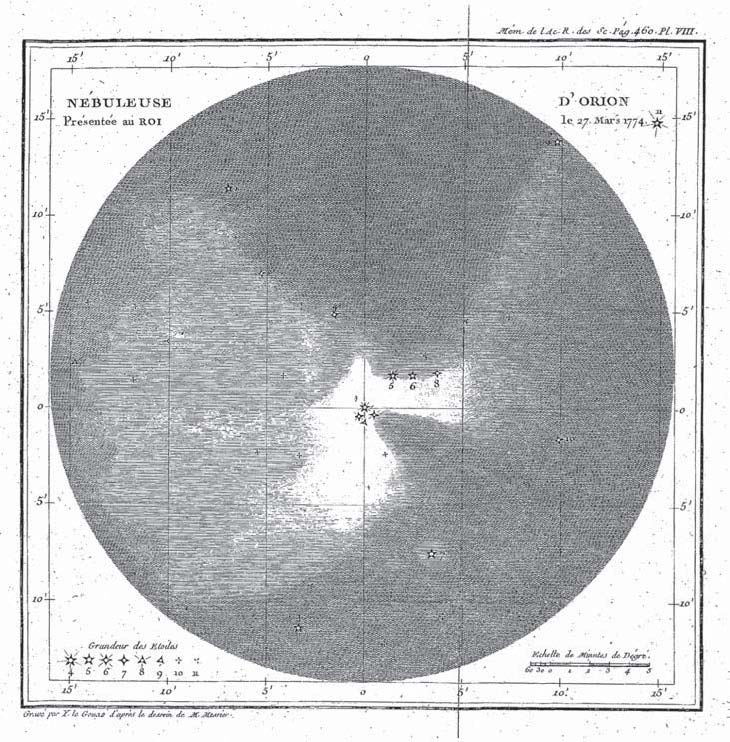
- M42 — the Orion Nebula, a bright star‑forming region.
- M45 — the Pleiades open cluster, familiar to the naked eye.
Work, methods and discoveries
Messier worked as an active comet hunter and is credited with the discovery of several comets; he recorded dozens of observations with modest telescopes by modern standards. Based at Parisian observatories and collaborating with contemporary astronomers, he emphasized practical charts, clear descriptions and repeatable coordinates so others could relocate the same objects. For background on his life and methods see biography and archival notes collections.
Historical context and legacy
Messier compiled his list before astronomers understood that some cataloged "nebulae" were separate galaxies outside the Milky Way. His practical catalog nonetheless preserved many of the brightest and most interesting deep‑sky targets and remains central to amateur observing programs such as the Messier Marathon. He is commemorated in astronomical place names and in continued use of Messier numbers among skywatchers; institutional summaries and modern editions keep his work accessible today.
While not a theoretician, Messier's disciplined observing, neat records and the simple utility of his catalog made a lasting contribution: a bridge between 18th‑century skywatching and the cataloging traditions that followed. His list continues to introduce new generations to the varied objects visible with small telescopes and binoculars.
Related articles
Author
AlegsaOnline.com Charles Messier Leandro Alegsa
URL: https://en.alegsaonline.com/art/18747
Sources
- comethunter.de : Maik Meyer. Catalog of comet discoveries