
Coalsack Nebula
A large, conspicuous dark nebula visible from the Southern Hemisphere that appears as a dark patch against the Milky Way; noted for its cultural importance and proximity to Earth.
Overview
The Coalsack Nebula is one of the most noticeable dark nebulae in the night sky. As a concentration of interstellar dust and gas it blocks light from background stars, producing a conspicuous dark area that can be seen with the naked eye. Astronomers classify it as a dark nebula or molecular cloud because its dust grains and molecules absorb and scatter starlight rather than emitting visible light; see dark nebula for general context. Many observers note the Coalsack's ease of visibility with the unaided eye, since it appears as a silhouette against the bright band of the southern Milky Way galactic plane.
Image gallery
6 Images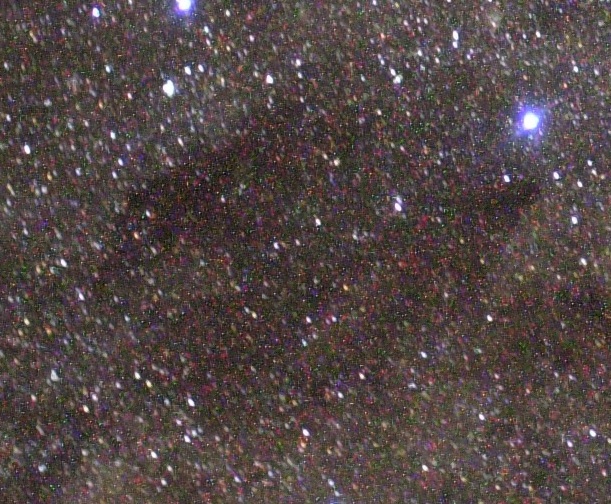





Physical characteristics and location
The nebula is a dense pocket of dust and cold molecular gas. Its dark appearance is due to microscopic solid particles — carbonaceous and silicate dust — mixed with hydrogen and other molecules. Distance estimates place it on the order of a few hundred light‑years; many sources give a commonly cited figure near 600 light‑years from Earth. On the sky it lies within the boundaries of the southern constellation Crux, near the Southern Cross, which helps observers locate it.
History and cultural significance
The Coalsack was familiar long before modern astronomy: it features in the sky lore of several Southern Hemisphere cultures. Australian Aboriginal traditions, for example, incorporate the dark shape into the so‑called "Emu in the Sky" asterism, where the Coalsack forms the emu's head. European records date back to the early Age of Exploration; the region was noted by navigators such as Vicente Yáñez Pinzón in 1499, and later by astronomers charting the southern skies historical accounts.
Scientific importance and study
Although visually striking, the Coalsack is not one of the most active star‑forming clouds known; nevertheless, it serves as a nearby laboratory for studying the properties of interstellar dust and the initial conditions of star formation. Observations at infrared and radio wavelengths penetrate the dust and reveal structure hidden from optical telescopes, allowing measurement of density, temperature, and molecular content. These multiwavelength studies make the Coalsack a useful point of comparison with more distant or more active molecular clouds.
How to observe
- Best seen from southern latitudes where Crux rises high above the horizon; it is essentially a Southern Hemisphere object.
- Look along the Milky Way band away from bright city lights; the nebula is most obvious when the Milky Way is well placed in the sky.
- Use binoculars or a low‑power telescope to trace the edges, though the dark patch is already apparent to the unaided eye on clear nights.
Notable distinctions
The Coalsack's prominence comes from contrast rather than intrinsic luminosity: it is defined by the absence of background stars rather than by emission. For more background on dark nebulae and comparisons to other nearby clouds, see general references on interstellar clouds and the southern Milky Way dark nebula and observational guides silhouette, southern Milky Way. Additional regional and technical resources are available for readers who wish to follow up distance measurements or historical notes from early observers and explorers. The Coalsack remains a striking feature for both casual stargazers and professional astronomers alike, located within Crux and readily found when the southern skies are dark and clear around the Southern Cross.
Related articles
Author
AlegsaOnline.com Coalsack Nebula Leandro Alegsa
URL: https://en.alegsaonline.com/art/21226