
Cloverleaf quasar (H1413+117) — a four-image gravitationally lensed quasar
The Cloverleaf quasar (H1413+117) is a high-redshift (z ≈ 2.56) quasar in the constellation Boötes whose light is split into four similar images by gravitational lensing and studied for lensing and host gas.
Overview
The Cloverleaf quasar, commonly catalogued as H1413+117, is a distant active galactic nucleus whose light is observed as four distinct images arranged like a four-leaf clover. The multiple images result from strong gravitational lensing by a foreground mass concentration that bends and magnifies the quasar's emission. The source sits at a redshift of about z = 2.56 and lies in the direction of the constellation Boötes. Astronomers often refer to it simply as the "Cloverleaf" because of the striking symmetric pattern formed by the images.
Image gallery
4 Images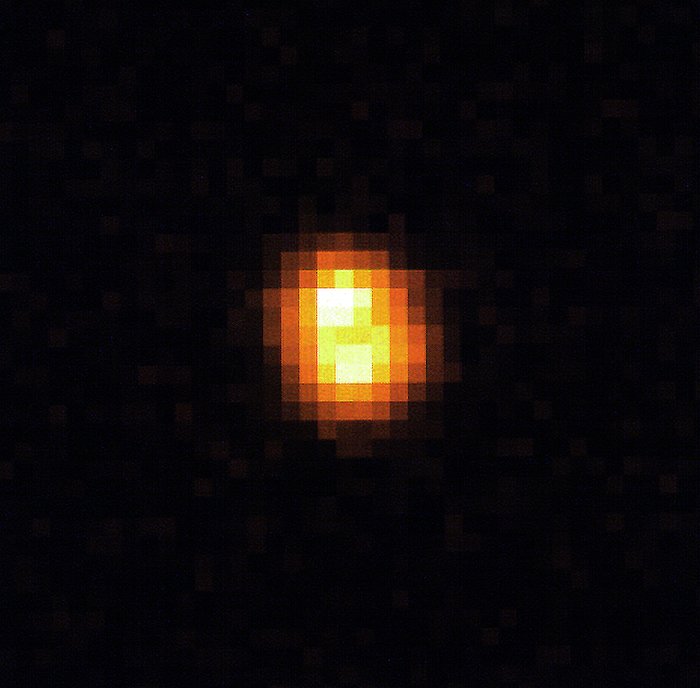


Physical characteristics
As a high-redshift active galactic nucleus, the Cloverleaf is an intrinsically luminous quasar. Its spectrum shows broad emission lines and features associated with vigorous accretion onto a supermassive black hole. The system is also classified as a broad absorption line (BAL) quasar, meaning some spectral lines exhibit strong blue-shifted absorption produced by fast outflowing gas. Millimeter and submillimeter observations have detected molecular emission (for example CO lines) from the quasar's host galaxy, made easier to study by the lensing magnification.
Discovery and follow-up observations
The multiple-image nature of H1413+117 was recognized in optical surveys and imaging that revealed four compact sources clustered within a small angular region. Higher resolution imaging and spectroscopy confirmed that the components share the same redshift and spectral features, establishing a lensing interpretation rather than a physical multiple quasar. Subsequent observations across radio, infrared and millimeter bands have probed both the lensed images and the properties of the host galaxy and intervening lensing matter.
Scientific importance and applications
The Cloverleaf serves as a useful laboratory for several areas of astrophysics. Its magnification allows detection and study of molecular gas and dust in a quasar host at an epoch when the Universe was a few billion years old. The configuration also enables tests of lens models and investigations of microlensing by stars in the lensing galaxy, which can reveal structure in the quasar's emitting regions. Time delays between light paths can in principle constrain the mass distribution of the lens and, with careful modelling, cosmological parameters.
Notable facts and distinctions
- Nickname stems from the fourfold image pattern resembling a cloverleaf.
- One of the well-studied examples of a quadruply lensed quasar, useful for lensing and host-galaxy studies.
- Shows broad absorption lines and strong molecular emission, making it important for studies of quasar winds and interstellar medium at high redshift.
Together, these characteristics make the Cloverleaf quasar a prominent object in studies of gravitational lensing, quasar physics and the interstellar medium of early galaxies. Researchers continue to monitor the system with high-resolution imaging and spectroscopy to refine lens models and to learn more about both the background quasar and the intervening mass that creates the lensing.
Related articles
Author
AlegsaOnline.com Cloverleaf quasar (H1413+117) — a four-image gravitationally lensed quasar Leandro Alegsa
URL: https://en.alegsaonline.com/art/21117