
Circinus galaxy — a nearby Seyfert galaxy behind the Milky Way
The Circinus galaxy is a nearby Type 2 Seyfert galaxy about 13 million light‑years away, lying close to the plane of the Milky Way. It hosts an obscured active nucleus, circumnuclear rings and strong multiwavelength emission.
Overview
The Circinus galaxy (catalogued as ESO 97‑G13) is a nearby active galaxy classified as a Seyfert type. Its compact nucleus produces bright emission across the electromagnetic spectrum and the object is one of the closest active galactic nuclei accessible to detailed study. Circinus lies in the small southern constellation Circinus and is often cited among the nearest galaxies with an active nucleus. The term Seyfert galaxy describes galaxies whose nuclei produce strong emission lines and significant non-stellar radiation due to accretion onto a central black hole.
Image gallery
4 Images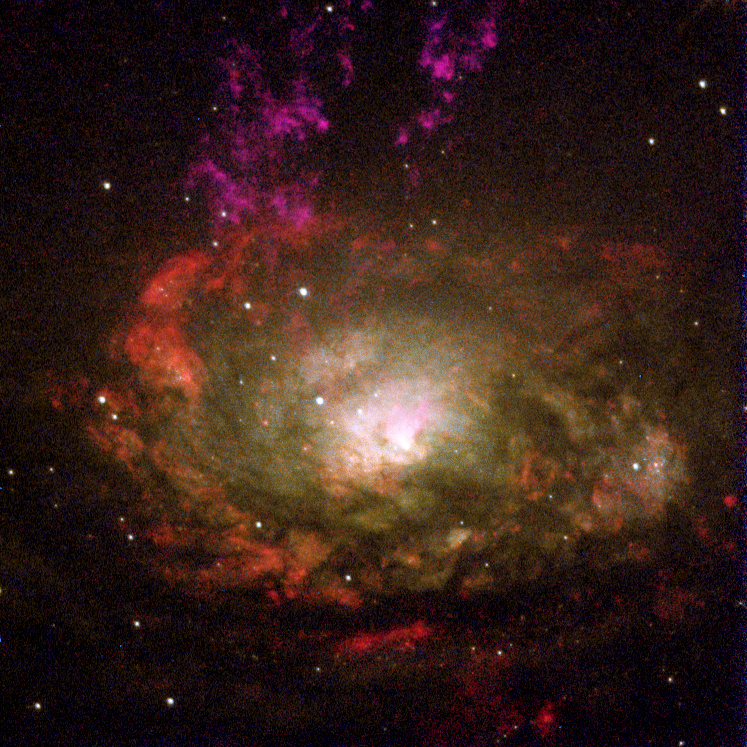


Location and distance
Viewed from Earth, Circinus appears only a few degrees below the disk of the Milky Way. Because of this low galactic latitude its light is partly obscured by intervening dust in the plane of our Galaxy, which delayed its recognition in optical surveys. Modern distance estimates place Circinus at roughly 13 million light years (about 4 megaparsecs), making it a relatively nearby extragalactic object and slightly farther than the well-known nearby radio galaxy Centaurus A. Its proximity makes it a convenient laboratory for studying active nucleus physics and circumnuclear star formation.
Active nucleus and energetic output
Circinus exhibits many hallmarks of an active galactic nucleus (AGN): a bright compact core, narrow optical emission lines, and extended ionized cones that trace illumination from the nucleus. The galaxy emits large amounts of electromagnetic radiation from radio through the infrared and into X-rays. Much of the central engine is obscured by gas and dust when seen from Earth; in X-ray studies it is often described as heavily obscured or Compton-thick, indicating that very dense material hides the innermost regions from direct view. Observations in the infrared, radio and hard X-rays are therefore important to probe the central source.
Circumnuclear rings and star formation
Surrounding the nucleus are concentric rings of gas and young stars. Observations reveal an inner ring with a radius of roughly 130 light years and a larger ring or ring-like structure around 700 light years from the center. These circumnuclear regions host intense star formation and complex interstellar structures where feedback from the AGN and from young star clusters interact. Dense molecular gas and dust lanes feed material inward, and outflows from the nucleus can excite narrow-line regions seen as ionization cones.
Maser emission and central structure
Circinus is notable for the detection of water maser emission near its nucleus. These masers trace dense molecular gas in the very central region and can be used to map the geometry and motion of gas close to the black hole. Studies of maser spots and narrow emission-line regions have provided constraints on the orientation of the nucleus and the structure of the inner accretion region.
Discovery and observational history
The galaxy escaped notice in many optical surveys until the late 1970s because it lies close to the galactic plane and suffers foreground extinction and crowding by Milky Way stars. Follow-up spectroscopy and multiwavelength campaigns in the decades since its recognition established its Seyfert classification and clarified its distance and properties. Because Circinus is relatively nearby and heavily obscured it has become a frequent target for studies that combine infrared, radio and X-ray data to penetrate the dust and reveal the active nucleus.
How to observe
Under dark skies the galaxy can be detected with modest amateur telescopes as a faint, diffuse object in the constellation Circinus; larger instruments and long exposures show its central brightness and some structure. Professional observatories and space telescopes, operating at infrared and X-ray wavelengths, have produced the most informative images and spectra because those bands are less affected by the intervening dust in the plane of the Milky Way. For context, references to the galaxy and its surroundings often compare it with nearby members of our extragalactic neighborhood and with the obscuring effect of the plane of the Milky Way.
Scientific importance and notable facts
- Circinus is a well-studied example of a Type 2 Seyfert nucleus, useful for understanding obscured AGN and the relationship between black-hole growth and star formation.
- The galaxy displays clear ionization cones and bright narrow-line regions that map the impact of the active nucleus on surrounding gas.
- Water maser detections help reveal the distribution and kinematics of molecular gas within tens of light years of the nucleus.
Because it lies close to our own Galaxy's disk yet is comparatively near in extragalactic terms, Circinus offers a valuable bridge between studies of local star formation and more distant active nuclei. Ongoing multiwavelength observations continue to refine our picture of how obscured nuclei are fed and how they influence their host galaxies; observers frequently cite its proximity and obscuration when discussing selection effects among nearby AGN and in surveys of the local universe. For further general information see resources on Seyfert galaxies and nearby extragalactic objects; the object is sometimes noted simply as a nearby, obscured active galaxy in the constellation Circinus and is catalogued in many modern surveys of the southern sky. More technical or historical references may be consulted for detailed spectroscopic and interferometric results on the nucleus and maser components, which have contributed to our understanding of central black-hole environments in nearby galaxies. For general context compare notes on the Circinus location relative to the Milky Way and other nearby systems.
Questions and answers
Q: What is the Circinus galaxy?
A: The Circinus galaxy is a Seyfert galaxy that emits large amounts of electromagnetic radiation.
Q: What constellation is the Circinus galaxy in?
A: The Circinus galaxy is in a constellation called Circinus.
Q: How close is the Circinus galaxy to the Milky Way?
A: The Circinus galaxy is one of the closest and nearest galaxies to the Milky Way, about 13 million light years away.
Q: How far away is the outer ring of the Circinus galaxy from its centre?
A: The outer ring of the Circinus galaxy is 700 light years away from its centre.
Q: How far away is the inner ring of the Circinus galaxy from its centre?
A: The inner ring of the Circinus galaxy is just 130 light years away from its centre.
Q: Is the Circinus galaxy visible with a small telescope?
A: Yes, the Circinus galaxy is visible with a small telescope.
Q: Why was the Circinus galaxy not noticed until 1977?
A: The Circinus galaxy was not noticed until 1977 because it lies close to the plane of the Milky Way and is obscured by galactic dust.
Related articles
Author
AlegsaOnline.com Circinus galaxy — a nearby Seyfert galaxy behind the Milky Way Leandro Alegsa
URL: https://en.alegsaonline.com/art/20434
Sources
- ned.ipac.caltech.edu : "NASA/IPAC Extragalactic Database"
- simbad.u-strasbg.fr : SIMBAD Astronomical Database
- books.google.com : Astronomy of the Milky Way: observer's guide to the southern sky