
Chi Cygni — a Mira-type pulsating red giant in Cygnus
Chi Cygni is a Mira-class pulsating red giant in Cygnus, notable for very large visual brightness changes and an extended atmosphere hundreds of times larger than the Sun.
Overview
Chi Cygni is a well-known long-period variable star in the constellation Cygnus. It belongs to the class of Mira variables, a subset of pulsating variable stars that show large, regular changes in brightness over many months. At maximum light Chi Cygni can be bright enough to be seen without optical aid; at minimum it fades below visual detection for most observers.
Image gallery
6 Images

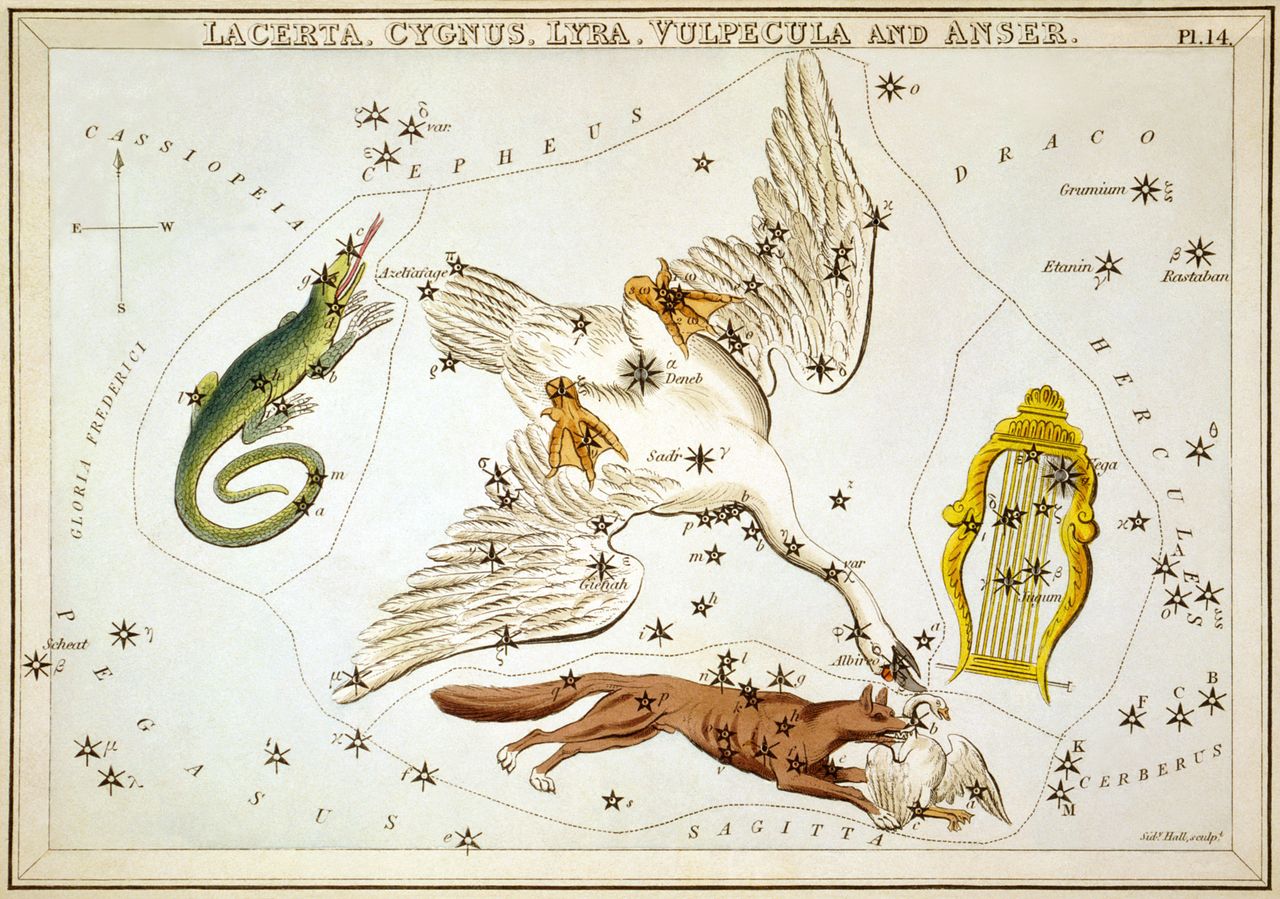


Key characteristics
Chi Cygni is a late-stage, cool giant with an extended atmosphere and intense pulsations. Its pulsation period is roughly around 400 days, placing it among long-period Miras. The star's apparent magnitude swings by many magnitudes between maximum and minimum, a hallmark of this class. Compared with the Sun, Chi Cygni's outer layers are enormously expanded — estimates commonly describe its radius as several hundred times that of the Sun, with some published values approaching the seven-hundred range.
Structure and evolutionary state
Chi Cygni is an evolved red giant on the asymptotic giant branch. Stars at this stage have exhausted core fuel and burn shells of hydrogen and helium, producing strong pulsations and heavy mass loss. Over time the star loses its envelope to the surrounding space; the remnant core will cool to become a white dwarf while the expelled material may form a planetary nebula.
Observational importance and history
Because of its large amplitude and relatively long period, Chi Cygni has been a frequent target for professional and amateur monitoring. Observations across optical, infrared and radio wavelengths probe its changing atmosphere, dust formation, and mass-loss processes. Long-term light curves help refine models of stellar pulsation and late-stage stellar evolution.
Notable facts and how to observe
Chi Cygni is notable for the dramatic color and spectral changes that accompany its brightness cycle: as it expands and cools it appears redder and shows molecular features not present at maximum. Amateur astronomers contribute useful data by timing maxima and minima or producing visual and photoelectric light curves. To locate it, observers search within the Cygnus region and watch over successive months for the predictable rise and fall in brightness.
- Type: Mira-class pulsating variable (Mira)
- Location: constellation Cygnus
- Scale: radius much larger than the Sun, often cited as several hundred times solar
For introductory reading on Mira variables and pulsating giants see general star catalogs and variable-star observer guides (variable star resources), and for stellar evolution summaries consult overviews of the red giant and asymptotic giant branch phases. More technical material and long-term data archives are available through professional databases and variable star associations (Mira research collections).
Tags
Related articles
Author
AlegsaOnline.com Chi Cygni — a Mira-type pulsating red giant in Cygnus Leandro Alegsa
URL: https://en.alegsaonline.com/art/19466