
Chandrayaan-2 — India's second lunar mission by ISRO
Chandrayaan-2 was India’s 2019 lunar mission featuring an orbiter, lander and rover to study the Moon’s south polar region; the orbiter remains active while the lander failed during descent.
Overview
Chandrayaan-2 was India’s second mission to the Moon, developed and flown by the Indian Space Research Organisation (ISRO). Launched on 22 July 2019 by a GSLV Mk III vehicle from Satish Dhawan Space Centre, the mission carried an orbiter, a soft-landing module and a small rover intended to explore the lunar surface. The plan targeted a near-polar lunar orbit and a soft touchdown close to the lunar south pole to study an area of scientific interest and relatively few prior missions.

Image gallery
10 Images




Spacecraft and main components
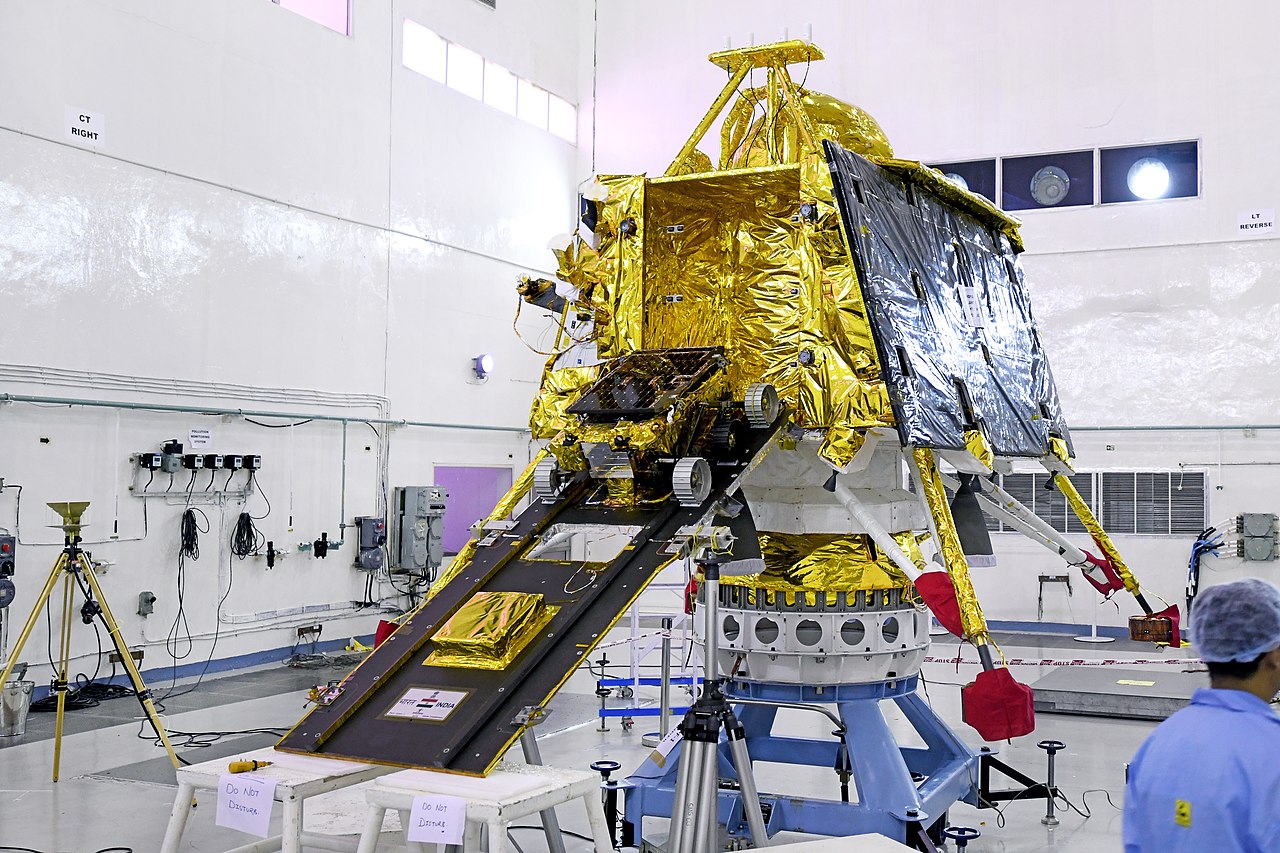
Chandrayaan-2 comprised three primary segments: the orbiter, the lander (named Vikram) and the rover (named Pragyan). The orbiter was designed to operate from lunar orbit and carry remote-sensing instruments for mapping, mineralogical studies and exosphere measurements. The lander carried instruments to characterise the immediate landing site and to deploy the rover. The rover was a small, solar-powered vehicle intended to move short distances and perform in situ analyses.
Mission timeline and outcome
The mission launched successfully on 22 July 2019 and the spacecraft was delivered to lunar transfer trajectory by the rocket. After several maneuvers the spacecraft entered lunar orbit and preparations were made for the separation and powered descent of the lander. During the final descent in early September 2019, communication was lost when the lander was near the surface. Investigations indicated loss of control during the last phase and the lander did not achieve a nominal soft landing. The orbiter, however, continued to function and carried out scientific observations from orbit for an extended period.
Scientific objectives and instruments
The mission aimed to expand knowledge of the Moon’s geology, mineralogy, surface chemistry and exosphere, with particular emphasis on the south polar region. Instruments on the orbiter and lander included spectrometers, a synthetic aperture radar, cameras and other sensors to detect surface composition, elemental abundances and water or hydroxyl signatures. Data returned by the orbiter have contributed to regional mapping and to follow-up studies of areas of interest identified by earlier missions such as Chandrayaan-1.
Historical context and significance
A successful soft landing near the lunar south pole would have made India the fourth country to achieve a soft lunar landing after the agencies of the United States, the Soviet Union and China. Even though the lander did not complete its final descent as planned, Chandrayaan-2 demonstrated complex mission capabilities: a large cryogenic-class launcher, precision orbit insertion, and operation of a multi-module lunar spacecraft. The mission expanded national and international scientific datasets and informed subsequent mission designs.
Legacy, follow-up and notable facts
The partial success of Chandrayaan-2—especially the continued operation of the orbiter—provided valuable reconnaissance and technical lessons. These lessons were applied to later Indian lunar efforts. The mission highlighted both the difficulties of powered soft landings and the value of orbital remote sensing as a resilient path to scientific return. For further overviews and technical summaries see mission pages from ISRO and related analyses (Moon mission context, south polar objectives).
- Primary goal: soft landing and surface exploration near the south pole (south pole).
- Launch vehicle: Geosynchronous Satellite Launch Vehicle Mark III (GSLV Mk III).
- Notable outcome: functional orbiter delivering scientific data while lander failed during descent.
Chandrayaan-2 remains an important case study in contemporary lunar exploration, illustrating how orbital science and iterative engineering contribute to long-term exploration goals.
Questions and answers
Q: What is the name of India's second moon mission?
A: The name of India's second moon mission is Chandrayaan-2.
Q: Who made the mission?
A: The mission was made by the Indian Space Research Organisation (ISRO).
Q: When was the mission launched?
A: The mission was launched on 22 July 2019 at 2:43 PM IST (09:13 UTC).
Q: What type of vehicle did it use to launch?
A: The mission used a Geosynchronous Satellite Launch Vehicle Mark III (GSLV Mk III) to launch.
Q: If successful, what would have been achieved?
A: If successful, India would have become the fourth country to achieve a soft landing on the Moon after space agencies from USA, USSR and China.
Q: When was the expected landing date for Chandrayaan-2?
A: The expected landing date for Chandrayaan-2 was 7 September 2019 at 01 :55 AM IST (6 September 2019, 20 :25 UTC).
Q: At what altitude did communication with Chandrayaan-2 get lost ?
A: Communication with Chandrayaan-2 got lost at an altitude of 2100 metres.
Related articles
Author
AlegsaOnline.com Chandrayaan-2 — India's second lunar mission by ISRO Leandro Alegsa
URL: https://en.alegsaonline.com/art/18535
Sources
- indianexpress.com : "ISRO to deliver "eyes and ears" of Chandrayaan-2 by 2015-end"
- isro.gov.in : "Launch Kit of GSLV Mk III M1 Chandrayaan-2"
- gadgets.ndtv.com : "Chandrayaan-2 to Be Launched in January 2019, Says ISRO Chief"
- pib.nic.in : "ISRO to send first Indian into Space by 2022 as announced by PM, says Dr Jitendra Singh"
- timesofindia.indiatimes.com : "Chandrayaan-2: All you need to know about India's 2nd Moon mission" · web.archive.org
- isro.gov.in : "Chandrayaan-2 – Home"
- isro.gov.in : "Chandrayan-2 Launch Rescheduled on 22nd July, 2019, AT 14:43 HRS"
- timesofindia.indiatimes.com : "Chandrayaan-2 launch put off: India, Israel in lunar race for 4th position"
- timesofindia.indiatimes.com : "ISRO chief signals India's readiness for Chandrayaan II mission"
- theguardian.com : "India's Chandrayaan-2 moon mission lifts off a week after aborted launch"
- isro.gov.in : "GSLV-Mk III – M1 / Chandrayaan-2 Mission"
- youtube.com : Chandrayaan-2 – India's Second Moon Mission