
Aitne (Jupiter moon)
Aitne (Jupiter XXXI) is a small, irregular retrograde satellite of Jupiter discovered in 2001; part of the Carme group and named after the divine personification of Mount Etna.
Overview
Aitne, designated Jupiter XXXI and originally announced as S/2001 J 11, is a small irregular moon of Jupiter. It is non-spherical in shape and too small for self-gravity to have pulled it into a round figure; such bodies are typically fragments captured or produced by past collisions. For a brief note on its form see non-spherical.
Image gallery
2 Images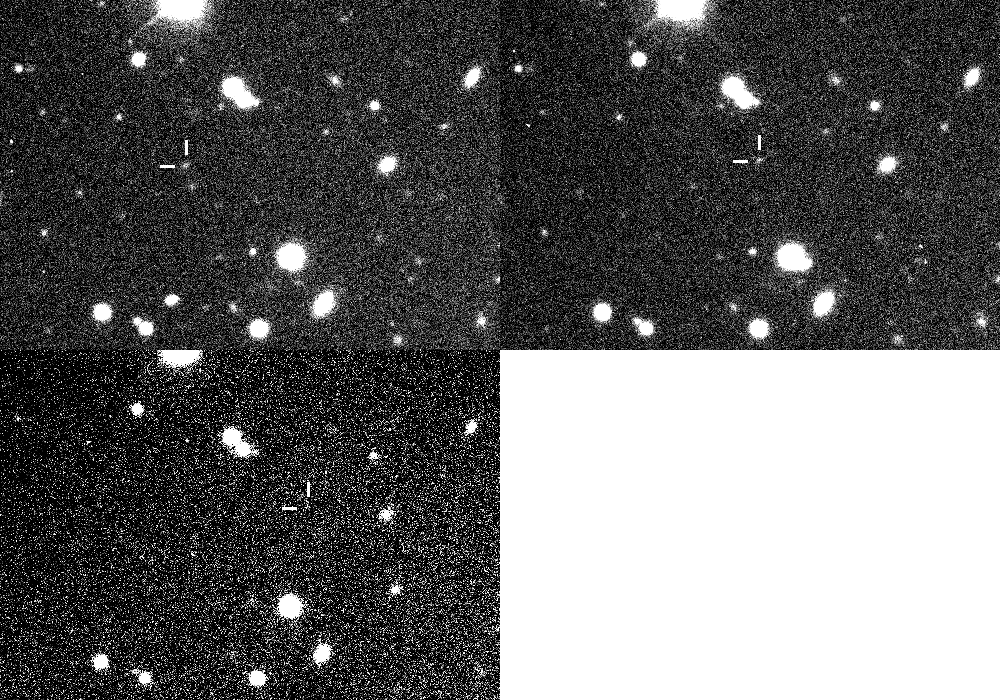

Physical characteristics
The satellite measures only a few kilometres across—commonly cited as about 3 km in mean diameter—and has a dark, likely rocky surface typical of many distant Jovian irregulars. Its modest size and irregular form place it among the population of minor satellites that are not geologically active and whose surfaces are shaped by impacts and space weathering.
Orbit and group
Aitne follows a distant, eccentric, retrograde orbit around Jupiter. Its average orbital radius is on the order of 22–24 million kilometres and its orbital period is roughly 680 days. The orbit is inclined strongly with respect to the ecliptic—around 164–166° measured relative to Jupiter's equator—and its eccentricity is significant (about 0.39), producing a noticeably elongated path. Because of these parameters, Aitne is classified with the Carme group, a cluster of irregular, retrograde moons that share similar orbital distances and inclinations. For background on retrograde motion among satellites, see retrograde.
Discovery and observational history
Aitne was discovered in 2001 by a team of astronomers working at the University of Hawaii, led by Scott S. Sheppard. The discovery announcement credits the group with several new Jovian satellites identified that year; the team and institution are discussed in more detail at University of Hawaii and in a summary of the discoverers led by Scott S. Sheppard. The provisional designation S/2001 J 11 records the year and host planet; the discovery was publicized alongside other finds from 2001 (2001 discoveries).
Name and mythology
The name Aitne (sometimes spelled Aitna) was assigned in August 2003. It derives from the Greek mythological personification of Mount Etna, a volcanically associated deity. In mythological accounts Aitne is connected to Zeus (the Greek analogue of Jupiter) and to the Sicilian twin gods known as the Palici; for those mythic links see Mount Etna, Zeus, and the Palici. Variations in ancient sources leave some genealogical details uncertain, which is common for mythic figures.
Importance and context
Although Aitne itself is small and offers limited opportunities for direct investigation, it contributes to the broader understanding of Jupiter's irregular satellite system. Members of the Carme group are believed to be fragments of a larger progenitor that was captured and later disrupted. Studies of such groups help astronomers trace collisional histories and the processes of capture in the early Solar System. For general orbital parameters and definitions see ecliptic and eccentricity.
For further reading on discovery teams and observational campaigns that locate faint outer satellites, consult summaries and databases maintained by professional survey groups and planetary science programs (non-spherical, University of Hawaii, Scott S. Sheppard).
Related articles
Author
AlegsaOnline.com Aitne (Jupiter moon) Leandro Alegsa
URL: https://en.alegsaonline.com/art/1722
Sources
- cfa-www.harvard.edu : IAUC 7900: Satellites of Jupiter
- cfa-www.harvard.edu : MPEC 2002-J54: Eleven New Satellites of Jupiter · webcitation.org
- cfa-www.harvard.edu : IAUC 8177: Satellites of Jupiter, Saturn, Uranus