
Albiorix — an irregular moon of Saturn
Albiorix is a prograde irregular satellite of Saturn, largest member of the Gallic group. Discovered in 2000, it is a small, non-spherical body thought to be a remnant of early collisions in Saturn's outer system.
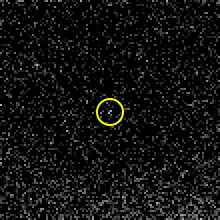
Albiorix is a distant, irregular moon of Saturn notable for its non-spherical shape and membership in a small cluster of similar satellites. Detected in 2000 and initially designated S/2000 S 11, it is the largest recognized member of the so-called Gallic group. Albiorix orbits far from Saturn at roughly sixteen million kilometres and appears small and dark in available observations; assuming a low reflectivity, its diameter is commonly estimated at about 32 kilometres. Photometric measurements indicate a rotation period on the order of half a day, often cited as approximately 13 hours and 19 minutes.
Image gallery
2 Images
Physical characteristics
Compared with Saturn's large regular moons, Albiorix is tiny and irregular in both shape and surface appearance. Key properties reported by observers include a low assumed albedo, a moderately eccentric and inclined prograde orbit, and a surface whose colour varies across the body. These features are typical of the outer irregular satellites, which are believed to be captured or collisional fragments rather than objects that formed in place.
- Shape: non-spherical, irregular.
- Size: roughly 32 km in diameter (albedo-dependent).
- Orbit: distant, prograde, and moderately eccentric.
- Rotation: rapid compared with orbital period; photometry gives a day near 13 h 19 min.
Discovery and name
The moon was discovered by a team led by W. M. Keck Observatory collaborator Holman and colleagues in 2000 and carried the provisional tag S/2000 S 11. In August 2003 it received the name Albiorix, drawn from a Celtic tradition — one of several names associated with a deity connected to tribal unity and sometimes linked with the figure better known as Toutatis. Naming irregular satellites after mythological figures from a consistent cultural set helps group related objects and follow International Astronomical Union conventions.
Group membership and origin hypotheses
Albiorix is considered the principal member of the Gallic group, a collection of prograde irregular satellites that share similar orbital elements and surface colours. Spectral and photometric studies have found variations across Albiorix's surface; one interpretation is that a large impact basin or crater exposes different material, producing colour differences. Another idea is that smaller moons in the same group, such as Erriapo and Tarvos, may be fragments produced by a past collision that partially disrupted a larger progenitor — possibly Albiorix itself. These scenarios are consistent with collisional family formation seen elsewhere in the Solar System, but they remain hypotheses based on remote sensing rather than direct imaging.
Observation, significance, and challenges
Albiorix and its companions are faint and challenging to observe from Earth. Most knowledge about them comes from ground-based surveys, long-term astrometric tracking, and colour photometry using large telescopes. Their study matters because irregular satellites preserve clues about the history of capture, collisional evolution, and the population of small bodies in the outer planetary systems. By comparing orbital clustering, surface properties, and rotation states, astronomers build models of how Saturn's outer satellite system assembled and how collisions have reshaped it over time.
For further general background on irregular moons, naming conventions, photometric methods, and group classifications see resources on non-spherical satellites, the Gallic group, and Celtic mythological names used in planetary nomenclature (Celtic traditions). Technical terms such as albedo and orbital points like pericentre and apocentre are useful when reading detailed studies. Suggested impact features and collisional links are discussed in papers and notes that explore surface colour differences and candidate fragments (impact hypotheses, Erriapo and Tarvos).
Questions and answers
Q: What is Albiorix?
A: Albiorix is a non-spherical moon of Saturn that was discovered in 2000.
Q: Who discovered Albiorix?
A: Albiorix was discovered by Holman, et al. in 2000.
Q: What is the Gallic group of non-spherical moons?
A: The Gallic group of non-spherical moons is a group of satellites of Saturn that share similar orbital characteristics.
Q: How did Albiorix get its name?
A: Albiorix was named after one of the Celtic names for the god of tribal unity, better known as Toutatis, in August 2003.
Q: How far does Albiorix orbit Saturn?
A: Albiorix orbits Saturn at a distance of about 16,000,000 km.
Q: What is the diameter of Albiorix?
A: The diameter of Albiorix is estimated at 32 kilometers, assuming an albedo of 0.04.
Q: What is the day length of Albiorix?
A: A day on Albiorix is 13 hours and 19 minutes long.
Related articles
Author
AlegsaOnline.com Albiorix — an irregular moon of Saturn Leandro Alegsa
URL: https://en.alegsaonline.com/art/2163