
Mount Etna: Sicily’s active stratovolcano and its impact
Mount Etna is Europe's largest active volcano on Sicily's east coast, famed for frequent eruptions, fertile soils, scientific study, tourism and long-term monitoring.
Mount Etna is a large, frequently active volcano on the east coast of Sicily, southern Italy. Rising to roughly 3,300 metres above sea level (its summit height varies as eruptions add or remove material), Etna dominates the regional landscape and influences local climate, agriculture and settlement. It is widely regarded as the largest active volcano in Europe and has been intensively studied by geologists, volcanologists and seismologists.
Image gallery
10 Images




Structure and volcanic behaviour
Etna is commonly described as a stratovolcano, but it has a complex architecture: a main central complex of summit craters, numerous parasitic cones and many flank vents. Its eruptions are typically basaltic, producing both effusive lava flows and Strombolian-style explosive activity; more energetic ash columns and intermittent Vulcanian or sub-Plinian events also occur. Magma supply, faulting and regional tectonics combine to produce frequent but variable eruptive behaviour. Repeated deformation and slip on the volcano’s flanks have been recorded during strong eruptive episodes.
Historic eruptions and notable events
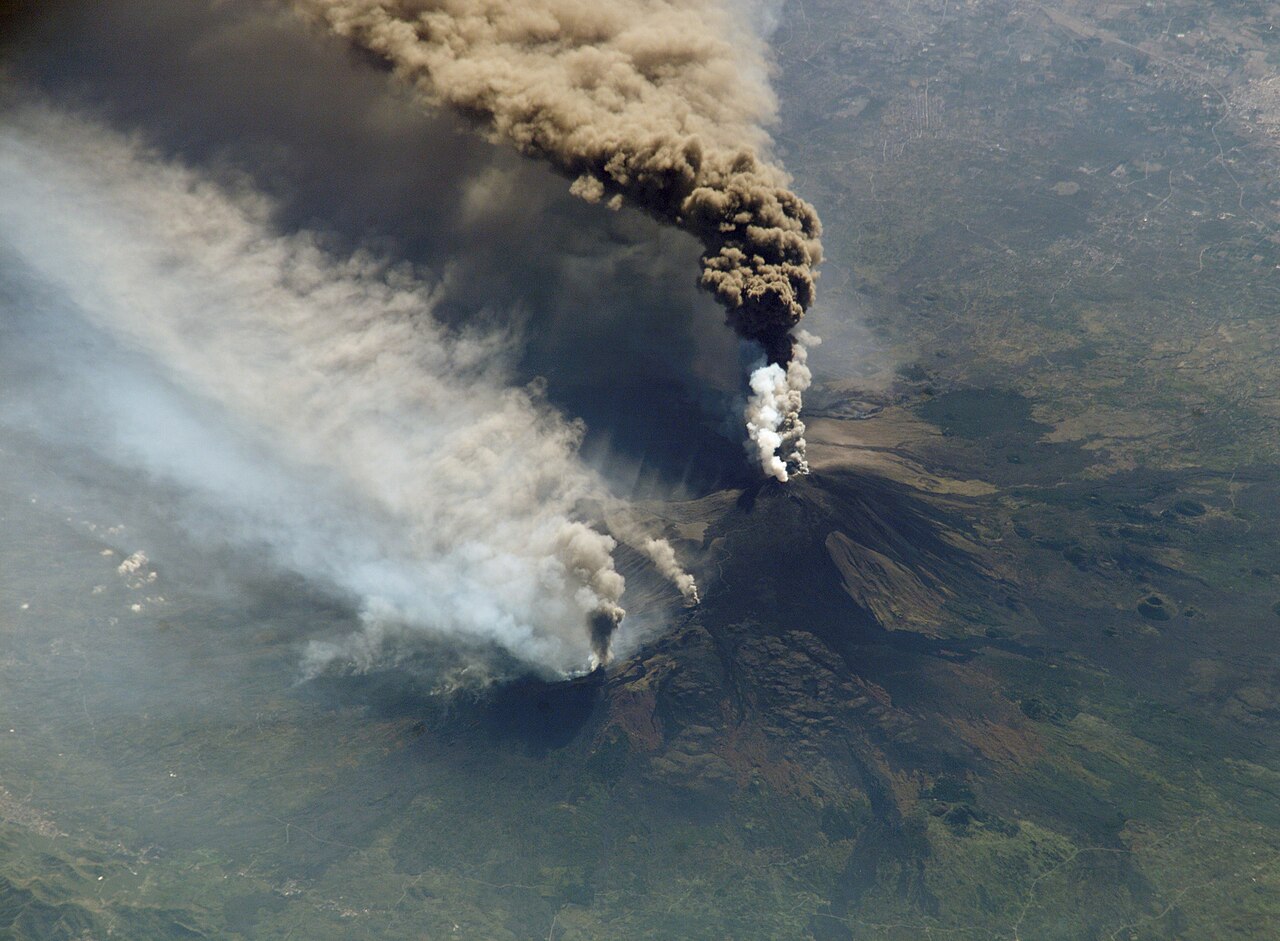
Written and archaeological records show Etna has been active for thousands of years and figures in local tradition and classical literature. Among historic episodes, a major destructive eruption began on 11 March 1669 and produced extensive lava flows that reached the outskirts of Catania weeks later. The 20th and early 21st centuries have seen multiple significant eruptions, including notable activity in 1928, 1949, 1971, 1983, 1992, 2001 and the extensive 2002–2003 sequence. The 2002–2003 events produced high ash columns visible from space, widespread ashfall, substantial slope deformation on the eastern flank and damage to buildings and mountain facilities. Repeated recent activity has made Etna one of the best monitored volcanoes in the world.
Recent activity and monitoring
Etna remains active with frequent eruptions and persistent fumarolic activity at the summit. Italian and international scientific bodies maintain dense monitoring networks of seismometers, GPS and tiltmeters, gas sensors and satellite remote sensing to track magma movement, ground deformation and ash emissions. The Istituto Nazionale di Geofisica e Vulcanologia (INGV) plays a central role in real-time monitoring, hazard assessment and public communication. Continuous observations provide valuable data for research into eruption mechanics and volcanic hazards.
Hazards and mitigation
Hazards associated with Etna include lava flows that can threaten buildings and roads, ash fall that disrupts transport and air traffic, ballistic projectiles around vents, gas emissions and earthquake shaking related to volcanic processes. Local authorities and scientists cooperate on contingency planning, civil protection measures and early-warning procedures. In some historic cases, civil engineering measures and diversion efforts have been used to protect towns from advancing lava; public education and land-use planning are key to reducing long-term risk.
Economy, ecology and cultural importance
The volcanic soils on Etna’s slopes are fertile and support vineyards, orchards and horticulture; wines and agricultural products from the Etna area have growing recognition. The mountain also supports a range of ecosystems from Mediterranean scrub to subalpine vegetation in higher elevations. Etna has deep cultural resonance in Sicily, appearing in myth, literature and regional identity. Parts of the mountain and its surroundings are protected for natural and cultural values and are a focus for conservation and sustainable tourism.
Tourism, recreation and research
Etna attracts hikers, scientists and many visitors keen to see recent lava flows, fumaroles and panoramic views of the island. Facilities for guided excursions, mountain huts and seasonal skiing on its slopes are part of the local visitor offer, though access is regulated during hazardous activity. The volcano provides an accessible natural laboratory for education and research into volcanic processes, eruption forecasting and magma dynamics.
Further information and resources
- General overview and basic facts: Mount Etna overview
- Geography and location on Sicily: Sicily and Etna
- Europe’s largest active volcano: Etna in Europe
- Volcanic products such as lava and ash: Lava and ash information
- Impact on nearby towns like Catania: Catania and Etna
- Long-range ash dispersal events: Ash transport examples
- Mediterranean context and regional effects: Mediterranean impacts
- Seismic monitoring and research: Seismic studies of Etna
Because Etna remains active, its shape and height change over time and new eruptions continue to influence local communities, science and tourism. Ongoing monitoring, hazard planning and public education are central to living with one of Europe’s most prominent and dynamic volcanoes.
Questions and answers
Q: Where is Mount Etna located?
A: Mount Etna is located on the east coast of Sicily, part of southern Italy.
Q: How often does Mount Etna erupt?
A: Mount Etna erupts every few years.
Q: What was the most destructive eruption of Mount Etna in historic times?
A: The most destructive eruption of Mount Etna in historic times started on 11 March 1669.
Q: How many villages were destroyed by the lava flows from the 1669 eruption?
A: The lava flows from the 1669 eruption destroyed 10 villages.
Q: When did the 1992 eruption of Mount Etna occur and what was its impact?
A: The 1992 eruption of Mount Etna occurred and the town of Zafferana was threatened by a lava flow, but successful diversion efforts saved the town with the loss of only one building few hundred metres outside it.
Q: What happened during the 2002-2003 eruptions of Mount Etna?
A: The biggest series of eruptions for many years threw up a huge column of ash that could easily be seen from space and fell as far away as Libya, and seismic activity in this eruption caused the eastern flanks of the volcano to slip by up to two metres and many houses on the flanks of the volcano were damaged.
Q: What was destroyed during the 2002-2003 eruption of Mount Etna?
A: The Rifugio Sapienza, a ski resort on the southern flank of the volcano, was destroyed during the 2002-2003 eruption of Mount Etna.
Related articles
Author
AlegsaOnline.com Mount Etna: Sicily’s active stratovolcano and its impact Leandro Alegsa
URL: https://en.alegsaonline.com/art/67025