
Allen Telescope Array
A radio interferometer of small dishes at Hat Creek, California, built for combined radio astronomy and SETI work; notable for commensal observing, wideband receivers, and its large-number-small-dishes design.
Overview
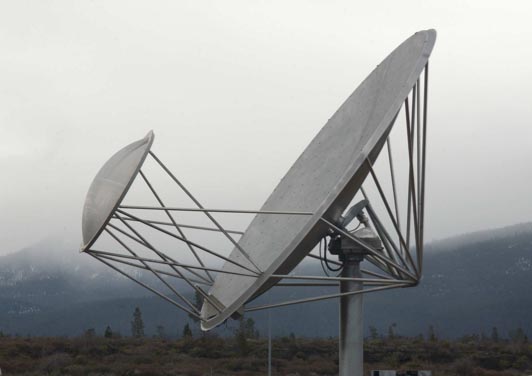
The Allen Telescope Array (ATA) is a radio interferometer located at the Hat Creek Radio Observatory in northern California. Conceived to support both traditional radio astronomy and the search for extraterrestrial intelligence (SETI), the ATA was developed through a collaboration between the SETI Institute and the Radio Astronomy Laboratory at the University of California, Berkeley (RAL). Its design follows the large-number-small-dishes (LNSD) philosophy: many modest-sized antennas working together to produce survey speed and flexibility that are difficult to achieve with a single large dish. The project was named for philanthropist Paul Allen and was formerly called the One Hectare Telescope.
Image gallery
6 Images




Design and components
The ATA uses an array of small parabolic antennas with broadband feeds and a digital signal-processing backend. Rather than rely on a few very large dishes, the array combines signals from many elements through correlation and beamforming to synthesize images, form multiple simultaneous beams, and enable commensal observations—running SETI searches in parallel with conventional science projects. The array architecture emphasizes wide instantaneous bandwidth and flexible digital electronics so observers can search for narrowband signals, conduct spectral-line studies, and monitor fast transients without changing hardware.
History and development
Construction began in the 2000s with the aim of ultimately deploying several hundred antennas on a roughly hectare-scale site. An initial operating group of 42 antennas, commonly referred to as ATA-42, was commissioned in October 2007 and permitted early scientific and SETI observations. Fundraising and operating-cost challenges have affected the project's continuity: operations were curtailed in 2011 for financial reasons, short-term support allowed partial resumption later that year, and organizational changes followed, including the University of California, Berkeley stepping back from active project management in 2012. The ATA remains an influential testbed for array concepts and digital observing techniques.
Scientific uses and importance
The ATA was built to serve multiple observational goals. Typical scientific uses include wide-area continuum and spectral-line surveys, monitoring and discovery of transient radio sources, pulsar searches and timing, and targeted SETI searches for technosignatures. Its ability to form many independent beams and to run commensal programs makes it particularly useful for long-duration monitoring campaigns and rapid follow-up of transients detected at other wavelengths. The combination of modest dish size and large element count gives a favorable trade-off between survey speed and sensitivity for many classes of experiments.
Notable features and legacy
- Commensal observing: simultaneous radio astronomy and SETI searches enabled by beamforming and digital backends.
- LNSD approach: many smaller antennas to increase sky coverage and survey throughput.
- Wideband receivers and flexible digital processing, allowing diverse science without frequent hardware changes.
- Named in recognition of support from Paul Allen and linked in public perception to broader technology philanthropy (he was co‑founder of Microsoft).
For more technical descriptions and ongoing updates, readers can consult materials from the building institutions, such as the Radio Astronomy Laboratory and the SETI Institute, which document the ATA's engineering choices, science programs, and status. The ATA remains an instructive example of how modern digital techniques and an array-of-dishes strategy can expand observational capability in radio astronomy and SETI.
Additional background on radio astronomy as a discipline and its instrumentation is useful for context; introductory resources are available from observatory and research institutions that describe the principles of interferometry, spectral-line work, and transient detection in radio bands (radio astronomy overviews).
Questions and answers
Q: What is the Allen Telescope Array (ATA)?
A: ATA is a radio interferometer developed by the SETI Institute and the Radio Astronomy Laboratory (RAL) at the University of California, Berkeley for radio astronomy observations and the search for extraterrestrial intelligence.
Q: Where is ATA located?
A: ATA is located at the Hat Creek Radio Observatory, which is 290 miles (470 km) northeast of San Francisco, California.
Q: What is the goal of ATA?
A: The goal of ATA is to have 350 antennas to improve its radio astronomy observations and search for extraterrestrial intelligence.
Q: When did ATA start operations and how many antennas were used then?
A: ATA started operations on October 11, 2007, with 42 antennas (ATA-42).
Q: Why did ATA stop operations in April 2011?
A: Lack of money stopped operations in April 2011.
Q: Did ATA get short-term funding after operations were stopped?
A: Yes, ATA got short-term funding in August 2011.
Q: Why is ATA named after Paul Allen?
A: ATA is named after Paul Allen, the co-founder of Microsoft, who made significant contributions to the project. Its old name was the One Hectare Telescope (1hT).
Related articles
Author
AlegsaOnline.com Allen Telescope Array Leandro Alegsa
URL: https://en.alegsaonline.com/art/2794
Sources
- news.cnet.com : "SETI's large-scale telescope scans the skies"
- latimes.com : "Aliens get a new switchboard: a SETI radio telescope in Northern California"
- archive.seti.org : archive.seti.org/pdfs/Shostak-spring2009-EnS.pdf
- nytimes.com : "Stretching the Search for Signs of Life"
- news.bbc.co.uk : "Skies to be swept for alien life"
- fcw.com : "SETI stops listening for alien signals -"
- archive.seti.org : archive.seti.org/pdfs/ATA-hibernation.pdf
- geekwire.com : "Search for ET continues as Paul Allen-backed telescope hits short-term funding goal"