
Retrograde and Direct Motion in Astronomy
Overview of prograde (direct) and retrograde motion: definitions, real vs apparent retrograde, causes, historical context, examples from planets, moons, asteroids, and observational consequences.
Overview: In astronomy, direct motion (also called prograde motion) describes a body moving in the same rotational sense as the primary object it orbits, while retrograde motion denotes motion in the opposite sense. The distinction can apply both to a body's orbit around a central object and to its own rotation on an axis. For a planetary body or satellite, prograde orbits generally follow the same direction as the central object's rotation; retrograde orbits move contrary to that direction. Observers and textbooks often separate apparent retrograde motion—an optical effect seen from a moving vantage point—from genuine retrograde orbits or spins that reflect the body's actual motion in space.
Image gallery
7 Images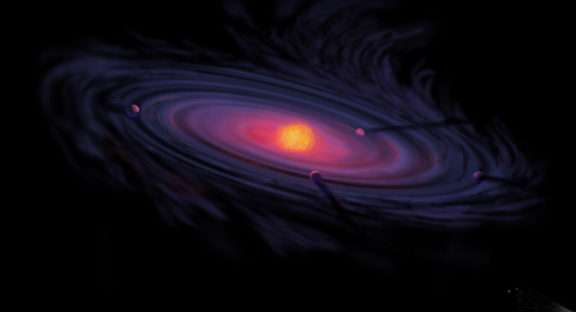




Key characteristics and definitions
Several practical definitions help determine whether a motion is retrograde or prograde. Orbital inclination is commonly used: an inclination between 0° and 90° (measured relative to the reference plane) indicates prograde motion, while an inclination greater than 90° up to 180° indicates a retrograde orbit. Rotational retrograde refers to the direction of axial spin; for example, Venus has a slow retrograde rotation relative to most planets. Irregular satellites and many small captured objects often display retrograde or highly inclined orbits because their origin differs from the main disk that formed most planets.
Real retrograde motion and common examples
Real retrograde motion occurs when the physical orbit or rotation is opposite to the standard reference sense. Notable examples include the retrograde orbit of Neptune's large moon Triton and groups of captured Jovian moons such as the Carme group, which orbit Jupiter in the opposite direction to the planet's rotation. Some planets show unusual rotations: Venus rotates slowly in a retrograde sense and Uranus has a very large axial tilt that makes its rotation appear retrograde under some definitions. Many comets and some asteroids follow retrograde or highly inclined paths because they originate from distant reservoirs or were perturbed by past encounters.
Apparent retrograde motion: geometry and observation
Apparent retrograde motion is an observational phenomenon that arises from relative motion between the observer (usually on Earth) and other orbiting bodies. When Earth overtakes an outer planet in its faster inner orbit, that planet appears to slow, reverse and trace a retrograde loop against the fixed stars before resuming prograde motion. This effect is most obvious for outer planets near opposition and is governed by relative orbital speeds and positions. Inner planets (Mercury and Venus) also show apparent retrograde segments when observed near inferior conjunction because of their interior orbits. The term outer planets is often used in discussion of opposition-phase retrograde loops.
Causes and dynamical origins
Most objects in a planetary system formed from a rotating disk of gas and dust and therefore inherited a common direction of orbital motion. Retrograde or highly inclined orbits typically arise later, through capture of external objects, gravitational interactions, or large collisions that alter spin. For moons, capture is a leading explanation for retrograde groups; for planets, giant impacts in the early system can change axial tilt or reverse spin. The physical distinction between rotation and revolution matters: a body may have prograde revolution while simultaneously having retrograde rotation, or vice versa, depending on its history and interactions. For clarity, one may compare terms like rotation and orbit when describing a specific case.
History, interpretation, and significance
Apparent retrograde motion played a central role in the history of astronomy. In geocentric models, complex devices such as epicycles were introduced to account for observed loops. The heliocentric model of Copernicus and the later laws of planetary motion by Kepler and Newton provided a simpler geometric and dynamical explanation: retrograde loops are natural consequences of relative orbital motion. Today the term remains important in orbital mechanics, mission planning and the study of solar system formation: whether an object orbits prograde or retrograde helps researchers infer its origin, past encounters and long-term dynamical stability.
Notable facts: Most major planets orbit in a prograde sense around the Sun, reflecting the angular momentum of the primordial disk. Retrograde orbits are much more common among captured, irregular satellites and some comets. Observers learning to follow the night sky can often spot apparent retrograde motion over weeks or months near opposition; amateurs and professionals alike use that behavior to predict positions and plan observations.
For further reading, introductory materials and observational guides often contrast apparent and true retrograde motion and show simple diagrams to make the geometry clear. Research literature and orbital catalogs document many specific retrograde cases in detail and can be consulted for specialized study.
planetary body | Carme group | rotation | orbit | outer planets | opposition
Related articles
Author
AlegsaOnline.com Retrograde and Direct Motion in Astronomy Leandro Alegsa
URL: https://en.alegsaonline.com/art/82352