
Cantonese language: overview, history, phonology and global presence
Comprehensive overview of Cantonese: its linguistic features, history, written forms, geographic distribution, relation to other Chinese varieties, and cultural significance.
Overview: Cantonese is a principal branch of the Yue varieties of Chinese historically centered on the Pearl River Delta. It is widely recognized as the prestige speech of Guangzhou (Canton) and Hong Kong and remains a major language of daily life, media and culture in those areas. Speakers often call the Guangzhou and Hong Kong lects "Cantonese," but linguists distinguish the broader Yue group from the specific urban standard associated with Guangzhou and Hong Kong. See general information about the language family: Sino-Tibetan family, and the regional origin: Canton (Guangzhou).
Image gallery
3 Images

Key linguistic characteristics
Cantonese is a tonal, analytic language with monosyllabic morphemes typical of Sinitic languages. It preserves a set of final consonants and a number of syllable distinctions that have been reduced or lost in Mandarin. Tone systems are often described with six main tones in many analyses (with additional entering tone categories), and the inventory of initials and finals yields a rich set of syllable shapes. Its sound system, register distinctions and numerous colloquial expressions give Cantonese a distinct phonetic identity compared with other varieties such as Mandarin and Wu.
Cantonese is sometimes called a "dialect" of Chinese (dialect) in everyday usage, but the degree of mutual unintelligibility with Mandarin is high: native speakers of each often cannot understand the other without study, a phenomenon described as mutual unintelligibility. Cantonese retains more conservative pronunciations in some respects and shows affinities to earlier stages of Chinese, including many forms found in Classical Chinese. The term Chinese covers a range of Sinitic varieties rather than a single uniform language.
Geography, speakers and diaspora
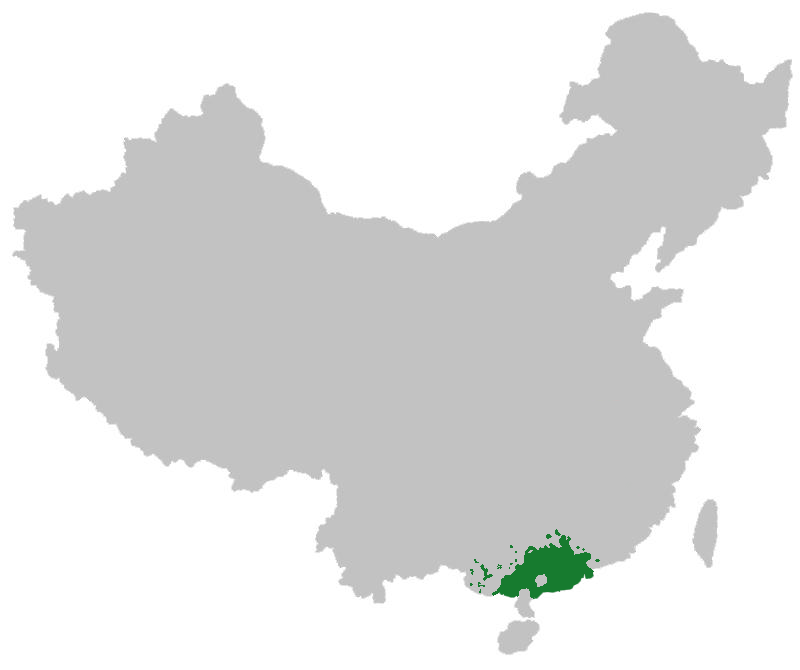
Cantonese is spoken natively in parts of southern China and in the two Special Administrative Regions: Hong Kong and Macau. It is also present across Southeast Asia and in overseas Chinese communities: notable locations include Malaysia, Singapore, and cities such as Melbourne. Cantonese-speaking communities are significant in parts of Southeast Asia and North America. Estimates of speakers vary by source; many millions use Cantonese as a first or heritage language, and it functions as a lingua franca in several urban and immigrant settings (spoken widely).
Writing and registers: In formal writing Cantonese speakers commonly use standard written Chinese conventions based on the broader Sinitic tradition and typically employ Traditional characters in Hong Kong and Macau. In informal contexts—comics, online chat, popular music and local media—distinct written Cantonese forms appear, using characters or symbols to represent colloquial words and grammatical features absent from standard written Chinese.
- Preservation: Cantonese conserves certain final consonants and syllable distinctions lost in other varieties.
- Registers: formal written Chinese versus colloquial Cantonese used in speech and popular culture.
- Media presence: strong in film, television, pop music and local broadcasting in Hong Kong and diaspora centers.
History and development: Cantonese developed within the Yue branch and absorbed influences from local substrate languages and trade contacts. Over centuries it has evolved its own vocabulary, idioms and pronunciation patterns distinct from northern varieties centered on Beijing. Modern prestige forms emerged around Guangzhou and later Hong Kong, where Cantonese became a central medium of education, administration and entertainment.
Notable facts and distinctions: Cantonese occupies a high social and cultural profile in the Cantonese-speaking world. Linguists often treat it as one of several Sinitic major varieties, alongside Mandarin and Wu. Its relation to older forms of Chinese explains why some classical readings appear closer to Cantonese pronunciations than to modern Mandarin. For general reference and comparative descriptions see links: classification, language status, Cantonese, Mandarin variants, and resources on cultural geography: intelligibility studies. For regional snapshots and policy contexts consult dedicated pages about where it is spoken, local communities and language planning.
Researchers and language learners benefit from comparing spoken samples, tone charts and syllable inventories. Practical exposure—films, music, conversation—remains the most effective way to gain familiarity with Cantonese' distinctive sounds and expressive vocabulary.
Further reading and external resources are available through regional language institutes and community organizations; for curated starting points see institutional links: overview, Hong Kong resources, Macau resources, and diaspora support networks in Southeast Asia and North America.
Questions and answers
Q: What is Cantonese?
A: Cantonese is an East Asian language which comes from Canton, southern China. It is often used to refer to the Guangzhou dialect, Hong Kong dialect, Xiguan dialect, Wuzhou dialect and Tanka dialect of Yue.
Q: Where is it spoken?
A: Cantonese is spoken by people in Southern China, Hong Kong, Macau, Malaysia and Singapore as well as places with many overseas Chinese who came from Cantonese-speaking parts of China such as Melbourne. It is also the most common language of overseas Chinese in Southeast Asia and North America.
Q: How many people speak it?
A: It is said that over 100 million people speak Cantonese.
Q: Is it a tonal language?
A: Yes, it has 6 kinds of tones.
Q: How does its status compare to other Chinese languages?
A: While Cantonese is only the third most spoken dialect of Chinese after Mandarin and Wu, its official status in Hong Kong and Macau make it widely known among other Chinese dialects.
Q: Is it mutually intelligible with Mandarin?
A: No, they are not mutually intelligible meaning that a speaker of one language cannot understand the other language without learning it beforehand.
Q: Is there any relationship between Classical or Traditional Chinese and Cantonese?
A: It is said that Cantonese is more closely related to Classical Chinese or Traditional Chinese than Mandarin.
Tags
Related articles
Author
AlegsaOnline.com Cantonese language: overview, history, phonology and global presence Leandro Alegsa
URL: https://en.alegsaonline.com/art/16657
Sources
- omniglot.com : "Spoken Chinese"
- scmp.com : "Cantonese almost became the official language"