
California newt (Taricha torosa)
An overview of the California newt, Taricha torosa: appearance, life cycle, toxin and predators, range in California, ecological role and conservation concerns.
Overview
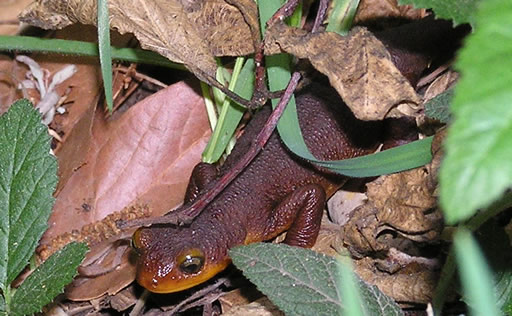
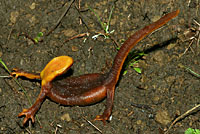
The California newt (Taricha torosa) is a medium-sized amphibian in the broader group of newts. Endemic to the U.S. state of California, it is commonly called the orange-bellied newt because of its bright underside. Adults typically reach about 8 inches (20 cm) in length and alternate between aquatic breeding periods and a mostly terrestrial lifestyle outside the breeding season.
Image gallery
6 Images



Identification and biology
California newts have rough, dry skin on the back that ranges from brown to dark olive and a conspicuous orange to yellow belly. Key characteristics include a stout body, relatively short limbs, and a rounded tail. Their skin contains potent toxins; the compound most often associated with newt toxicity is tetrodotoxin, which can cause serious illness if ingested. For this reason their toxic skin protects them from many predators and serves as a warning signal (aposematism).
Life cycle and behavior
Breeding usually takes place in still or slow-moving water during cooler seasons. Males court females and attach to them in amplexus while the female lays eggs in gelatinous strands wrapped around aquatic vegetation. Larvae develop in the water until metamorphosis, after which juveniles disperse onto land. California newts feed on small invertebrates such as worms, slugs and insects, and are largely nocturnal when active on land.
Predators, toxin interactions and notable ecology
Although the toxin deters most would-be predators, some species—most notably certain garter snakes—are known to prey on California newts. Populations of garter snakes vary in their tolerance to the newt's toxin, allowing a limited predator–prey interaction in some areas. This biochemical defense and the corresponding predator responses have made the species a subject of ecological and evolutionary study.
Range, habitat and threats
Taricha torosa occupies coastal ranges and interior foothills across parts of California. It uses terrestrial refuges such as logs and leaf litter outside the breeding season and returns to ponds, marshy pools or slow streams to reproduce. Threats to the species include habitat loss and fragmentation, road mortality during migrations to breeding sites, introduced predators (for example non-native fish or bullfrogs), pollution and disease. Conservation efforts emphasize habitat protection, creating safe migration passages and monitoring populations.
Human interactions and best practices
People should avoid handling newts because of their toxic skin secretions and to reduce stress on the animals; any handling should follow local wildlife guidance. Observers and researchers rely on field surveys and habitat assessments to track populations. For additional information on identification, range maps and conservation advice see resources linked here: garter snake interactions, California distribution and general species accounts (Taricha torosa).
- Common name: California newt or orange-bellied newt
- Scientific name: Taricha torosa
- Size: up to ~8 inches (20 cm)
- Toxin: tetrodotoxin (skin secretions)
For further reading and regional guidance consult local wildlife authorities and amphibian conservation organizations. Respecting breeding habitats during the wet season helps maintain healthy populations of this distinctive Californian amphibian.
Related articles
Author
AlegsaOnline.com California newt (Taricha torosa) Leandro Alegsa
URL: https://en.alegsaonline.com/art/16131