
Californosaurus: a Late Triassic ichthyosaur from California
Californosaurus was a small, dolphin‑like ichthyosaur that lived in Late Triassic seas off what is now California. Fossils show a basal body plan adapted for fast swimming and aquatic birth.
Overview
Californosaurus was a genus of marine reptile that lived during the Late Triassic in the shallow seas covering parts of what is now California. It is commonly described as a small, streamlined form of marine reptile with a body plan convergent on modern dolphins and some sharks. Adult specimens reached roughly 3 m (about 10 feet) in length and combined an elongate snout with a compact, hydrodynamic trunk.
Image gallery
10 Images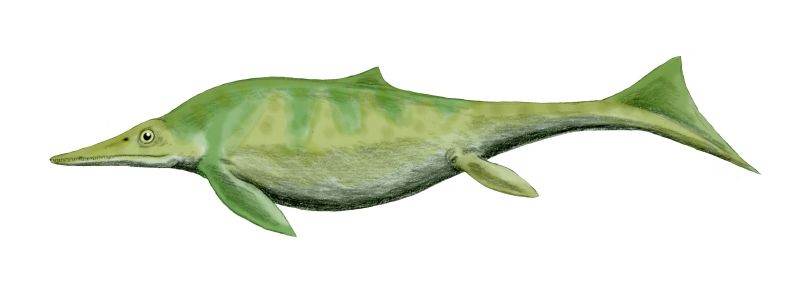


Physical characteristics
The skull of Californosaurus was long and narrow, bearing sharp, conical teeth suited for grasping slippery prey. Like other ichthyosaurs it had four paddle‑shaped limbs; the fore‑ and hindlimbs were modified into flippers that helped steer and stabilize the animal in water. The tail shows a marked downward bend where the vertebral column turns, supporting a small vertical fluke and suggesting active, tail‑driven propulsion. Some specimens indicate it may also have carried a small dorsal fin, though that soft‑tissue feature is rarely preserved.
- Length: about 3 m (10 ft)
- Long, pointed snout with sharp teeth
- Four paddle‑like flippers for maneuvering
- Downturned tail and small vertical fluke for swimming
Discovery and classification
Fossils of Californosaurus were recovered from marine Triassic deposits and described as part of the early radiation of ichthyosaurs. It is regarded as one of the more basal examples of a true ichthyosaur, retaining primitive skull proportions while sharing derived adaptations for life in open water. Comparisons are often made with other early forms such as Mixosaurus and Cymbospondylus, which illustrate different stages in ichthyosaur evolution from eel‑like ancestors toward more fish‑ and dolphin‑shaped bodies.
Paleobiology and ecology
Like other ichthyosaurs, Californosaurus was a carnivorous predator that fed on fish and cephalopods. Its dentition and jaw shape indicate a grasping, rather than crushing, feeding strategy. Evidence from related ichthyosaurs shows that these reptiles gave birth to live young in the water rather than returning to land, and Californosaurus is thought to have had similar reproductive biology. Its body plan—streamlined torso, powerful tail, and reduced limbs—reflects adaptations for sustained swimming and rapid pursuit of small, agile prey.
Significance and notable facts
Californosaurus helps fill an important gap in the fossil record of marine reptiles by representing an early stage in ichthyosaur specialization. Its dolphin‑like silhouette is an example of evolutionary convergence with modern marine mammals, demonstrating how similar selective pressures in the ocean produce comparable solutions in unrelated lineages. For general readers interested in this group, reptilian origins and the transition from terrestrial to fully aquatic life are illustrated well by the anatomy of Californosaurus, including its streamlined body and limb modifications. Paleontological summaries and specimen records can be found through curated resources and specialist literature comparing ichthyosaurs to dolphins and broader studies on early marine reptiles and flipper evolution. For further reading consult museum overviews and fossil catalogues that discuss Late Triassic marine faunas and ichthyosaur diversity.
Californosaurus remains an illustrative genus for students of paleobiology because it combines primitive skull proportions with modern‑looking swimming adaptations, linking ancient reptile lineages to the long history of vertebrate life in the oceans.
Late Triassic seas hosted a diverse assemblage of marine reptiles, and discoveries like Californosaurus continue to refine our understanding of how quickly reptiles adapted to pelagic life. Comparative anatomy with taxa such as Mixosaurus and Cymbospondylus highlights the mosaic of features seen among early ichthyosaurs and the stepwise acquisition of traits such as a tail fluke and a more fish‑like body shape.
California Triassic localities preserve many marine fossils that illuminate this evolutionary story; researchers often reference field collections and regional studies to place Californosaurus within the broader framework of Mesozoic marine ecosystems. For accessible introductions, see museum summaries and educational sites that describe basal ichthyosaurs and their role in prehistoric oceans.
Questions and answers
Q: What was Californosaurus?
A: Californosaurus was an extinct marine reptile that belonged to the ichthyosaur group.
Q: How long was Californosaurus?
A: Californosaurus was 10 feet (3 meters) long.
Q: Did Californosaurus come onto dry land?
A: Like other ichthyosaurs, Californosaurus probably never came onto dry land.
Q: What did Californosaurus eat?
A: Californosaurus fed on fish and other small marine creatures.
Q: Did Californosaurus give birth on dry land or water?
A: Californosaurus gave birth in the water, as other ichthyosaurs did.
Q: What is the most basal known true ichthyosaur?
A: Californosaurus is the most basal known true ichthyosaur.
Q: How was Californosaurus shaped?
A: Californosaurus was shaped more or less like a dolphin, with a long-snouted head that is small in comparison with the rest of the body, and a tail that is sharply turned downwards with a small vertical fluke.
Related articles
Author
AlegsaOnline.com Californosaurus: a Late Triassic ichthyosaur from California Leandro Alegsa
URL: https://en.alegsaonline.com/art/16154