
Caliban (moon) — irregular retrograde satellite of Uranus
Caliban is an irregular, retrograde moon of Uranus discovered in 1997. It is a non-spherical satellite of roughly 72 km diameter and likely part of a small dynamical cluster with similar moons.
Overview
Caliban is an irregular, retrograde satellite of the planet Uranus. Classified among the planet's non-spherical moons, it follows a distant, inclined and eccentric orbit in the outer region of Uranus's satellite system. Caliban is one of several small, captured objects that differ markedly from the large, regular moons formed in the planet's equatorial disk.
Image gallery
6 Images


Discovery and name
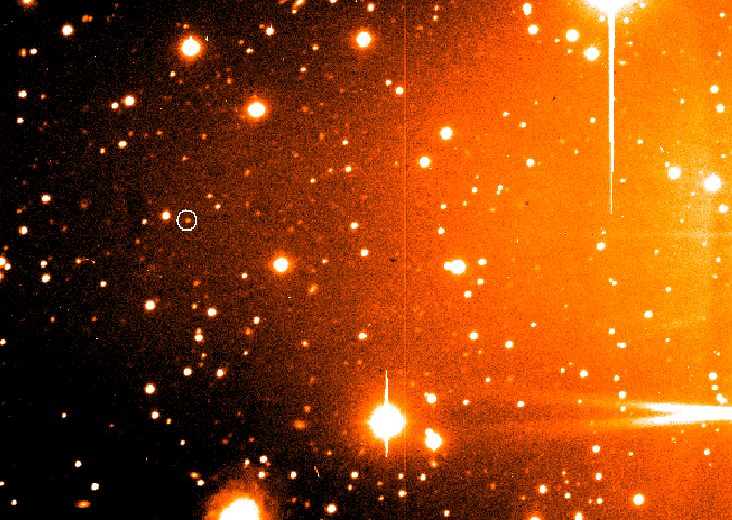
Caliban was discovered on 6 September 1997 by a team led by Brett J. Gladman, with Philip D. Nicholson, Joseph A. Burns and John J. Kavelaars using the 200-inch Hale telescope. At discovery it received the provisional designation S/1997 U1 and later the permanent number Uranus XVI. The name Caliban is taken from the monstrous character in William Shakespeare's play The Tempest, following the convention of naming Uranian moons after characters from Shakespeare and Alexander Pope. The discovery was announced alongside the identification of the moon Sycorax.
Orbit and dynamical relationships
Caliban travels on a distant orbit around Uranus in a retrograde direction, meaning it revolves opposite to the planet's rotation. Such orbits are common among irregular satellites thought to be captured objects rather than bodies formed in place. Orbital parameters and long-term integrations suggest Caliban may share a dynamical association with other small retrograde moons; in particular, its orbital elements indicate a possible relationship with the moon Stephano, which could imply a shared origin through fragmentation or capture of related debris.
Physical characteristics
Caliban is small and irregular in shape rather than spherical. Based on its observed brightness and an assumed surface reflectivity (an albedo) near 0.04, its diameter is estimated to be about 72 km, making it the second largest of Uranus's known irregular non-spherical moons after Sycorax. Its low albedo is typical for distant, dark bodies believed to be composed of primitive rock and ice mixtures. Photometric measurements indicate a variable brightness as the object rotates, consistent with an elongated or irregular shape.
Rotation, observations and study
Light-curve studies of Caliban show a relatively rapid rotation, with a measured period of roughly 2.7 hours. Monitoring of its light curve provides the primary means to infer rotation, shape, and surface variation for such faint, small satellites. Caliban and its companions are challenging targets for ground-based telescopes because of their faint magnitudes and proximity to the bright glare of Uranus, so much of what is known comes from careful long-exposure imaging and follow-up photometry using large telescopes such as the Hale telescope.
Importance and comparisons
Studying Caliban contributes to a broader understanding of the outer, irregular satellite populations around the giant planets. These moons provide clues about capture processes, collisional histories and the environment of the early Solar System. Caliban is often discussed in context with other Uranian irregulars like Sycorax and Stephano, and references to its non-spherical nature or general category appear in overviews of irregular satellites (non-spherical). Observational terms and techniques applied to Caliban include studies of light curves and analysis of surface reflectivity or albedo. Its name and literary origin trace back to William Shakespeare and the character Caliban in The Tempest, often described as a monstrous figure in dramatic literature (Caliban as character). For further technical summaries and catalog listings see specialized astronomical resources and discovery announcements (discovery and name).
Related articles
Author
AlegsaOnline.com Caliban (moon) — irregular retrograde satellite of Uranus Leandro Alegsa
URL: https://en.alegsaonline.com/art/16108
Sources
- arxiv.org : Preprint
- journals.uchicago.edu : journals.uchicago.edu/AJ/journal/issues/v121n5/200443/200443.text.html
- arxiv.org : Preprint
- cfa-www.harvard.edu : IAU-NSES
- ssd.jpl.nasa.gov : NASA JPL