
Callirrhoe (Jupiter XVII) — irregular moon of Jupiter
Callirrhoe is a small, retrograde irregular moon of Jupiter (Jupiter XVII). Discovered in 1999, it orbits far from Jupiter and belongs to the Pasiphaë group of captured, non-spherical satellites.
Overview
Callirrhoe, also known by its Jovian designation Jupiter XVII, is one of the outer, irregular satellites of Jupiter. It is a small body with an estimated diameter of about 8.6 kilometres and follows a distant, retrograde orbit. Because of its distance and size it is faint and observable only with large telescopes and targeted spacecraft imaging campaigns; it has been described as one of Jupiter's farthest named moons.
Image gallery
3 Images

Discovery and naming
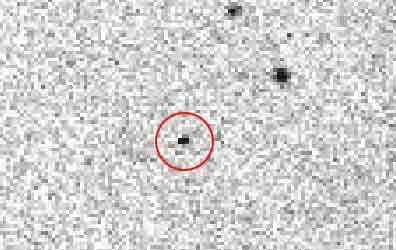
Callirrhoe was first detected on 6 October 1999 by the Spacewatch survey and initially catalogued as an asteroid under the provisional label 1999 UX18. Subsequent observations established that the object was gravitationally bound to Jupiter; on 18 July 2000 Tim Spahr identified its Jovian orbit and it received the temporary designation S/1999 J 1, later numbered Jupiter XVII. In October 2002 it was officially named for the mythological figure Callirhoe, a daughter of the river-god Achelous associated with Zeus (the Greek counterpart of Jupiter).
Orbit and physical characteristics
Callirrhoe is classified as an irregular, retrograde satellite. Its orbit is highly inclined compared with the ecliptic and Jupiter's equator and exhibits substantial eccentricity, characteristics typical of captured small bodies rather than objects formed in situ.
- Average orbital distance: about 24,356,000 km from Jupiter
- Orbital period: approximately 776.543 days
- Inclination: ~141° to the ecliptic (about 140° to Jupiter's equator) — see inclination
- Eccentricity: ~0.264 — see orbital eccentricity
- Physical shape: likely irregular and non-spherical; small size precludes hydrostatic equilibrium — see non-spherical
Group membership and origin
Callirrhoe is usually placed among the satellites associated with the Pasiphaë group, a collection of retrograde irregular moons that orbit at large distances from Jupiter. Members of this grouping share similar orbital distances and inclinations, and are widely interpreted as fragments of a captured progenitor that was broken apart, either by collision or tidal disruption, early in the Solar System's history. While grouping provides a useful framework, individual orbits like Callirrhoe's show variations in inclination and eccentricity, so membership is determined by comparing orbital elements rather than an exact match.
Observation and exploration
Because Callirrhoe is small and distant, ground-based observations are challenging; its discovery illustrates how asteroid surveys can also reveal planetary satellites. The object was imaged as part of a navigation and calibration exercise by the New Horizons spacecraft on 10 January 2007, providing useful positional data though no close-up mapping. Continued telescopic monitoring refines its orbit and helps to constrain its brightness and surface properties.
Notable facts and context
Callirrhoe exemplifies the class of captured, irregular moons that populate the outer regions of the giant planets. Its history—from initial asteroid designation to recognition as a Jovian moon—illustrates how observational follow-up can change the classification of faint Solar System objects. Studies of such satellites contribute to understanding capture processes, collisional fragmentation, and the dynamical evolution of planetary satellite systems.
For more technical datasets and continuing updates on orbital elements and discovery circumstances, consult survey archives and mission releases that track Jupiter's irregular satellites and their evolving ephemerides (survey records, satellite catalogs, discovery notes, inclination details, eccentricity reports, naming citations, group analyses, shape studies, mission imagery).
Related articles
Author
AlegsaOnline.com Callirrhoe (Jupiter XVII) — irregular moon of Jupiter Leandro Alegsa
URL: https://en.alegsaonline.com/art/16178
Sources
- cfa-www.harvard.edu : IAUC 7460: S/1999 J 1
- cfa-www.harvard.edu : MPEC 2000-Y16: S/1975 J 1 = S/2000 J 1, S/1999 J 1
- cfa-www.harvard.edu : IAUC 7998: Satellites of Jupiter