
Sycorax (Uranian moon)
Sycorax is the largest retrograde irregular satellite of Uranus, discovered in 1997. This article covers its discovery, orbit and physical traits, origin theories, and place among Uranus' moons.
Overview
Sycorax is a natural satellite of Uranus classified as an irregular, retrograde moon. It is the largest known member of Uranus' distant, non-spherical satellites and was the first of several outer moons discovered in the late 1990s. Because it orbits far from the planet and follows a retrograde, inclined path, Sycorax is generally considered to be a captured object rather than having formed in place with Uranus' regular moons.
Image gallery
7 Images


Physical characteristics
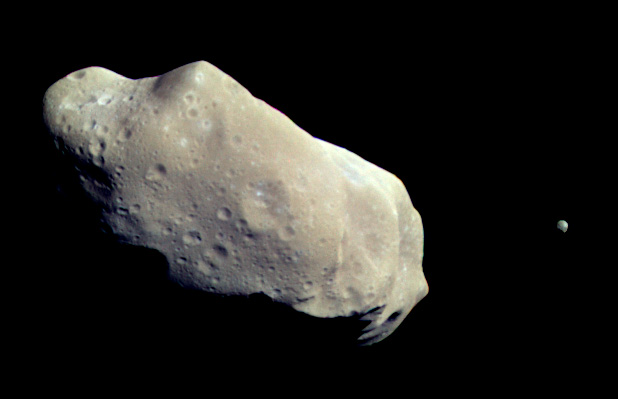
Observations indicate Sycorax has a dark, reddish surface and an irregular shape rather than a spherical form, suggesting a modest size and insufficient gravity to pull it into a round figure. Its visible reflectivity (albedo) is low, consistent with many outer irregular satellites and with primitive, carbon-rich surfaces. Estimates based on brightness and assumed dark reflectivity place its diameter on the order of a few hundred kilometres, though exact dimensions depend on uncertain albedo assumptions.
Orbit and dynamics
Sycorax orbits Uranus at a large distance and on a retrograde path, meaning it moves opposite to the planet's rotation. Its orbit is significantly inclined and eccentric compared with the regular moons close to Uranus. Such orbital characteristics are typical of captured minor bodies and indicate a dynamically separate population of satellites. Long-term study of these orbits helps astronomers reconstruct capture scenarios and the collisional history of the outer Uranian system.
Discovery and name
Sycorax was discovered on 6 September 1997 by Brett J. Gladman, Philip D. Nicholson, Joseph A. Burns and John J. Kavelaars using the 200-inch Hale Telescope at Palomar Observatory; it received the provisional designation S/1997 U2. The discovery team also reported another outer moon, Caliban, at the same time. The International Astronomical Union later assigned the permanent name Sycorax and the numerical designation Uranus XVII. The name is drawn from literature: Sycorax is the mother of Caliban in William Shakespeare's play The Tempest, and the naming follows the convention of selecting characters from Shakespearean works and related literature; see Shakespeare for the source play.
Scientific importance and observations
Though faint and distant, Sycorax is important for understanding the population of captured objects around the giant planets. Photometric studies yield colours and lightcurves that hint at surface composition and rotation, while dynamical work places it within families of irregular satellites. Continued observations from large ground-based telescopes and occasional space-based measurements refine its orbit and physical parameters; for technical data and catalog entries consult sources such as orbital databases.
Relation to other Uranian moons
- Sycorax is part of a group of irregular satellites distinct from the larger regular moons like Titania and Oberon.
- Its retrograde motion and colour contrast with some prograde irregulars, suggesting a heterogeneous capture history.
- Comparisons with nearby satellites such as Caliban help test whether some irregular moons may share a common origin through fragmentation or collisional capture.
Overall, Sycorax remains one of the more accessible outer Uranian moons for telescopic study and serves as a representative example of captured, irregular satellites around the giant planets.
Questions and answers
Q: What is Sycorax?
A: Sycorax is one of Uranus' moons.
Q: What makes Sycorax unique among Uranus' moons?
A: Sycorax is the biggest retrograde non-spherical moon of Uranus.
Q: When was Sycorax discovered?
A: Sycorax was discovered on September 6, 1997.
Q: Who discovered Sycorax?
A: Sycorax was discovered by Brett J. Gladman, Philip D. Nicholson, Joseph A. Burns, and John J. Kavelaars.
Q: How was Sycorax found?
A: Sycorax was found using the 200-inch Hale telescope.
Q: How was Sycorax designated?
A: Sycorax was given the designation S/1997 U 2.
Q: Why was Sycorax named that way?
A: Sycorax was named after Sycorax, Caliban's mother in William Shakespeare's play The Tempest.
Related articles
Author
AlegsaOnline.com Sycorax (Uranian moon) Leandro Alegsa
URL: https://en.alegsaonline.com/art/95574