
Calypso — small Trojan moon of Saturn
Calypso is a small, irregular moon of Saturn that shares Tethys's orbit as a trailing Trojan. It was found in 1980, imaged by spacecraft, and helps scientists study co-orbital dynamics and small icy bodies.
Overview
Calypso is a minor natural satellite of Saturn that occupies a stable co-orbital position with the much larger moon Tethys. It is classified as a Trojan moon because it sits at one of Tethys's Lagrangian points, following the planet–moon pair in the same orbit around Saturn. Calypso is small and irregular in shape and, like many of Saturn's inner moons, is composed largely of water ice with a surface marked by craters and other impact features.
Image gallery
6 Images



Physical characteristics
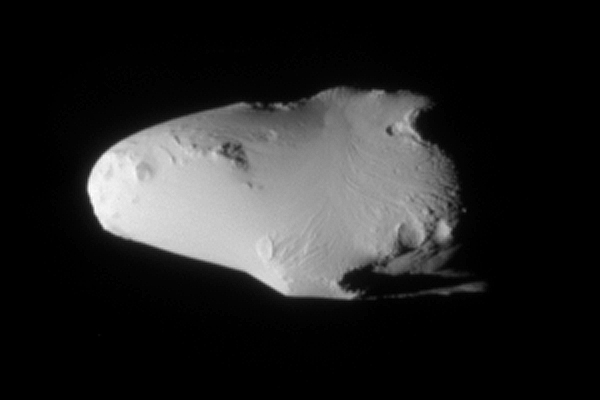
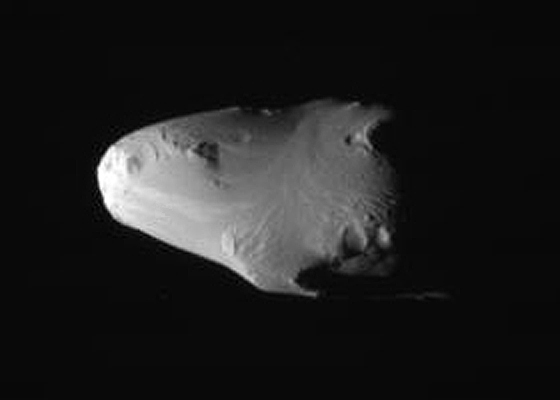
Calypso is too small to be spherical and appears as a potato-shaped body when viewed up close. Its surface reflectivity and composition are broadly consistent with icy Saturnian moons. Observations show a heavily cratered terrain typical of small, collisionally processed satellites. Detailed shape models and close-up images were obtained by robotic spacecraft, improving knowledge of its dimensions, rotation, and surface texture.
Orbit and relationship with Tethys
Calypso shares nearly the same orbital radius as Tethys and occupies the trailing Lagrangian point, approximately sixty degrees behind Tethys along the orbit. This configuration—one of the classical L4/L5 Trojan arrangements—keeps Calypso in a stable configuration relative to Tethys and Saturn. The leading counterpart at the opposite Lagrangian point is the moon Telesto, which orbits about sixty degrees ahead of Tethys.
Discovery and exploration
Calypso was identified from Earth-based observations in 1980 by a team of astronomers credited with the discovery, using telescopic imaging and orbital analysis from data sets collected at observatories on Earth studying Saturn. The name derives from the nymph in Greek mythology Calypso, and follows the convention of naming Saturnian moons after mythological figures. Later, spacecraft missions to the Saturn system provided higher-resolution images and orbit refinements; those missions have been essential for resolving Calypso's shape and surface geology.
Scientific importance and distinctions
As a Trojan companion of Tethys the larger moon, Calypso illustrates how small bodies can remain long-term occupants of Lagrangian points, held roughly sixty degrees ahead or behind a primary. Its sister Trojan, Telesto shares the same orbital pathway but occupies the opposite Lagrange point. Calypso's name echoes its mythological origin Calypso the nymph, a reminder of the naming tradition in planetary science. Studying Calypso helps researchers understand co-orbital dynamics, the collisional history of Saturn's moons, and the properties of small icy worlds in the outer Solar System.
- Type: Trojan moon of Tethys
- Composition: predominantly water ice (typical)
- Notable companions: Tethys (primary), Telesto (other Trojan)
Related articles
Author
AlegsaOnline.com Calypso — small Trojan moon of Saturn Leandro Alegsa
URL: https://en.alegsaonline.com/art/16223