
Harthacnut (Harthacanute): King of Denmark and England, 1018–1042
Harthacnut, son of Cnut and Emma, ruled Denmark (1035–1042) and England (1040–1042). His short English reign was marked by heavy taxation, unrest, and a sudden death that brought Edward the Confessor to the throne.
Overview. Harthacnut (Old Danish name Hardeknud) was a son of Cnut the Great and Emma of Normandy who became king in both northern realms during a turbulent decade. He succeeded to the throne of Denmark in 1035 and later to the throne of England in 1040. His rule is often remembered for its fiscal demands, a bitter dispute over succession, and a sudden death that ended the North Sea empire that his father had forged.
Family background and rivals. Born about 1018, Harthacnut was the only legitimate son of Cnut and Emma. The complicated dynastic situation in England and Scandinavia involved half-brothers and familial claimants. His older half-brother Harold Harefoot acted as regent and later king in England while Harthacnut remained in the north. Emma of Normandy’s earlier marriage to Ethelred the Unready produced Edward, later known as Edward the Confessor, who spent years in exile in Normandy until recalled to the English court.
Accession and military difficulties. When Cnut died in 1035 Harthacnut inherited the Danish crown, but his grip on power was contested. Rivalries and the ambitions of regional rulers—most prominently Magnus of Norway—meant that Harthacnut could not immediately assert control in all parts of his father’s realm. Ongoing challenges across Scandinavia delayed his journey to England and forced him to focus on securing his northern dominions before attempting an invasion or recovery of the English throne.
English reign and domestic policy. Harthacnut ruled England only briefly, formally taking the crown in 1040 after Harold Harefoot’s death. His government is widely characterized as austere and heavily centred on raising revenue to maintain fleets and loyalty. To fund naval forces and administration he raised taxes sharply; tax collection provoked resistance, notably in Worcester, where two of his tax-collectors were killed. The king responded with force and the city was sacked. Contemporary and later sources paint him as severe and unpopular; one chronicle remarks that he "never accomplished anything kingly" while he ruled.
Cultural notes and succession. Traditions such as the story of Lady Godiva riding through Coventry to protest burdensome levies are sometimes linked by historians to the environment of heavy taxation in this period, though exact dates and origins of the tale remain uncertain. Harthacnut had no recorded marriage or children and appears to have been reconciled with his half-brother Edward: in 1041 he invited Edward the Confessor to return from Normandy and placed him in his household, likely naming him as heir.
Image gallery
6 Images
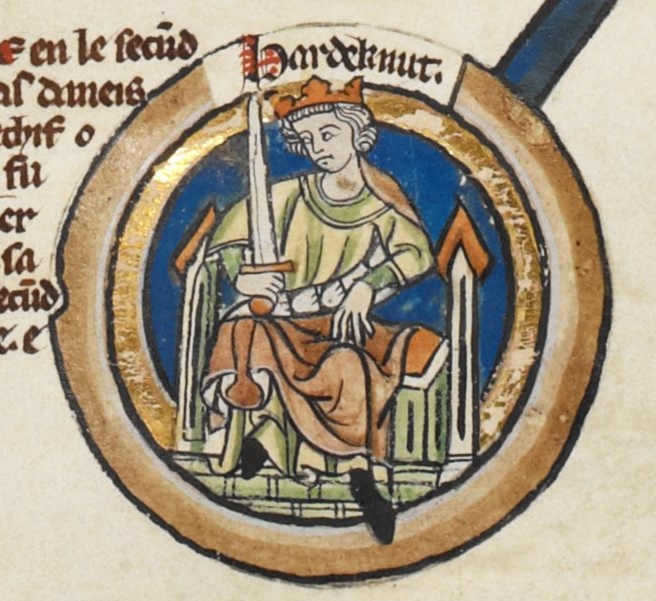


Death and legacy
On 8 June 1042 Harthacnut died suddenly at Lambeth. Contemporary accounts describe an abrupt collapse while drinking, and his body was taken for burial to Winchester Cathedral in Hampshire. With his death the direct line of Cnut’s dynasty in England came to an end and Edward the Confessor succeeded to the throne. Historians judge Harthacnut’s reign as short and troubled: he secured the Danish inheritance to an extent but left England politically exhausted and prepared for a new phase under Anglo-Norman influence.
Notable points
- Reigned in Denmark from 1035 and in England from 1040 until his death in 1042.
- Only legitimate son of Cnut the Great and Emma of Normandy; his half-brothers were major rivals.
- Raised taxes heavily to sustain naval and military needs, provoking unrest such as the Worcester incident.
- Associated in popular memory with tales of tax protest (for example, the Lady Godiva tradition), though such stories are hard to date precisely.
- Died without heirs; his death brought Edward the Confessor to the English throne and altered the balance of power in the British Isles.
This article summarizes widely accepted points about Harthacnut’s life and reign while avoiding speculative detail; for further study consult specialized histories of the early 11th century and primary sources of the period.
Questions and answers
Q: Who was Harthacanute?
A: Harthacanute (also known as Canute the Hardy, Hardicanute, and Hardecanute) was King of Denmark from 1035 to 1042 and England from 1040 to 1042. He was the only son of Canute the Great and Emma of Normandy.
Q: What prevented him from taking up his throne in England?
A: Fighting with Magnus I of Norway stopped him from sailing to England to take up his throne.
Q: Who became regent of England while he was away?
A: His older, illegitimate half-brother, Harold Harefoot, became regent of England.
Q: How did Harthacanute regain his kingdom?
A: After settling the situation in Scandinavia he prepared an invasion of England to take over his kingdom. Harold died, and Harthacanute was able to take back his throne peacefully.
Q: How did people react to Harthacanutes rule?
A: People were unhappy with Harthacanut's rule; he greatly increased taxation rates which led people in Worcester killing two of his men who had been collecting taxes. In response, he burned the city down.
Q: What is the story behind Lady Godiva's ride through Coventry?
A: The story may have originated during Harthacanut's reign when Lady Godiva rode naked through Coventry streets in order persuade a local earl lower taxes imposed by Harthacanut.
Q: Who succeeded him when he died?
A: When he died on 8 June 1042 at Lambeth Edward the Confessor (his mother Emma's son by Ethelred the Unready) became king after being recalled from exile in Normandy and made a member of his household prior to this death
Related articles
Author
AlegsaOnline.com Harthacnut (Harthacanute): King of Denmark and England, 1018–1042 Leandro Alegsa
URL: https://en.alegsaonline.com/art/120386