
Biophysics: Applying Physical Principles to Living Systems
Biophysics uses methods and concepts from physics to analyze biological structures and processes, from molecules to cells and organisms, linking theory, measurement, and technology.
Overview — Biophysics is an interdisciplinary field that applies physical theories, quantitative methods and experimental tools to understand living systems. Its aim is to explain how biological structure and function emerge from physical principles such as mechanics, thermodynamics, electromagnetism and statistical physics. Practitioners often work between traditional disciplines, connecting the laws of physics and the empirical study of biology.
Image gallery
4 Images

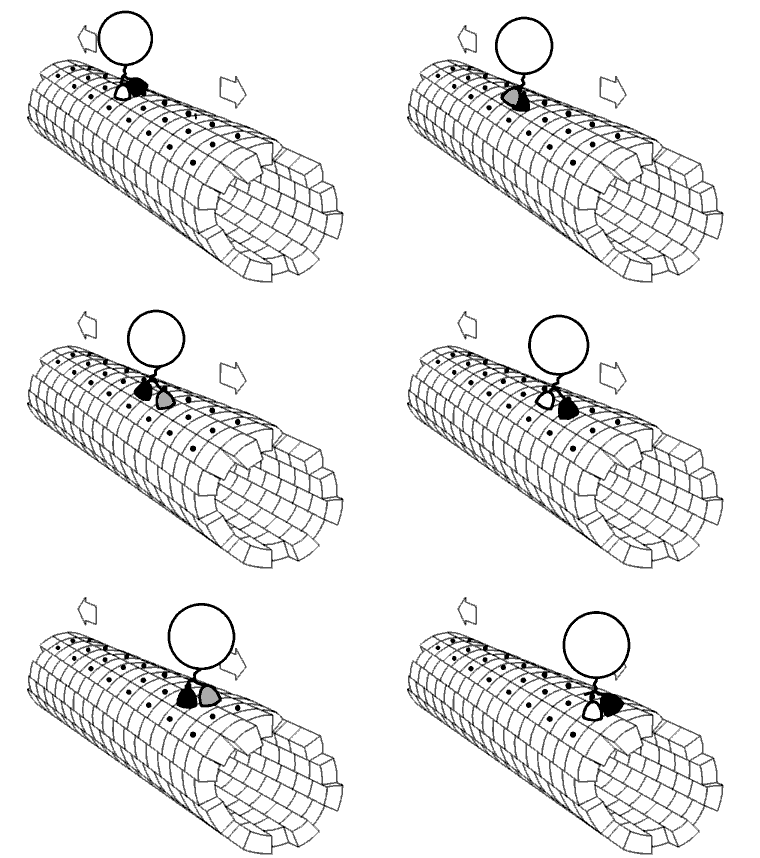

Scope and focus
Unlike fields that primarily describe chemical composition, biophysics emphasizes mechanisms and measurements at scales from single molecules to cells and tissues. Researchers may study the motion of protein domains, forces generated by molecular motors, the electrical behavior of membranes, or the folding and dynamics of RNA and proteins. The field overlaps with but differs from biochemistry and molecular biology by prioritizing quantitative models and physical explanations, and often by focusing on single molecules or small assemblies rather than only bulk biochemical pathways.
Common methods
- Single-molecule techniques: optical tweezers, atomic force microscopy and single-molecule fluorescence to probe forces and kinetics.
- Imaging and spectroscopy: advanced microscopy, NMR, and electron paramagnetic resonance for structure and dynamics.
- Computational modeling: molecular dynamics and statistical mechanics approaches to simulate behavior at different scales.
Applications and importance
Biophysical approaches inform drug design, synthetic biology, medical diagnostics and biomaterials development. For example, measuring how a ligand alters the mechanical stability of a protein can guide therapeutic strategies. Educationally and technologically, biophysics builds bridges between theoretical concepts and practical instruments.
History and distinctions
The discipline emerged in the 20th century as physicists and biologists shared tools and ideas. Its practitioners may identify with physics, biology, engineering or medicine. Key distinguishing features include emphasis on quantitative models, experiments that quantify forces or energies, and investigations at the molecular scale or of macromolecules. For further reading, see an accessible general survey at biophysics overview, educational resources at biology portals, and comparative introductions to related fields at molecular biology and biochemistry. Additional technical references can be found via specialized collections and reviews (physical principles).
Biophysics remains a dynamic, integrative area of science that continually adapts new instruments and theoretical ideas to probe the physical basis of life.
Related articles
Author
AlegsaOnline.com Biophysics: Applying Physical Principles to Living Systems Leandro Alegsa
URL: https://en.alegsaonline.com/art/11667