
Chemical Biology: Chemistry Applied to Living Systems
Chemical biology applies chemical techniques and synthetic molecules to study, probe, and manipulate biological systems, creating tools for imaging, functional analysis, and therapeutic discovery across scales.
Overview
Chemical biology is an interdisciplinary discipline that brings chemical principles, methods and reagents to bear on biological problems. Practitioners design small molecules, probes and reactions to interrogate biomolecules, trace pathways inside cells, perturb biological networks in controlled ways, and sometimes create new functions not found in nature. The field stands between traditional chemistry and biology, using synthesis and analysis from chemistry together with experimental systems and questions drawn from biology.
Image gallery
7 Images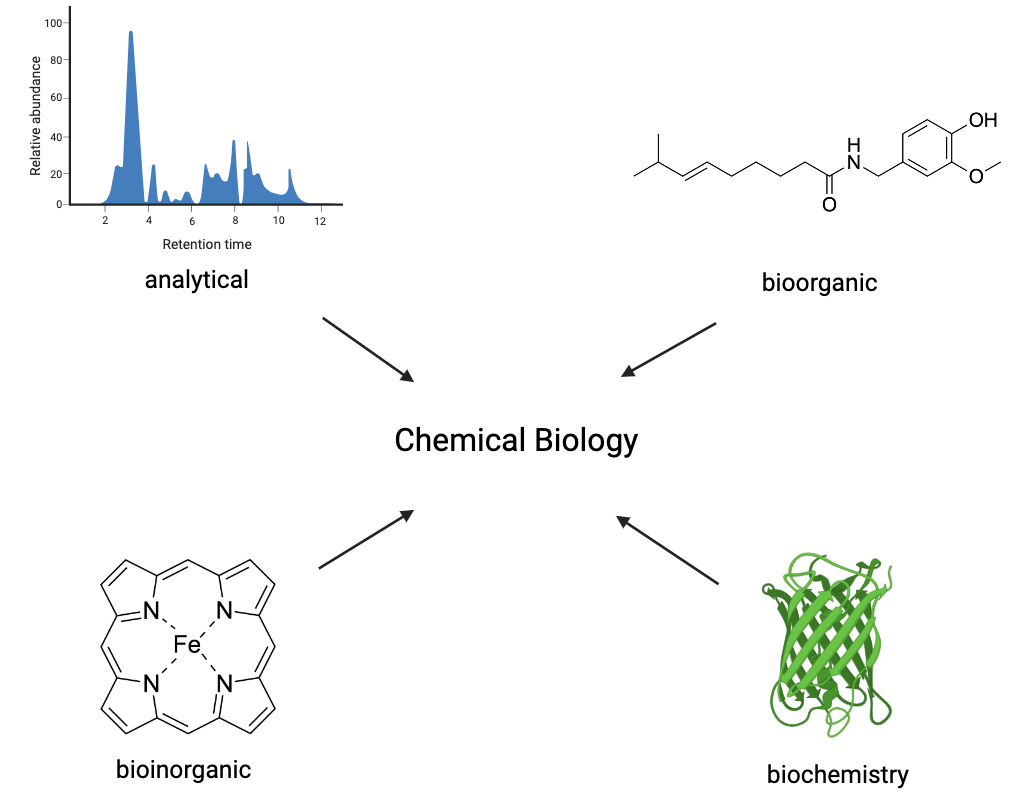





Core approaches and characteristics
At its core, chemical biology emphasizes the use of chemically defined tools to answer biological questions. This often involves preparing bespoke compounds by synthetic chemistry, selecting or engineering molecules that bind selectively to targets, and developing labeling or reporter strategies that function in living systems. Experiments typically combine molecular design, biophysical characterization and cellular assays to link a molecule’s structure with its biological effect.
How it differs from related fields
Chemical biology overlaps with but is distinct from areas such as biochemistry. Biochemistry studies the chemical properties and reactions of biomolecules — for example, enzyme mechanisms, protein structure and metabolic networks. Chemical biology uses chemical tools to modulate those systems in cells or organisms: designing inhibitors, fluorescent probes or synthetic mimics to probe function rather than only describing intrinsic chemistry. Where a biochemist may elucidate how an enzyme catalyzes a reaction, a chemical biologist often aims to perturb that enzyme’s role in a biological context.
Common techniques and tools
- Small-molecule screening and medicinal-chemistry optimization to develop selective ligands.
- Covalent and noncovalent chemical probes for protein modulation and target validation.
- Bioorthogonal chemistry for labeling and tracking biomolecules in living cells and organisms.
- Photo‑activated and light‑responsive compounds for temporal control of activity.
- Chemical proteomics and mass spectrometry to identify targets and interaction networks.
- Genetically encoded tags combined with chemical reporters for visualization and manipulation.
Experimental design, validation and limitations
Designing meaningful chemical biology experiments requires attention to probe selectivity, potency, cell permeability and toxicity. Proper controls — including inactive analogs and orthogonal methods — help distinguish direct effects from off‑target or pleiotropic consequences. Quantitative readouts, dose–response characterization and complementary genetic perturbations are commonly used to increase confidence in interpretations. The field recognizes intrinsic limits: chemical probes may not fully recapitulate genetic loss of function and many biological contexts introduce complexity that challenges simple molecular explanations.
Applications and examples
Chemical biology underpins many practical advances in basic science and translational work. Representative applications include using fluorescent sensors to monitor metabolite dynamics, applying bioorthogonal reactions to tag biomolecules in animals, developing small molecules that reveal signaling pathways in disease models, and creating chemical strategies for targeted protein degradation or conditional activation. These approaches contribute to target identification, mechanistic studies and the development of therapeutic leads.
Training, interdisciplinarity and collaboration
Training in chemical biology is often cross‑disciplinary: students and researchers learn synthetic methods, analytical instrumentation, and cellular or organismal biology. Successful projects typically combine chemists, biologists and specialists in areas such as structural biology, computational chemistry or clinical research. This collaborative culture helps translate molecular insights into broader biological understanding and potential applications.
Ethical, safety and practical considerations
Working with bioactive chemicals and biological systems requires adherence to laboratory safety, proper handling of hazardous reagents, and consideration of ethical concerns when experiments involve animals or primary human materials. Reproducibility, transparent reporting of compound characterization, and sharing of validated probes are important practices that strengthen the field.
Future directions
Ongoing developments combine innovation in synthesis, analytical methods and biological models. Areas of active interest include more selective and reversible probes, tools for controlling cellular functions with spatial and temporal precision, and chemical strategies that enable new types of biological measurements in vivo. Integration with computational design and high‑throughput techniques continues to expand the scope and impact of chemical biology.
Further reading and resources
Readers seeking foundational background may consult introductory materials on biological molecules and on protein structure, as well as methodological primers on cellular techniques. Curated reviews and community portals provide overviews of current practice and protocols at research links and general summary pages at overview pages.
Tags
Related articles
Author
AlegsaOnline.com Chemical Biology: Chemistry Applied to Living Systems Leandro Alegsa
URL: https://en.alegsaonline.com/art/19160