
Cloud chamber (Wilson chamber)
A cloud chamber is a simple particle detector that makes ionizing radiation visible by producing condensation trails in a supersaturated vapor, used historically and for education.
Overview
A cloud chamber is a sealed, transparent vessel in which a supersaturated vapour of water or alcohol is maintained so that tiny droplets form around ions. When an energetic charged particle passes through the chamber it ionizes the gas along its path. The free ions act as condensation nuclei and a visible track of droplets appears, tracing the particle's trajectory.
Image gallery
10 Images


How it works
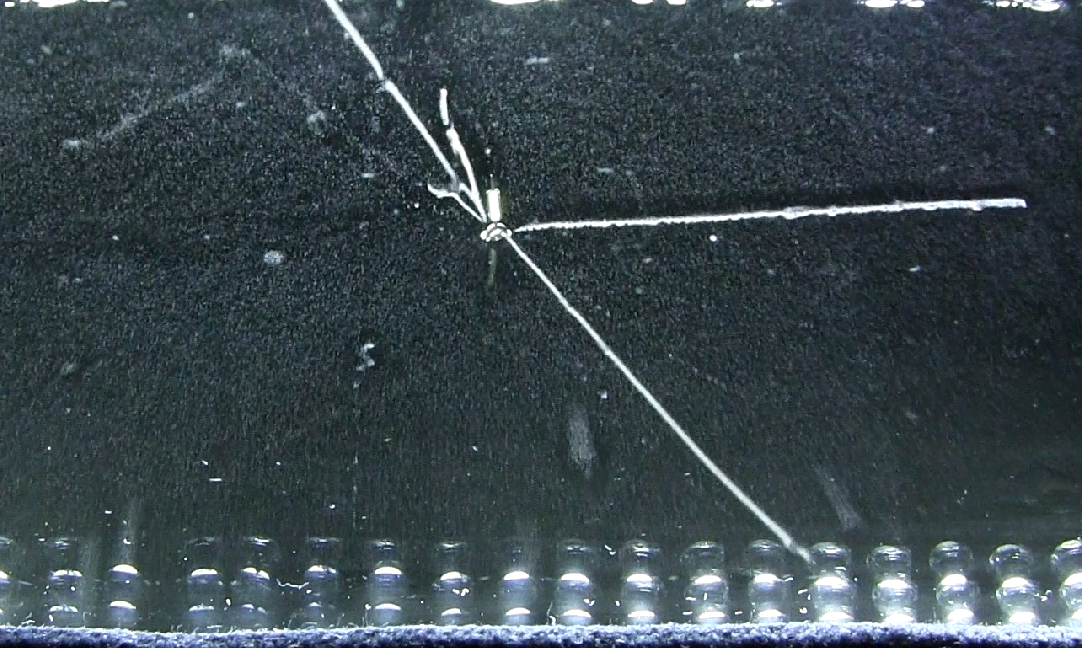
Tracks in a cloud chamber are produced by the localized release of ionization energy. Heavy particles such as an alpha particle leave wide, dense, relatively short tracks because they deposit large amounts of energy over a short distance. Lighter, faster particles such as a beta particle (electron or positron) leave thinner, longer tracks that often show curvature in the presence of a magnetic field. The physical process is classical condensation: the vapour becomes supersaturated and droplets form preferentially on the ions created when the medium is ionized.
Key characteristics
- Visibility: produces continuous, easily photographed tracks suitable for qualitative study.
- Sensitivity: responds to a wide range of ionizing radiation, from alpha particles to cosmic rays.
- Magnetic analysis: placing a uniform magnetic field across the chamber reveals charge sign and momentum by curvature.
- Operating modes: diffusion, expansion and electric-field cloud chambers are common variants.
History and development
The cloud chamber was developed by Charles Wilson, a Scottish physicist, in the early 20th century after he studied condensation in the atmosphere; his laboratory device became the first practical instrument to make subatomic particles directly visible. Wilson's work earned him the Nobel Prize in Physics in 1927 and the apparatus is often called the Wilson chamber. Early uses included studies in atomic physics and cosmic-ray research; later, cloud chambers documented phenomena such as positron tracks and helped validate emerging theories of the subatomic world.
Uses, examples and modern context
Historically, cloud chambers played a central role in experimental particle physics and in the discovery or confirmation of many particles. For example, cloud chambers with applied magnetic fields were instrumental in identifying the positron and studying cosmic rays. Today they are mainly used as educational tools and demonstration devices because they provide an immediate, visual way to observe ionizing radiation, whereas modern research typically uses more sophisticated particle detectors such as wire chambers, bubble chambers and semiconductor trackers.
Variants and notable facts
Several practical designs exist: expansion cloud chambers cool a gas suddenly to create supersaturation, while diffusion chambers rely on a temperature gradient. Some educational models use alcohol mist and a cooled plate to sustain the vapour. Although largely superseded in research by faster and higher-resolution detectors, the cloud chamber remains important historically and pedagogically for demonstrating core ideas about ionization, condensation, charge, and the interaction of radiation with matter. For more general reading and diagrams, see resources linked below.
Supersaturated vapour · Water or alcohol · Charged particle · Alpha · Beta · Ionized · Ions · Magnetic field · Scottish · Atomic physics · Particle detectors
Questions and answers
Q: What is a cloud chamber?
A: A cloud chamber is a sealed box with a supersaturated vapour of water or alcohol.
Q: How does a charged particle interact with a cloud chamber?
A: When a charged particle (e.g. an alpha or beta particle) goes through it, the vapour is ionized.
Q: What is the result of ionization in a cloud chamber?
A: The resulting ions act as nuclei, around which a mist forms from the vapour.
Q: How are the tracks of different charged particles distinctive in a cloud chamber?
A: The high energies of alpha and beta particles mean that a trail is left by ions produced along the path of the charged particle. These tracks have distinctive shapes (for example, an alpha particle's track is broad and shows more evidence of deflection by collisions, while an electron's is thinner and straight).
Q: What happens when any uniform magnetic field is applied across a cloud chamber?
A: When any uniform magnetic field is applied across the cloud chamber, positively and negatively charged particles will curve in opposite directions, according to the Lorentz force law.
Q: Who invented the cloud chamber?
A: The cloud chamber was invented by Charles Wilson (1869–1959), a Scottish physicist who received the Nobel Prize in Physics in 1927 for this work.
Q: When was the first cloud chamber made?
A: The first cloud chamber was made in 1911.
Tags
Related articles
Author
AlegsaOnline.com Cloud chamber (Wilson chamber) Leandro Alegsa
URL: https://en.alegsaonline.com/art/21101