
Alexander Haig: U.S. Army General, White House Chief of Staff, and Secretary of State
Overview of Alexander M. Haig Jr., his military career, roles in the Nixon, Ford, and Reagan administrations, NATO command, honors, controversies, and legacy.
Overview
Alexander Meigs Haig, Jr. (December 2, 1924 – February 20, 2010) was an American Army general and public official who held senior posts in the U.S. military and federal government. Over a career that spanned active combat, high command and senior civilian office, Haig became a prominent and sometimes polarizing figure in Cold War-era policy and administration.
Image gallery
10 Images


Early life and military career
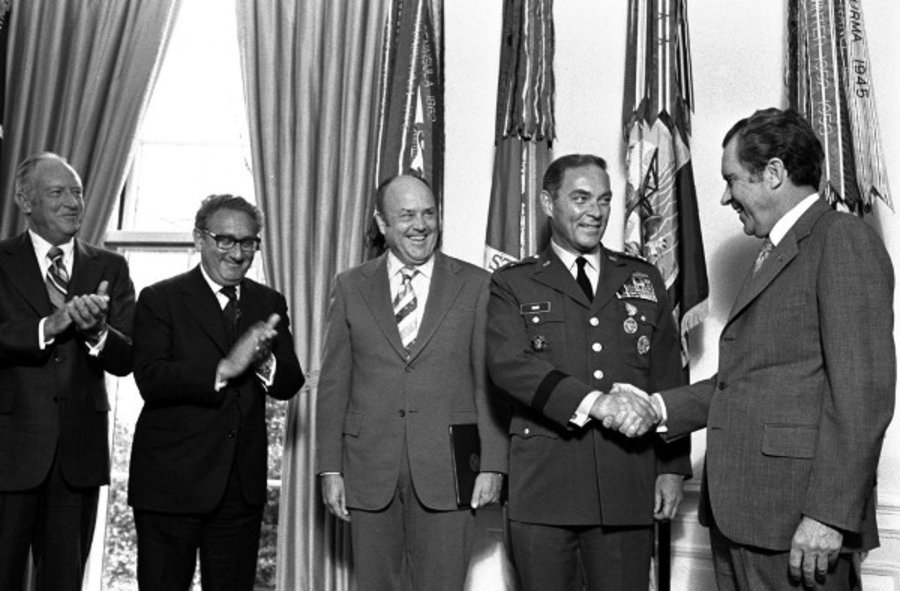
Haig trained as an Army officer and served in both the Korean and Vietnam wars, earning recognition for battlefield leadership. He rose through the ranks to become one of the Army's most senior officers, serving as Vice Chief of Staff of the United States Army, the service's second-highest uniformed position. His record included awards for valor and wounds received in combat.
NATO command and White House service
After assignments in the Pentagon and in operational commands, Haig was appointed to a senior NATO command responsible for coordinating allied forces in Europe. He later moved into political staff roles, serving as White House Chief of Staff during the administrations of Presidents Richard Nixon and Gerald Ford. In this capacity he managed presidential staff operations during turbulent post-Watergate years, shaping policy implementation and staff organization.
Secretary of State and Washington years
In the early 1980s Haig joined the cabinet as United States Secretary of State under President Ronald Reagan. His tenure came during a period of intense Cold War diplomacy and included management challenges and public controversy. Haig's public statements and management style drew attention: some praised his decisiveness and experience, while others criticized his approach to civilian diplomatic leadership. He resigned from the State Department after a relatively brief tenure and later worked in the private sector and as a commentator on defense and foreign policy.
Honors, controversies and legacy
Haig received several military decorations for valor and service. His career is often discussed in studies of civil-military relations, presidential management and NATO command during the Cold War. He remained a frequent commentator on security issues and a figure in debates over the proper roles of military leaders who transition to political office. Alexander Haig died in 2010 from complications of a staphylococcal infection, leaving a complex legacy that continues to be examined by historians and policy analysts.
Further reading and links
- Military biography and early service
- Decorations and awards
- Tenure as Secretary of State
- Relations with the Reagan administration
- Role as White House Chief of Staff
- Service under President Nixon
- Service under President Ford
- Vice Chief of Staff of the Army
- U.S. Army history context
- NATO command and responsibilities
- Korean War service
- Vietnam War service
- Distinguished Service Cross citation
- Silver Star and oak leaf cluster
- Purple Heart and combat wounds
- Circumstances of death
- Medical and posthumous reports
Related articles
Author
AlegsaOnline.com Alexander Haig: U.S. Army General, White House Chief of Staff, and Secretary of State Leandro Alegsa
URL: https://en.alegsaonline.com/art/113655
Sources
- ford.utexas.edu : "ALEXANDER M. HAIG, Assistant to the President: Files, 1973–74"
- cnn.com : "Former Secretary of State Alexander Haig dies at 85"
- hosted.ap.org : "Haig, top adviser to 3 presidents, hospitalized"