
Silver Star Medal: United States military decoration for gallantry
The Silver Star Medal is the United States Armed Forces' third-highest combat decoration, awarded for gallantry in action against an enemy and presented to eligible military personnel for acts of heroism.
Overview
The Silver Star (formally the Silver Star Medal) is the third-highest military decoration for valor awarded to members of the United States Armed Forces. It recognizes gallantry in action against an enemy and is conferred for courageous conduct that falls short of the service crosses but clearly exceeds the level required for other commendations.
Image gallery
3 Images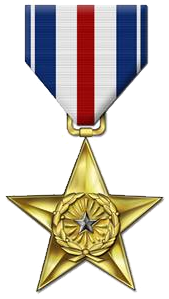


Appearance and characteristics
The medal consists of a small, five-pointed star suspended from a ribbon and is worn according to uniform regulations of the recipient's service. Additional awards are indicated by service-specific devices rather than issuing duplicate medals. The decoration may be given posthumously and is recorded in official military personnel records.
History and development
The Silver Star traces its origin to earlier citations used in the early 20th century and was established in its current form to create a recognized medal for acts of gallantry. Since its adoption, it has been presented across multiple conflicts and to members of all branches of the U.S. military. The award's evolution reflects shifts in how armed forces formally honor battlefield heroism.
Eligibility and criteria
To be awarded the Silver Star, a service member must have performed acts of conspicuous gallantry in action against an enemy or during combat operations. Recommendations are submitted through the chain of command and reviewed by the appropriate military authority. The decoration covers single acts of valor as well as sustained bravery during a specific engagement.
Significance and notable facts
- The Silver Star ranks below the service crosses (e.g., Distinguished Service Cross, Navy Cross, Air Force Cross) and above the Bronze Star.
- It is one of the most commonly awarded high-level valor decorations, with recipients drawn from all branches and horizons of military service.
- The medal serves both to honor individual heroism and to document exemplary conduct in official histories and citations.
Context and comparison
In military award systems the Silver Star occupies a distinct position: it formally recognizes combat gallantry without requiring the extraordinary criteria of the highest decorations. For those studying military honors, the Silver Star helps illustrate how armed forces differentiate levels of risk, leadership, and selfless action on the battlefield.
Further official details, regulations, and historical citations can be found through military records and reference sources maintained by each service branch (see official guidance).
Questions and answers
Q: What is the Silver Star medal?
A: The Silver Star medal is the third highest military decoration for valor in the United States.
Q: Who can receive the Silver Star medal?
A: Any person serving in the United States Armed Forces can receive the Silver Star medal.
Q: What type of action is the Silver Star medal awarded for?
A: The Silver Star medal is awarded for gallantry in action against an enemy of the United States.
Q: Is the Silver Star medal only awarded to soldiers?
A: No, the Silver Star medal can be awarded to any person serving in the United States Armed Forces.
Q: How many medals are awarded as the Silver Star?
A: There is only one medal awarded as the Silver Star.
Q: What is the difference between the Silver Star and other military decorations?
A: The Silver Star is the third highest military decoration for valor in the United States, whereas other decorations may be awarded for different types of service or merit.
Q: Is the Silver Star a prestigious award?
A: Yes, the Silver Star is a highly prestigious award for valor in the United States Armed Forces.
Related articles
Author
AlegsaOnline.com Silver Star Medal: United States military decoration for gallantry Leandro Alegsa
URL: https://en.alegsaonline.com/art/90471
Sources
- tioh.hqda.pentagon.mil : "Silver Star"
- tioh.hqda.pentagon.mil : The Institute of Heraldry
- maxwell.af.mil : Korean War pilot receives Silver Star 56 years later