
50000 Quaoar — trans-Neptunian object and dwarf‑planet candidate
50000 Quaoar is a large Kuiper belt object discovered in 2002. Located beyond Neptune, it has a small moon, a mixed rock–ice composition and is considered a likely dwarf‑planet candidate.

Overview
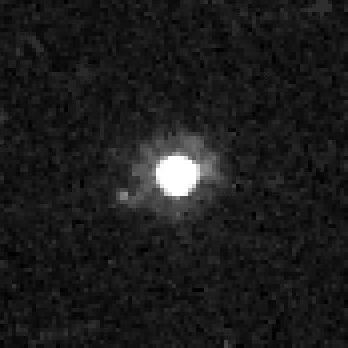
50000 Quaoar is a large object in the outer solar system that orbits in the Kuiper belt beyond Neptune. It is classified as a Trans‑Neptunian object and is widely regarded by astronomers as a strong dwarf planet candidate because of its size and inferred internal properties. Quaoar attracted attention soon after its discovery for being one of the brighter and larger bodies in the classical Kuiper belt.
Image gallery
10 Images


Physical characteristics
Observations show Quaoar to be composed of a mixture of water ice and rock, with surface signatures that include crystalline water ice and traces of methane. Its visible color is moderately red, indicating complex organic materials on the surface. Measurements from its small moon and from thermal observations imply a diameter of roughly one thousand kilometers, and a density that suggests a substantial rock fraction rather than being purely icy.
Orbit and rotation
Quaoar follows a nearly circular, low‑inclination orbit in the classical Kuiper belt (a so‑called "cubewano"), at an average distance of several dozen astronomical units from the Sun. Its orbital period is on the order of a few centuries. Lightcurve studies show the body rotates on its axis in a matter of hours, though exact rotation periods have been refined as more data were gathered.
Discovery and name
The object was discovered on June 4, 2002 by Chad Trujillo and Michael Brown while working at the California Institute of Technology. It was assigned the number 50000 and later named Quaoar after a creation deity of the Tongva people, honoring the native culture of the Los Angeles basin where the discovery team worked.
Satellite and scientific importance
Quaoar has a small natural satellite, which has been used to determine the system mass and constrain Quaoar's density. Its status as a sizeable Kuiper belt object with a moon makes it valuable for studies of formation and evolution in the outer solar system. Scientists use Quaoar to probe the distribution of volatile ices, collisional history, and the processes that distinguish dwarf planets from smaller trans‑Neptunian objects.
Notable facts
- Classified among the brighter Kuiper belt members and a representative of classical objects.
- Name derives from indigenous mythology rather than Greco‑Roman sources.
- Presence of a moon enables direct mass and density estimates, important for assessing dwarf‑planet status.
Related articles
Author
AlegsaOnline.com 50000 Quaoar — trans-Neptunian object and dwarf‑planet candidate Leandro Alegsa
URL: https://en.alegsaonline.com/art/112946
Sources
- boulder.swri.edu : "Orbit Fit and Astrometric record for 50000" · webcitation.org
- cfa-www.harvard.edu : "MPEC 2008-O05 : Distant Minor Planets (2008 Aug. 2.0 TT)" · webcitation.org
- doi.org : 10.1086/382513
- gps.caltech.edu : Reprint
- arxiv.org : Preprint