
52 Europa — large main-belt asteroid
52 Europa is a large, dark main-belt asteroid discovered in 1858. Roughly 289 km across, it is a carbonaceous C-type body with complex rotation, silicate signatures, and a notable observational history.
Overview
52 Europa is a substantial asteroid in the main asteroid belt between Mars and Jupiter. With an estimated diameter of about 289 km, Europa ranks among the largest asteroids by volume and mass, holding just under 2% of the total mass of the asteroid belt. It is classified as a dark, carbon-rich C-type object and is the fourth-largest known member of that spectral class. For a general context, see asteroid and the name origin linked to Europa.
Image gallery
3 Images
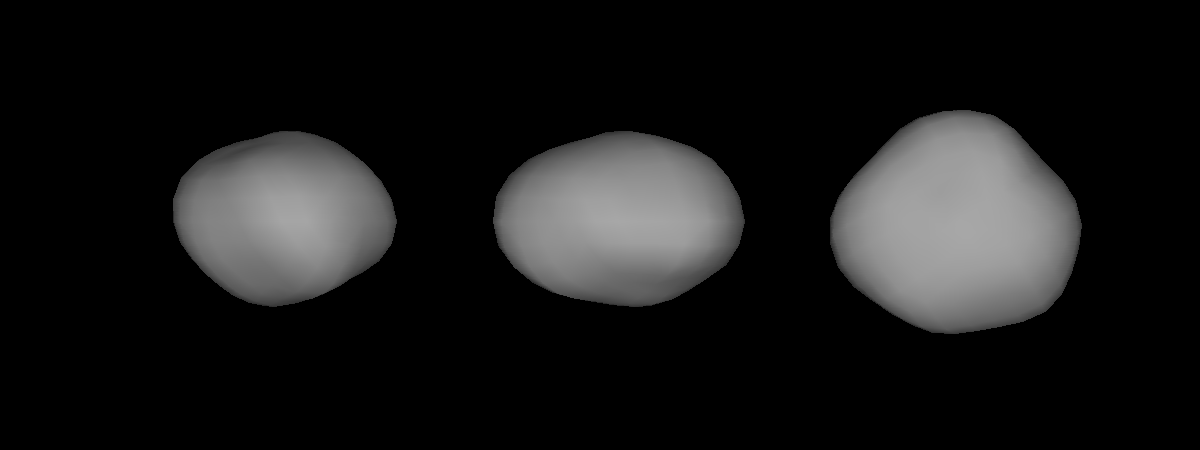

Discovery and name
Europa was discovered on February 4, 1858, by the astronomer H. Goldschmidt. Following the period convention of the 19th century, the discoverer assigned a name from classical mythology: Europa, a figure associated with the god Zeus in Greek mythology. The name has been used consistently in scientific literature since discovery and helps distinguish this object from other astronomical uses of the name Europa.
Physical characteristics
Key properties of 52 Europa include its substantial size, low surface reflectivity, and mixed mineralogy. Observations and spectral analyses indicate a dark, carbonaceous surface typical of C-type asteroids (C-type). Despite its low albedo, spectroscopic studies have detected signatures consistent with silicate minerals such as olivine and pyroxene, suggesting the surface includes both primitive carbon-rich material and more processed rocky components.
- Diameter: ≈ 289 km (approximate).
- Albedo: low, typical of carbonaceous bodies.
- Spectral class: C-type (carbonaceous).
- Composition indicators: olivine and pyroxene detections among dark material.
Orbit, rotation, and pole
52 Europa orbits within the main belt and lies spatially near the Hygiea family of asteroids, though dynamical studies indicate it is not a true family member. Determining Europa's rotation has been unusually challenging. Lightcurve observations produced conflicting periods for many years (reports around 5.5 hours versus around 11 hours were debated). More detailed analyses now confirm a prograde rotation, but the precise orientation of its spin axis remains uncertain. The most comprehensive solutions place its pole near ecliptic coordinates approximately (β, λ) = (70°, 55°) or (40°, 255°), each with an uncertainty of about 10°, which corresponds to possible axial tilts of roughly 14° or 54% depending on the chosen pole solution. For discussion of axial orientation, see axial tilt.
Observations, history, and noteworthy facts
Because of its size and darkness, Europa has been the subject of many ground-based photometric and spectroscopic campaigns. Its lightcurve complexity and surface heterogeneity have made modeling its shape and spin state more difficult than for many comparably large asteroids. An historical curiosity: a variable-star entry catalogued as CV Aquarii in 1934 was later determined to be a misidentification — the recorded object was actually 52 Europa. That misidentification and subsequent correction are discussed in archival notes about CV Aquarii.
Importance and comparisons
In the context of the main belt, Europa is notable for its combination of large size, carbonaceous nature, and the presence of silicate features. It is usually listed after Ceres, Vesta, Pallas, Hygiea, and Interamnia in mass ranking among main-belt objects, making it an important component of the belt's mass budget. Its proximity to, but dynamical separation from, the Hygiea family offers an example of how spatial clustering does not always imply common origin. For more general reading on classification and related topics, consult references on asteroids and spectral taxonomy such as C-type discussion pages.
Further technical details and recent observational studies are available in astronomical databases and specialized literature; the anchors above link to thematic entries and historical notes for readers who wish to follow specific threads of inquiry.
Questions and answers
Q: What is 52 Europa?
A: 52 Europa is an asteroid.
Q: How big is it?
A: It has a diameter of 289 km.
Q: Who discovered it?
A: It was found on February 4, 1858 by H. Goldschmidt.
Q: What does its name refer to?
A: Its name refers to Europa, one of Zeus's conquests in Greek mythology.
Q: Where does it rank in terms of size among asteroids?
A: It is the seventh biggest asteroid by volume and the sixth biggest by mass (after Ceres, Vesta, Pallas, Hygiea, and Interamnia).
Q: What type of asteroid is it?
A: It is a very dark carbonaceous C-type.
Q: What has been determined about its rotation period?
A:It has been determined that Europa is a prograde rotator but the exact direction in which its pole points remains unclear.
Related articles
Author
AlegsaOnline.com 52 Europa — large main-belt asteroid Leandro Alegsa
URL: https://en.alegsaonline.com/art/112964
Sources
- journals.uchicago.edu : Supplemental IRAS Minor Planet Survey
- rni.helsinki.fi : Photometry and models of selected main belt asteroids I. 52 Europa, 115 Thyra, and 382 Dodona
- edpsciences.org : Determination of asteroid masses II. (6) Hebe, (10) Hygiea, (15) Eunomia, (52) Europa, (88) Thisbe, (444) Gyptis, (511) Davida and (704) Interamnia
- psi.edu : PDS lightcurve data
- aa.springer.de : ISO results on bright Main Belt asteroids: PHT – S observations
- adsabs.harvard.edu : A High-Resolution CCD Spectroscopic Survey of Low-Albedo Main Belt Asteroids
- aavso.org : CV Aquarii identified with (52) Europa