
Vostok (rocket family)
Soviet R-7–derived launch vehicles used in the late 1950s–1960s for Sputnik, Luna probes and the crewed Vostok missions, notable for strap-on boosters and the Blok‑E upper stage.
Overview
The Vostok family is a line of Soviet launch vehicles developed from the R-7 intercontinental ballistic missile. Built under the direction of chief designer Sergei Korolev, this rocket architecture provided the basis for some of the earliest and most important spaceflights. The Vostok boosters served both uncrewed scientific and crewed orbital missions operated by the Soviet Union, and they became the principal means of getting payloads into low Earth orbit and beyond during the late 1950s and early 1960s. As a direct descendant of the R-7, the Vostok shared the same general layout but added an extra upper stage to broaden mission capability; it was widely used as the main launch vehicle for early Soviet space exploration programs (main launch vehicle).
Image gallery
7 Images


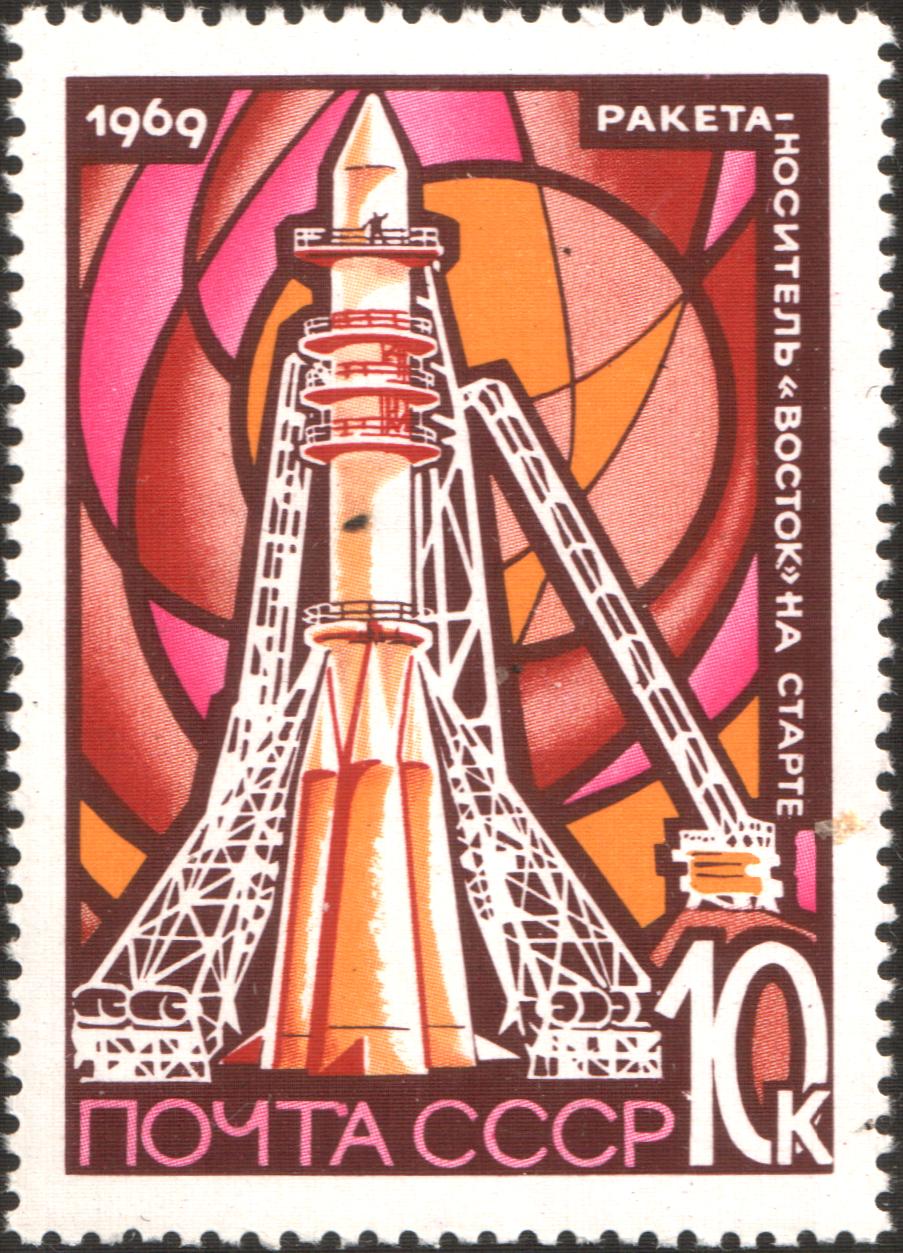
Design and characteristics
At its core, the Vostok design retained the R-7 pattern: a central sustainer stage with four liquid‑propellant strap-on boosters clustered around it. Each booster carried a powerful engine, and all five engines ignited at liftoff. After the strap-on boosters burned out and were jettisoned, the central core continued to power the vehicle until its own fuel was spent. The Vostok family introduced an additional upper stage commonly called Blok‑E, which provided the final injection impulse for higher orbits and interplanetary trajectories.
- Propellants: kerosene (RP‑1 type) and liquid oxygen for the main stages (kerosene, liquid oxygen).
- Configuration: four strap-on boosters plus central core; sequential staging with a dedicated upper stage.
- Capabilities: low Earth orbit insertion, lunar flyby and impact trajectory injection, and early heliocentric probes.
History and notable missions
The R-7 first demonstrated orbital capability with the launch of Sputnik 1 in October 1957. Modifications that resulted in the Vostok family allowed the rocket to support a broader range of missions. In January 1959, a Vostok-derived vehicle launched Luna 1, which became the first human-made object to enter a heliocentric (solar) orbit. Later that year, Luna 2 became the first spacecraft to reach the Moon, and Luna 3 returned the first photographs of the Moon’s far side.
Perhaps the most famous Vostok flights were the crewed missions. A Vostok rocket carried Vostok 1, the spacecraft that transported Yuri Gagarin on the first human orbital flight on April 12, 1961. Subsequent Vostok missions continued the early human spaceflight program; notably, Valentina Tereshkova flew aboard Vostok 6, becoming the first woman in space on June 16, 1963.
Uses, variants and legacy
The Vostok family encompassed several variants adapted for different payloads and missions, including versions optimized for biological tests, crewed capsules, and robotic lunar probes. Its modular strap-on design influenced many future Soviet and Russian launchers derived from the R-7 lineage. The reliability and lift capability of the Vostok-type vehicles established a durable platform that continued to evolve into later families of rockets.
Distinctive facts
- Vostok vehicles are direct descendants of an operational ICBM, repurposed for peaceful space exploration.
- The same basic R-7 architecture has been developed and used in many variants over decades, forming one of the longest-lived lineages in rocketry.
- Key firsts achieved with Vostok-derived launches include the first artificial satellite orbit, first human in orbit, first lunar impact, and first images of the Moon’s far side.
For further reading and primary-source material, see launch records and historical summaries produced by participating organizations and archives (Soviet-era programs, launch vehicle overviews, and mission pages for Sputnik 1, Luna 1, Luna 2, Vostok 1, Vostok 6). Biographical sources discussing Sergei Korolev and the early human spaceflight pioneers also provide context (Gagarin, Tereshkova).
Related articles
Author
AlegsaOnline.com Vostok (rocket family) Leandro Alegsa
URL: https://en.alegsaonline.com/art/105941
Sources
- historicspacecraft.com : "Historic Spacecraft - Information About Russian Rockets"