
Vostok 1 — first human spaceflight led by Yuri Gagarin
Vostok 1 was the Soviet mission that carried Yuri Gagarin into orbit on 12 April 1961, the first human journey into outer space. The flight demonstrated crewed orbital operations and had lasting historical impact.
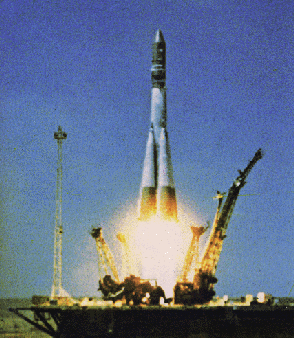
Vostok 1 was the pioneering crewed spaceflight that placed the first human being into orbit. Launched on 12 April 1961, the mission carried Soviet cosmonaut Yuri Gagarin and completed a single orbit of Earth in about 1 hour 48 minutes. The flight used a Vostok 3KA spacecraft and represented the major early milestone of the Soviet space effort during the Cold War. It combined a compact, spherical descent module with a launch vehicle and a simple onboard layout intended to prioritize reliability and crew survival.
Image gallery
10 Images




Spacecraft and design characteristics
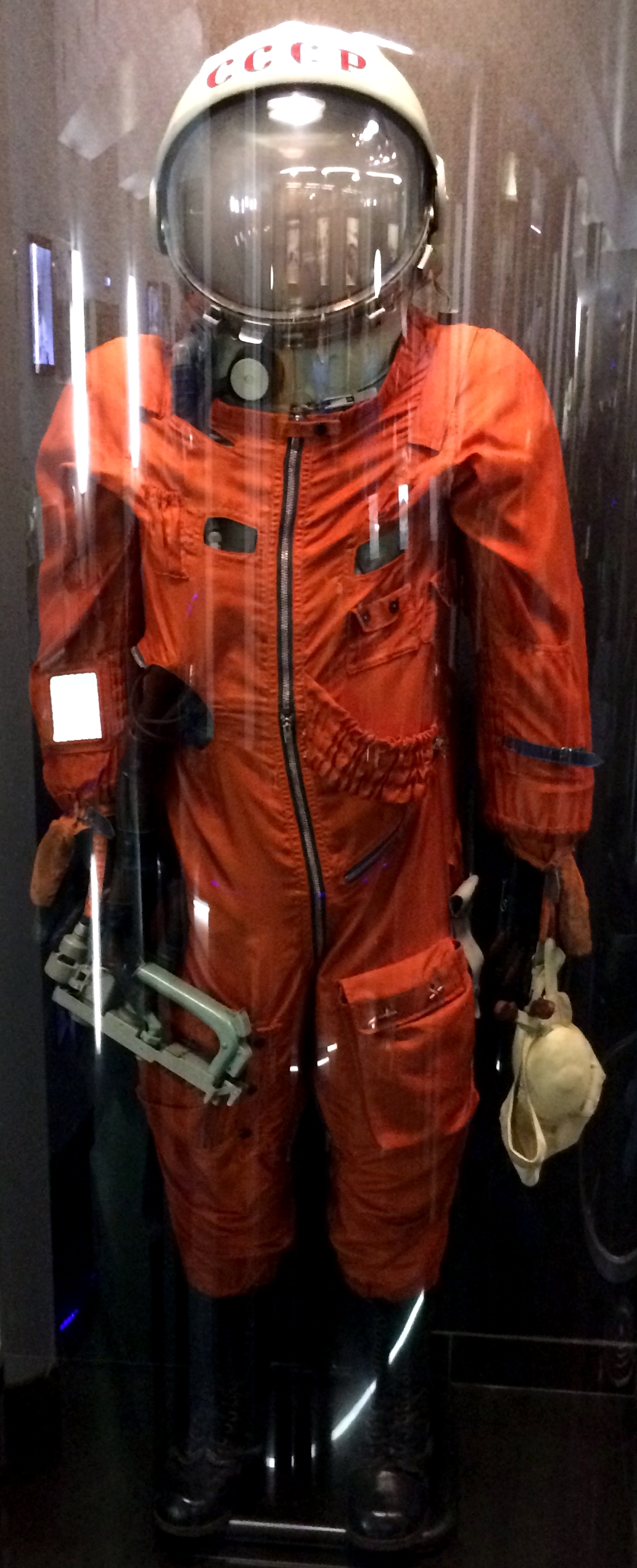
The Vostok capsule was compact and robust. The crew rode in a spherical descent module with an ejection seat, instruments for monitoring flight, a short-range radio, and storage for basic supplies and small scientific experiments. Typical published specifications list a mass of roughly 4.7 tonnes, a length of about 4.4 m and a diameter near 2.4 m. Controls were present primarily for emergency use; the cosmonaut was expected to follow ground instructions rather than actively pilot routine orbital operations. The reentry capsule was paired with an instrument module that separated before atmospheric entry.
- Configuration: Spherical descent module plus instrument compartment.
- Mass and size: approximately 4.73 t, 4.4 m long, 2.43 m diameter.
- Life support: short-duration systems for a few hours in orbit.
- Safety: ejection seat and parachute recovery for the cosmonaut.
Flight profile and timeline
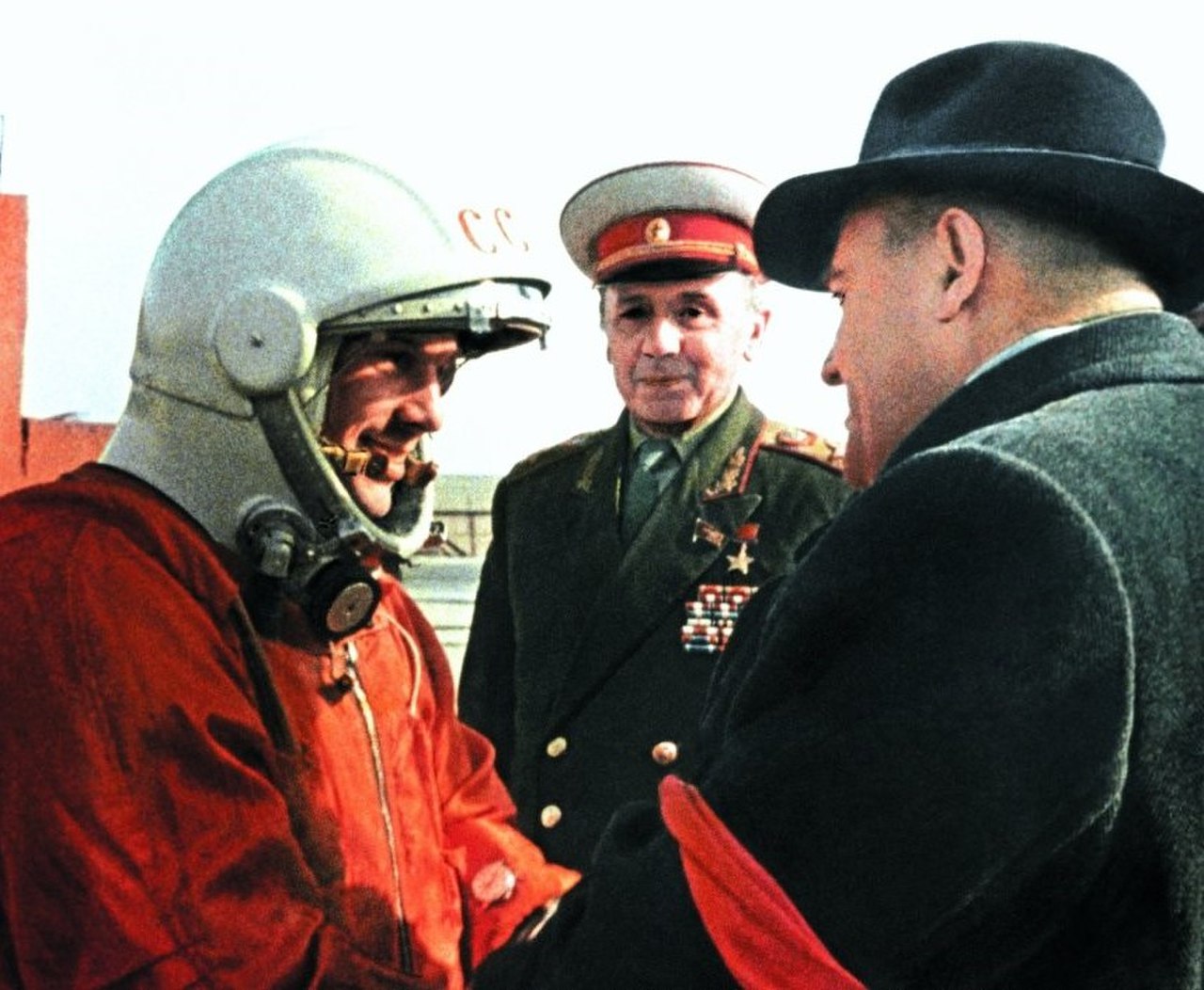
Vostok 1 was launched atop an expendable booster developed by Soviet rocket engineers and overseen by leading designers, including Sergei Korolev and Kerim Kerimov. After ascent and insertion into low Earth orbit, the spacecraft completed one full circuit of the planet. Reentry was initiated after the orbital period, the instrument module separated, and the descent module reentered the atmosphere. As planned, the cosmonaut left the capsule during descent and returned to the ground under his own parachute. The mission's concise timeline and emphasis on automated systems reflected both the engineering priorities of the era and the high risks involved in early human spaceflight.
Historical context and significance
Vostok 1 occurred at the height of the Space Race between the Soviet Union and the United States and became a global symbol of human space exploration. Yuri Gagarin's flight established that a person could survive launch, orbit and reentry and return safely, proving many aspects of human spaceflight were feasible. The mission had broad cultural and political effects, inspiring scientific programs, accelerating crewed flight plans elsewhere, and elevating Gagarin to an international icon. Technical lessons from Vostok shaped subsequent spacecraft design, mission planning and safety protocols.
Legacy, follow-up flights and notable facts
Vostok 1 was the first of a sequence of manned Vostok missions; in total six crewed flights used the basic Vostok design. The program culminated with Vostok 6, which carried Valentina Tereshkova in June 1963, making her the first woman in space. The Vostok series proved a straightforward, reliable approach to early human orbital flight and informed later Soviet projects. The mission is often referenced in discussions of pioneering space achievements and remains an enduring milestone in aerospace history.
For further reading and archival materials, consult program summaries and biographical resources on the spacecraft type and its participants: the Vostok family of vehicles (Vostok 3KA), general mission histories (Vostok), biographies of participants (Yuri Gagarin and designers), and broader context about the Soviet Union space program. Technical discussions of orbital mechanics and mission operations are available under general topics such as orbit and launch vehicle engineering (rocket).
Notable facts: the crewed Vostok flights emphasized automation over manual control; their descent modules were intentionally small to minimize mass and thermal loads; and the use of an ejection seat meant the crew member descended separately from the vehicle. These and other design choices reflect both the constraints and the ingenuity of early 1960s space engineering.
Related articles
Author
AlegsaOnline.com Vostok 1 — first human spaceflight led by Yuri Gagarin Leandro Alegsa
URL: https://en.alegsaonline.com/art/105939
Sources
- records.fai.org : "Aviation and Space World Records" · web.archive.org
- nssdc.gsfc.nasa.gov : "Vostok 1 – NSSDC ID: 1961-012A"
- maps.google.com : "Google Maps – Vostok 1 Launch Pad – Gagarin's Start photo"
- maps.google.com : "Google Maps – Vostok 1 Landing Site – Monument"
- maps.google.com : "Google Maps – Vostok 1 Landing Site – Monument Photo"
- astronautix.com : "Vostok 1"