
VHS (Video Home System): overview, history, and legacy
VHS (Video Home System) is an analog videocassette format introduced in the 1970s that dominated home video recording and playback through the 1980s–1990s before being superseded by optical discs and digital media.
The Video Home System, commonly known by the initials VHS, is an analog videocassette format developed for consumer use. It stores moving-picture information and one or more audio tracks on magnetic tape inside a plastic cassette. Consumers used VHS equipment to record broadcasts or home movies, to rent and buy prerecorded titles, and to play them back on a household television. The name is often used interchangeably with related terms such as the recording medium (videotape) and its containers, the videocassette.
Image gallery
10 Images


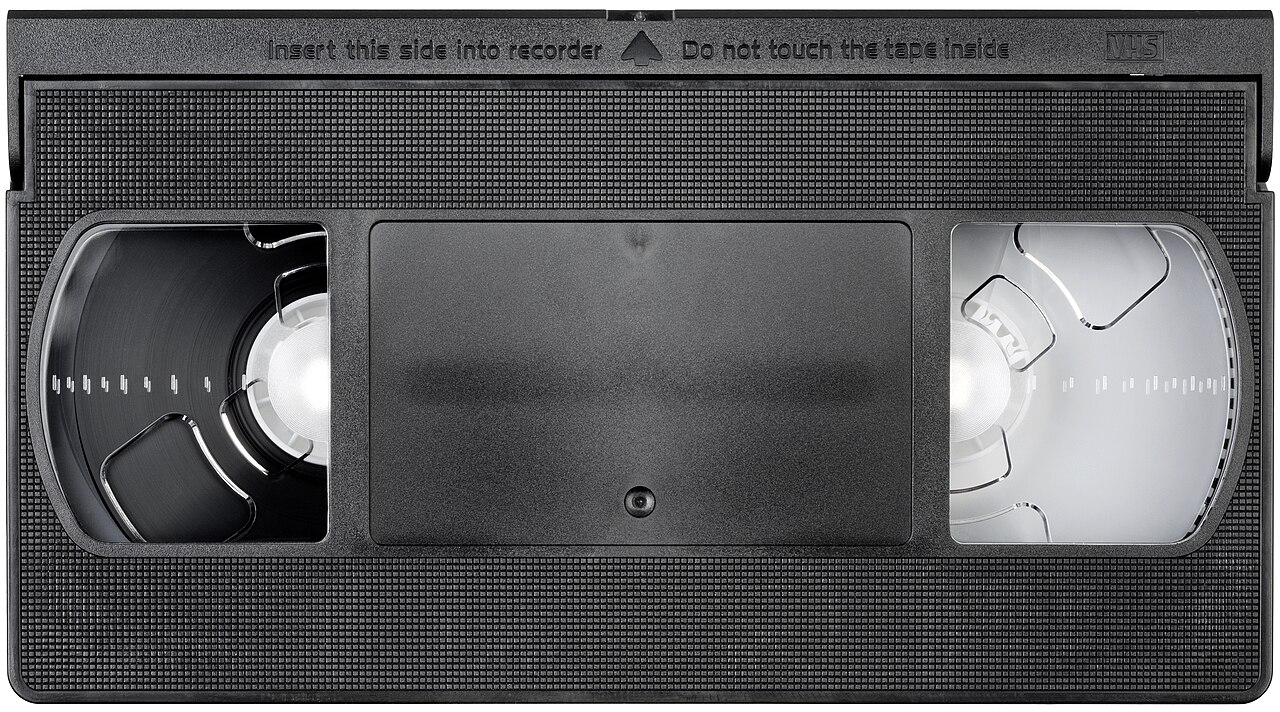
How VHS works and main components
VHS records and plays back analog video and sound by magnetizing particles on a moving tape. A consumer playback machine, the VCR (videocassette recorder), draws tape past rotating heads that use a helical-scan method to encode picture information across the tape width. The basic components include a plastic cassette housing the tape, the magnetic tape itself, the head drum and transport mechanism inside the VCR, and electronics to convert the analog signal for display as video on a television. Recording length varied with cassette size and the chosen speed or mode; longer playbacks were available at lower quality settings.
- Cassette: enclosure that protects and winds the magnetic tape.
- Tape: a magnetic medium carrying luminance and chrominance information in analog form.
- VCR: device for recording, playback, dubbing and sometimes indexing recorded material.
- Recording modes: standard play and extended-play modes traded off image quality for recording time.
Variants and related formats
Several variants and related formats emerged from the VHS family. Compact versions such as VHS-C were developed for small camcorders and could be played in standard VCRs with an adapter. Higher-resolution versions such as S-VHS sought improved picture detail by increasing luminance bandwidth. Hybrid devices later combined capabilities, for example using both DVD and VHS mechanisms in a single unit, allowing users to bridge older tapes and newer disc media.
Origins and the format competition
VHS was introduced commercially by the Victor Company of Japan (JVC) in 1976. It entered a market where competing standards, most notably Sony’s Betamax, were also vying for consumer acceptance. VHS gained a mass market lead through factors such as recording length options, a licensing approach that encouraged broad manufacturer support, and the availability of prerecorded movies for rental and sale. Through the 1980s and 1990s, VHS became the dominant consumer format for home video.
Common uses and cultural impact
VHS transformed how audiences accessed moving images. Families and hobbyists used video cameras and camcorders to capture events directly onto tape. Households used VCRs to time-shift broadcast programs and to create personal archives. A large rental market for prerecorded tapes developed, reshaping film distribution and enabling home ownership of movies. Educational institutions, local television producers and businesses also used VHS for training and documentation.
- Home recording and time-shifting of television broadcasts.
- Home-movie capture with camcorders and transfer to cassette.
- Film rental, retail sales and the growth of video libraries.
- Educational, institutional and archival uses.
Decline, preservation and legacy
Starting in the late 1990s, optical-disc formats and later digital distribution began to supplant VHS. Consumers preferred discs and digital files for their random access, durability and ease of use; manufacturers introduced combo units and migration paths so users could transfer content. Although mass production of new consumer-grade VHS hardware and many prerecorded titles largely ceased, blank tapes and used equipment remained available for many years. Preservation of VHS material poses challenges: analog tapes degrade, and specialized playback equipment and transfer procedures are required to preserve content. Archivists and collectors often advocate timely digitization to stabilize endangered recordings.
VHS left a lasting imprint on home media culture: it normalized personal recording, enabled a home-rental economy, and influenced expectations about access to and ownership of audiovisual content. Today, VHS is also a subject of historical and aesthetic interest; some artists and filmmakers deliberately use tape characteristics such as tracking noise, color shifts and tape artifacts for creative effect. For further background on system aspects and consumer devices see entries on the system, the notion of video, recordings like videotape, playback hardware such as the VCR, and capture tools such as the video camera. The rise and cultural prominence of the format during the 1980s and 1990s remain important chapters in the history of consumer electronics and media distribution.
Technical and historical references, manufacturer archives and specialized preservation guides are recommended for readers seeking repair, detailed timelines, or step-by-step digitization practices. Hybrid systems and transition devices incorporating both DVD and VHS functions eased migration for many users during the format changeover and are a useful topic for further study.
Related articles
Author
AlegsaOnline.com VHS (Video Home System): overview, history, and legacy Leandro Alegsa
URL: https://en.alegsaonline.com/art/104846
Sources
- commons.wikimedia.org : VHS
- cedmagic.com : "AMPEX VRX-1000 – The First Commercial Videotape Recorder in 1956"
- books.google.com : The History of Television 1942-2000, pg 169
- ce.org : "VCR"
- nytimes.com : "Shizuo Takano, 68, an Engineer Who Developed VHS Recorders"
- rickmaybury.com : "VHS STORY – Home Taping Comes of Age"