
1980s (1980–1989): Politics, culture, technology and global change
A concise overview of the 1980s covering major political shifts, cultural trends, technological advances, sports highlights and the decade's lasting influence.
The 1980s describes the ten-year span from January 1, 1980 to December 31, 1989. It was a decade marked by rapid social and economic change in many parts of the world. In several English-speaking countries the period became associated with vigorous consumerism, visible displays of wealth and a strong emphasis on market-oriented economic policy. The term "yuppie" entered common use to describe young urban professionals who pursued careers and lifestyles tied to corporate and financial sectors.
Politically the decade saw the consolidation of conservative governments in nations such as the United States and the United Kingdom, where leaders promoted deregulation, tax reform and privatization. At the same time the long postwar standoff between NATO and the Warsaw Pact entered its closing phase. The Soviet Union faced a costly intervention in Afghanistan and mounting internal strains, and the year 1989 ended with the symbolic breach of the Berlin Wall — the beginning of a wider unraveling of Communist rule in Eastern Europe.
Events in the developing world were also consequential. Conflicts, revolutions and humanitarian crises in parts of Africa, Asia and Latin America shaped international relations and aid responses. Economic policies, debt crises and structural adjustments influenced growth and inequality in many countries. The decade's geopolitics blended ideological rivalry, regional wars and the gradual recalibration of alliances as the global order shifted.
Cultural life in the 1980s was vivid and diverse. Popular music expanded with new wave, synthpop, punk continuations, the rise of hip hop and the mainstreaming of electronic sounds. Fashion favored bold silhouettes, bright colors, large hair and athletic wear as everyday clothing. Television and cinema matured into a global entertainment industry; cable networks and music television changed how audiences discovered songs and artists. Home video and arcade and console gaming also became mass-market pastimes, helping to create modern leisure industries.
Technological and commercial developments accelerated change in daily life and business. Early personal computers, graphical user interfaces, and portable electronics began to alter workplaces and homes; microprocessors and networking foundations set the stage for later internet growth. Corporate mergers, stock market dynamics and the spread of multinational firms reshaped employment patterns and consumer choices.
Sporting achievements, major tournaments and celebrity athletes helped define national moments and communal pride. The decade left a complex legacy: it catalyzed innovation and cultural exchange while highlighting economic disparities and political tensions. Many trends born or popularized in the 1980s — from media formats to fashion motifs and economic ideas — continued to influence the years that followed.
Image gallery
10 Images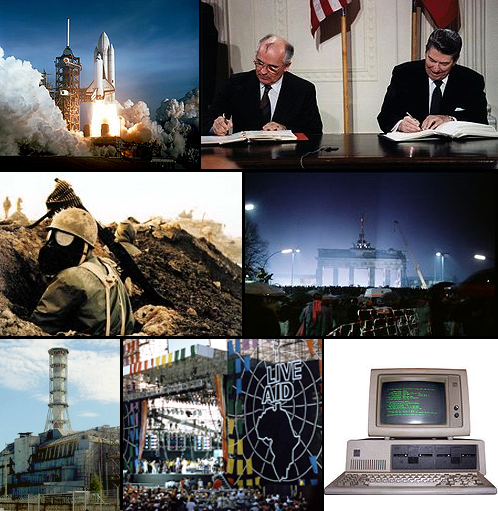



Related topics and further reading
- Decade overview
- 1960s context
- 1970s context
- Young professionals (yuppies)
- Urban life
- Labor markets and careers
- Conservative politics
- United States leadership
- Presidency and governance
- United States history
- United Kingdom leadership
- British political history
- Canadian leadership
- Canada in the 1980s
- Soviet Union
- Wars and interventions
- Afghanistan conflict
- Civil wars
- Ethiopia in the 1980s
- Berlin Wall
- End of the Cold War
- Communism in Eastern Europe
- Eastern European transitions
- 1980s fashion
- Hairstyles and trends
- Punk and alternative music
- Funk and dance styles
- Computing advances
- Video games
- Italy in sport
- Argentina in sport
- FIFA World Cup history
- Baseball champions
- Los Angeles sports
- St. Louis teams
- Baltimore sports
- Detroit athletics
- Kansas City teams
- New York sports
- Minnesota athletics
- Oakland sports
- World Series overview
- Pittsburgh teams
- San Francisco sports
- Chicago teams
- New York football
- Super Bowl champions
- Los Angeles Lakers
- Houston Rockets
Questions and answers
Q: What decade is the text referring to?
A: The text is referring to the 1980s.
Q: What was this decade called in English speaking countries?
A: This decade was sometimes referred to as the "Greed Decade" in English speaking countries.
Q: Who were yuppies during this time period?
A: Yuppies during this time period were young adults who lived in cities and had good jobs, known as "young urban professionals".
Q: Who were some of the political leaders during this time period?
A: During this time period, Ronald Reagan was president of the United States, Margaret Thatcher was Prime Minister of the United Kingdom, and Brian Mulroney was Prime Minister of Canada.
Q: What significant event happened at the end of this decade that marked a shift in global politics?
A: At the end of this decade, there was a fall of the Berlin Wall which started the end of Cold War and Communism in Eastern Europe.
Q: What popular music genres originated or became popular during this decade?
A: Popular music genres such as New Wave, punk rock, funk and rap music first started to get big in the 80s.
Q: Which teams won major sports championships during this era?
A: In sports, Italy and Argentina won FIFA World Cup while Philadelphia Phillies, Los Angeles Dodgers, St. Louis Cardinals, Baltimore Orioles, Detroit Tigers, Kansas City Royals ,New York Mets ,Minnesota Twins and Oakland Athletics won World Series; Pittsburgh Steelers ,Oakland Raiders ,San Francisco 49ers ,Washington Redskins ,Los Angeles Raiders ,Chicago Bears and New York Giants won Super Bowl; finally Los Angeles Lakers dominated NBA with only Houston Rockets winning title.
Related articles
Author
AlegsaOnline.com 1980s (1980–1989): Politics, culture, technology and global change Leandro Alegsa
URL: https://en.alegsaonline.com/art/112159