
Trio (music): ensembles and compositions for three performers
A trio is an ensemble of three singers or instrumentalists or a composition for three parts. Common in chamber, jazz and popular music, trios vary widely in instrumentation, repertoire and performance practice.
A trio in music denotes either an ensemble of three performers—vocalists or instrumentalists—or a composition written for three independent parts. The word also names a sectional contrast in dance forms (the minuet or scherzo trio). For other uses of the word, see other uses of trio, and for the sectional meaning see the minuet entry.
Image gallery
1 Image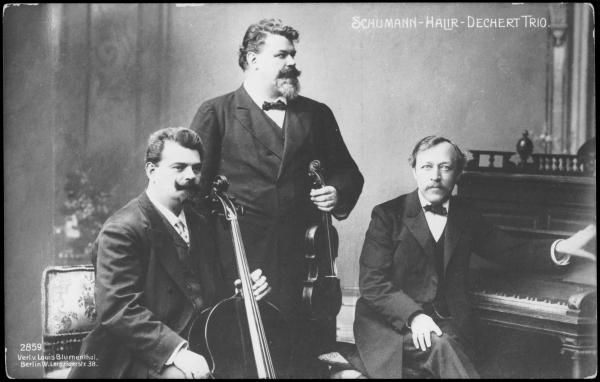
Common instrumentations and naming conventions
Trios are often identified by their principal instruments. A piano trio normally means piano, violin and cello; the standard ensemble and its repertoire are discussed in many introductions to the piano trio. A string trio usually comprises violin, viola and cello, while a vocal trio refers to three singers performing together, either in tight harmony or with separate melodic lines. Combinations that pair a wind instrument with piano and a string or another wind are commonly called by the featured wind (for example, a clarinet trio or horn trio).
- Piano, violin and cello — the classical piano trio format and a staple of chamber repertoire; see notes on the piano, violin and cello.
- String trio — violin, viola and cello, often used for intimate chamber textures.
- Wind-featured trios — examples include works for clarinet, viola and piano, or horn, violin and piano.
- Jazz and popular trios — in jazz a common rhythm trio is piano/bass/drums; rock and pop often use a guitar/bass/drums "power trio" configuration.
Historical background and forms
The trio concept appears in several historical strands. In the Baroque era the term "trio sonata" described a texture of three written parts—typically two upper melodic lines and a basso continuo—though realization of the continuo could involve multiple instruments. During the Classical and Romantic periods composers produced many standalone works for three players; for instance, Johannes Brahms wrote a notable work commonly known as his Horn Trio, and Wolfgang Amadeus Mozart composed a celebrated combination for clarinet, viola and piano. Chamber music as a genre provides much of the trio repertoire; see general treatments of chamber music.
Roles, texture and arranging for three parts
Composing or arranging for a trio demands careful balance among melody, harmony and rhythm. In many ensembles one part establishes harmonic foundation (often piano or bass), another presents the principal melody, and the third supplies counter-melody, inner voice or rhythmic drive. Effective scoring emphasizes clarity of lines, complementary timbres and dynamic control so each voice can be heard without masking the others. For keyboard ensembles, registration choices and voicing are essential; for mixed ensembles, blending and articulation help achieve a unified sound.
Repertoire, pedagogy and contemporary practice
Repertoire for trios ranges from pedagogical pieces and salon works to major concert compositions. A piano trio (piano, violin, cello) is common in conservatory training and public recital programs. Some works explore unusual timbral mixes—Brahms's horn-piano-violin piece or Mozart's clarinet-viola-piano combination—while modern composers continue to create new three-part groupings. In jazz and popular music, three-player groups adapt repertoire for improvisation and amplification: acoustic ensembles and progressive trios such as Nickel Creek show how traditional forms evolve in folk and contemporary contexts. A lighter keyboard novelty is music for "piano six hands," written for three performers at one instrument.
For performers and teachers, study of editions, part allocation, balance exercises and historically informed performance practice is useful. Practical guides and conservatory syllabuses often include suggestions for ensemble rehearsal, edition choices and interpretive approaches; introductory resources typically cover formats such as the piano trio and general chamber music principles. Additional background on instruments and scoring may be found in general references to musical instruments and ensemble technique.
Related articles
Author
AlegsaOnline.com Trio (music): ensembles and compositions for three performers Leandro Alegsa
URL: https://en.alegsaonline.com/art/101546