
The Gambia: geography, people, history and economy
The Gambia, officially the Republic of the Gambia, is the smallest country on mainland Africa. Bordered by Senegal and the Atlantic, it is defined by the Gambia River and a rich cultural and natural heritage.
The Gambia, officially the Republic of the Gambia, is a narrow West African state centered on the Gambia River. Located in West Africa, it is almost entirely surrounded by Senegal and opens to the Atlantic Ocean on its western edge. The country is notable for being the smallest on continental Africa and for the river that bisects its territory from east to west.
Image gallery
10 Images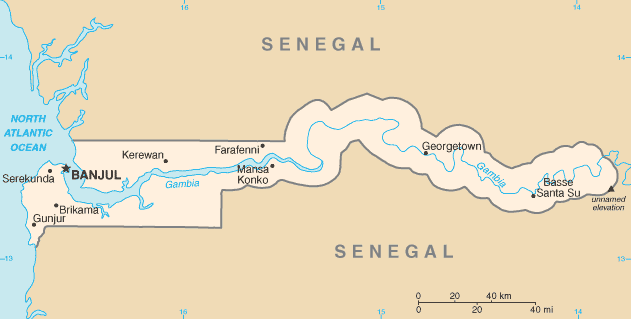


Geography and environment
The Gambia's landscape follows the course of the Gambia River, whose floodplain and estuary shape much of the nation’s ecology, settlement patterns and transport routes. The country has a tropical climate with a distinct rainy season and a drier season. Mangroves, wetlands and patches of savanna support diverse birdlife and other fauna; several reserves and protected areas conserve important habitats and attract eco-tourism.
History and government
The area now called The Gambia was part of long-standing West African trade and cultural networks and later became a focus of European trading activity. It was administered by Britain as a colony and protectorate before gaining independence in the mid-20th century. In the late 20th and early 21st centuries the country experienced significant political change; it is today a republic with a political system evolving through elections and constitutional processes.
People, language and culture
English is the official language used in administration and education, while a range of local languages are widely spoken. Major ethnic groups include the Mandinka, Fula, Wolof and Jola, among others. Islam is the predominant religion, and cultural life features rich musical and oral traditions, with instruments and storytelling playing central roles in community life.
Economy and society
The Gambian economy relies on agriculture, fishing and services. Smallholder farming—historically including groundnuts (peanuts) as an important export—along with coastal tourism and cross-border trade are significant contributors to livelihoods. Conservation of coastal and riverine environments supports tourism and fisheries, while development priorities include improving infrastructure, education and health services.
Cities and administration
The national capital is Banjul, a port city at the mouth of the Gambia River and the country's administrative center. Larger urban and suburban population centers include Serekunda and Brikama, which are economic and cultural hubs. The country is organized into local government areas that manage municipal services and development planning.
Quick facts
- Official name: the Republic of The Gambia; capital: Banjul.
- Smallest country on mainland Africa, with territory defined by the Gambia River corridor.
- Official language: English; predominant religion: Islam; diverse West African ethnic groups.
- Key sectors: agriculture, fisheries, tourism and cross-border commerce.
The Gambia's combination of a compact geography, the central riverine feature and a long cultural history makes it distinctive in West Africa. Its cities, natural areas and communities continue to shape its role in regional affairs, conservation and tourism.
Related articles
Author
AlegsaOnline.com The Gambia: geography, people, history and economy Leandro Alegsa
URL: https://en.alegsaonline.com/art/98029
Sources
- cia.gov : "The World Factbook: Gambia, The" · web.archive.org
- imf.org : "The Gambia"
- data.worldbank.org : "GINI index (World Bank estimate) - Data" · web.archive.org
- hdr.undp.org : "Human Development Report 2019"
- bbc.co.uk : bbc.co.uk/news/magazine-18233844
- statehouse.gm : statehouse.gm/
- britannica.com : "Banjul | national capital, The Gambia"
- worldpopulationreview.com : "Population of Cities in Gambia (2019)"
- books.google.com : Climatology of West Africa