
Adenine: structure, functions, and biological significance
Adenine is a purine nucleobase found in DNA and RNA; it forms base pairs, contributes to energy carriers (ATP), and appears in signaling and coenzymes.
Adenine is a purine nucleobase common to life’s informational polymers. As an organic molecule with the formula C5H5N5, it combines with a sugar to form the nucleoside adenosine and with one or more phosphate groups to form nucleotides such as AMP, ADP and ATP. Adenine is one of the four standard bases in DNA and one of the four in RNA, and it plays central roles in molecular biology and bioenergetics.
Image gallery
4 Images
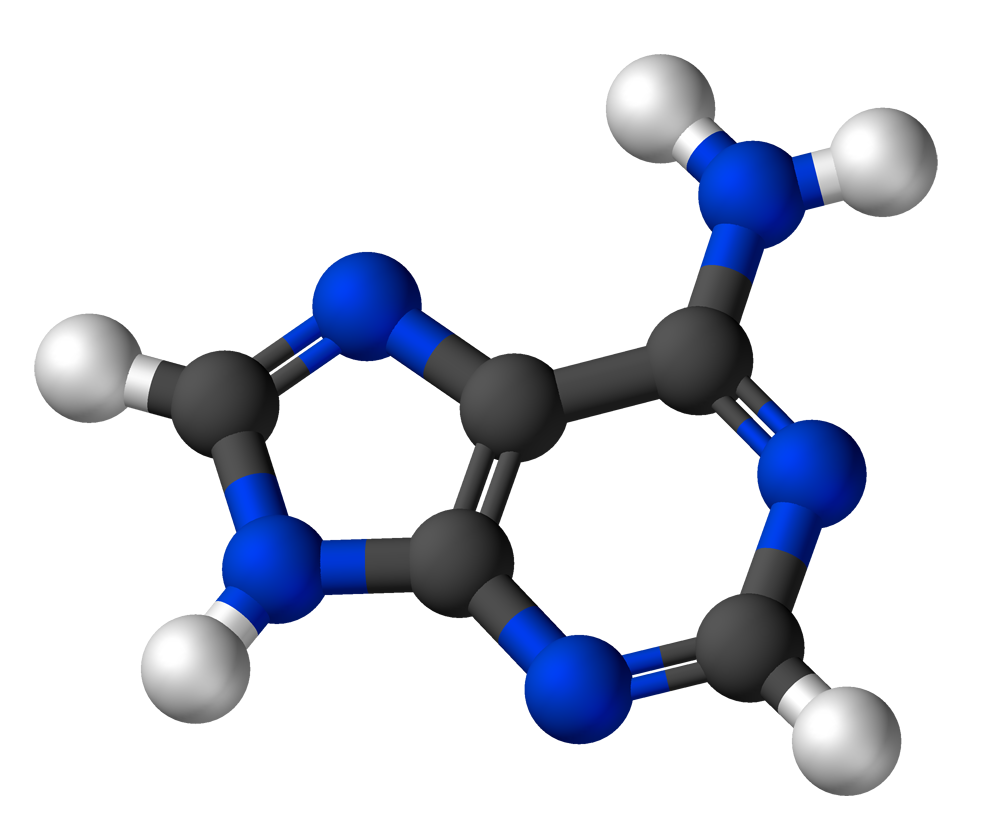


Chemical features and base pairing
Structurally, adenine belongs to the purine family: two fused heterocyclic rings with multiple nitrogen atoms. In double-stranded DNA it typically pairs with thymine through two hydrogen bonds; in RNA the complementary partner is uracil. These predictable pairing interactions are the basis for faithful copying and storage of genetic information.
Biological roles
Beyond encoding genetic information, adenine is a building block of several critical molecules. Adenosine triphosphate (ATP) is the cell’s primary short-term energy currency, while cyclic AMP (cAMP) functions in intracellular signaling. Adenine also appears in cofactors such as NAD, NADP and FAD, linking it to metabolism and enzymatic reactions.
Origin, synthesis and stability
Organisms synthesize adenine de novo and recycle it through salvage pathways. In origin-of-life research, adenine has been produced in laboratory simulations of prebiotic chemistry, suggesting routes for its formation before life existed. Chemically, adenine can undergo modifications (deamination, oxidation) that may affect base pairing and are addressed by cellular repair systems, a subject of interest in molecular genetics and disease research.
Notable distinctions and uses
- Distinction: adenine (base) vs adenosine (nucleoside) vs AMP/ATP (nucleotides).
- Laboratory use: foundational for sequencing, PCR primer design and synthetic biology.
- Research note: modifications of adenine influence gene expression and mutation rates, so it is studied in genetics and epigenetics (genetics).
Overall, adenine is a small but versatile component of life, connecting heredity, energy transfer and regulation across all domains of biology.
More on nucleobases — DNA basics — RNA roles — Molecular structure — Genetics overview
Related articles
Author
AlegsaOnline.com Adenine: structure, functions, and biological significance Leandro Alegsa
URL: https://en.alegsaonline.com/art/967
Sources
- springerlink.com : "The prebiotic role of adenine: A critical analysis"
- doi.org : 10.1007/BF01581575